
The US Commodity Futures Trading Commission (CFTC) is investigating political candidates who traded prediction-market contracts on their own elections. Enforcement director David Miller said so on 22 October 2026 at the NEXTPredict conference in New York, less than two weeks before the 3 November midterms. “We do investigate and have investigated and have open investigations about some candidates,” Miller said, according to Trade Handle; Reuters reported the remarks in similar words. He would not name anyone or discuss specific midterm cases.
Exchange rules vs federal law
Miller drew a line between breaking an exchange’s rules and breaking federal law. Insider trading, he said, “basically is about a breach of duty”: having better information is not enough on its own. Campaign staff who trade on internal polling or other confidential information from their job would be misappropriating it, which can be insider trading. A candidate betting on their own race may break an exchange ban without breaking federal insider-trading law, but Covers reports Miller said false statements made to move a contract’s price could count as market manipulation. He said some of the candidate cases involve statements “inconsistent with the truth”.
Asked about the November elections, when thousands of political contracts are due to settle, Miller said the CFTC has “a robust surveillance capability” and works with exchanges: “We’re watching.” Reuters adds that he also said a probe into suspicious oil trading around the US war with Iran remains open, after a Bloomberg report that a political appointee had asked staff to withdraw a referral.
Key facts
Speaker: David Miller, CFTC Director of Enforcement.
Where: NEXTPredict NYC, New York, 22 October 2026.
New: open CFTC investigations into some candidates who traded on their own races; no names given.
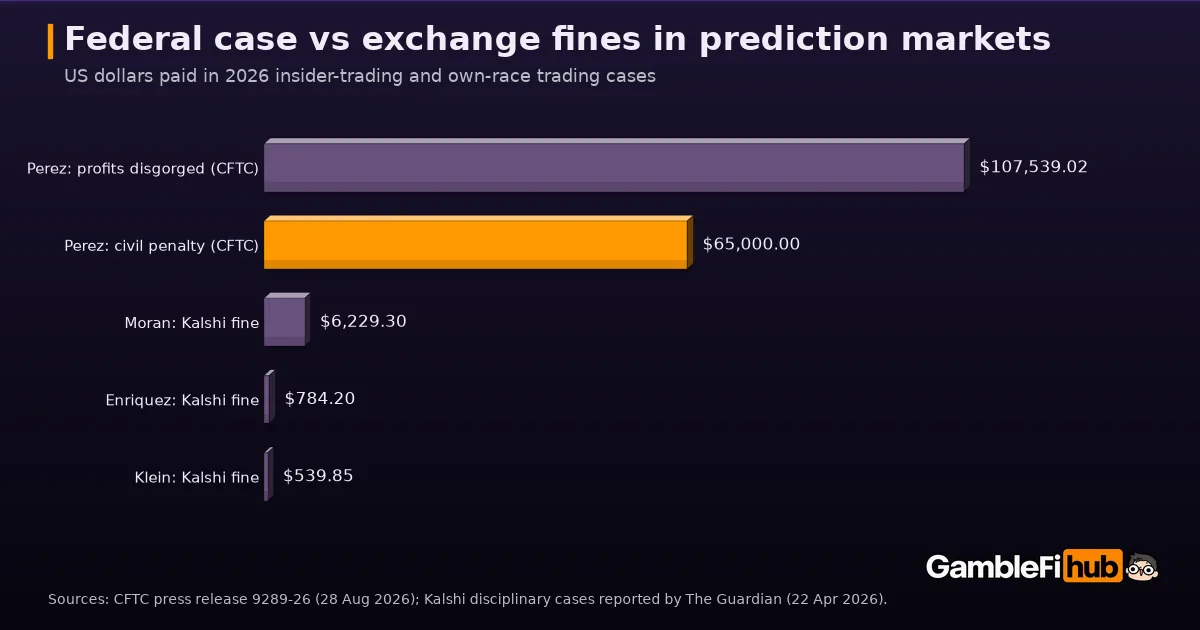
Earlier exchange cases: Kalshi fined three candidates in April 2026 (Mark Moran $6,229.30, Zeke Enriquez $784.20, Matt Klein $539.85, each with a five-year ban) and did not refer them to the CFTC, per The Guardian.
Earlier federal case: former White House teleprompter operator Gabriel Perez, 28 August 2026: $107,539.02 disgorged, $65,000 civil penalty, three-year trading ban (CFTC release 9289-26).
Election date: 3 November 2026.
Offshore venues and mention markets
Miller was also asked about Polymarket, which runs a CFTC-regulated US exchange next to its international onchain venue. He did not comment on any probe, but said trading on an offshore platform does not automatically put someone outside the CFTC’s reach, and that the agency prefers to bring platforms into the US system. On mention markets, the contracts at the heart of the Perez case, he would not say whether they are on the way out, but said the CFTC remains concerned about fraud and manipulation. The remarks follow the agency’s letters to two exchanges this week, covered in CFTC halts Novig micro and ProphetX scorigami contracts, and our look at how Polymarket US now outtrades its onchain international venue.
Why it matters for GambleFi
Onchain betting markets and the platforms behind an iGaming token (also called a GambleFi token) share one weak spot with regulated prediction markets: when one person can know or steer the result, prices stop being fair. Regulated venues can ban insiders, fine them and pass cases to the CFTC; open onchain markets mostly rely on wallet analysis after the fact. For an onchain betting exchange, see our SX Bet profile; the GambleFi FAQ covers the basics. This is a news report, not legal or betting advice.