
On 7 October 2026 the UK Gambling Commission (UKGC) announced that three casino operators owned by The Rank Group Plc will pay £5,012,261 in lieu of a financial penalty after an investigation found anti-money laundering (AML) and social responsibility failures. The operators, Grosvenor Casinos Limited, Grosvenor Casinos (GC) Limited and Gaming Group Limited, run 51 casinos across Great Britain. One finding stands out for the crypto gambling sector: the regulator criticised how the business assessed cryptocurrency assets that customers relied on as a source of funds or source of wealth.
Key Takeaways:
Settlement: a payment in lieu of a financial penalty of £5,012,261 on behalf of Grosvenor Casinos Limited and the wider group, directed to the Government’s Consolidated Fund, plus a payment towards the Commission’s investigation costs.
Breaches: Licence Condition 12.1.1 paragraphs 2 and 3 (prevention of money laundering and terrorist financing) and Social Responsibility Code Provision 3.4.1 (premises-based customer interaction).
Remedy: a third-party external audit of the business within six months of the conclusion of the licence review.
Rank said it had already made a £5.0m provision in its 2025/26 accounts in July and that there is no further impact on group profits.
Primary sources: UKGC announcement, UKGC public statement, Rank Group RNS.
How the case started
According to the public statement, the Commission opened a licence review under Section 116 of the Gambling Act 2005 after receiving information and key event notices submitted by Grosvenor Casinos Limited. While that review was underway, further intelligence prompted a targeted compliance assessment of one of the operator’s venues on 13 June 2025. The settlement was proposed to the Commission and accepted on behalf of the licensee and the wider group, because the group companies used the same policies, procedures and controls.
The crypto source-of-funds finding
The UKGC found a lack of clarity in parts of the operator’s AML controls, and said this applied to how the business assessed the risk and legitimacy of cryptocurrency assets used as a partial source of funds or source of wealth. In the regulator’s words, the processes “appeared to have required only that such assets be verified as having been converted into fiat currency via an appropriate bank account before being used to gamble.”
The statement also describes records where a customer’s use of cryptocurrency assets as the source of their funds did not raise that customer’s risk level, even though the operator’s own policies said such customers should not be treated as standard risk and should receive enhanced due diligence as soon as possible. For anyone watching how traditional regulators treat crypto wealth, the message is clear: confirming that coins reached a bank account is not, on its own, treated as enough scrutiny of where the money came from.
Other AML failures
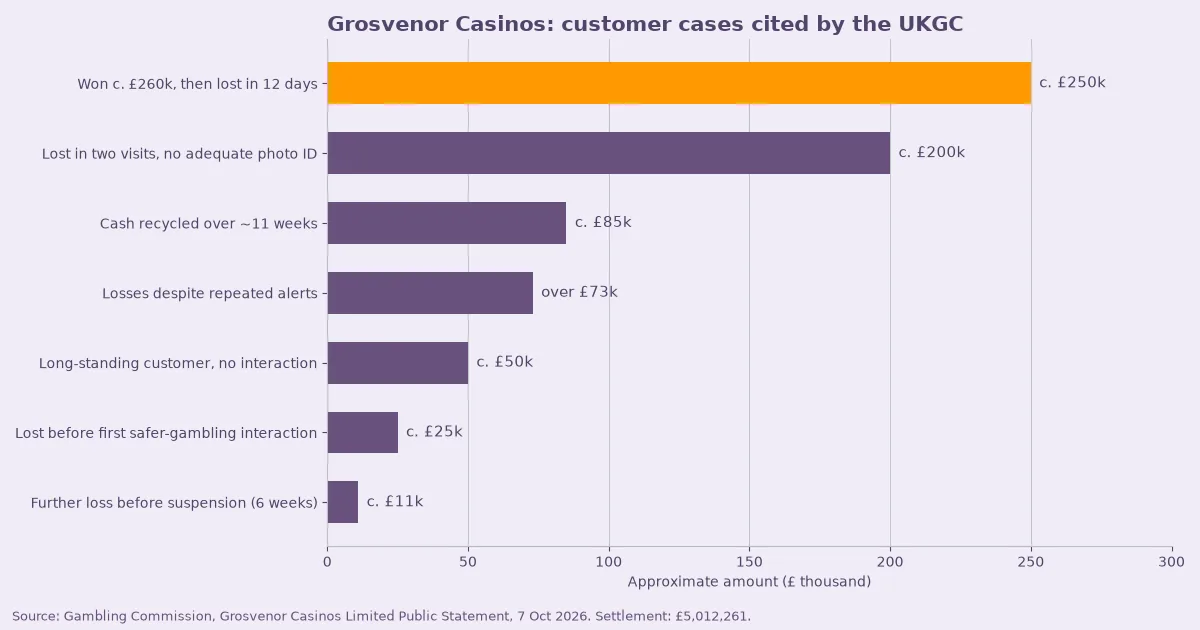
The Commission said the AML policies had not been properly updated for changes to the Money Laundering Regulations made in 2020, and that venue managers’ autonomy led to inconsistent decisions on higher-risk customers. Cited examples include a customer who returned after a long break and lost around £200,000 in two visits without adequate photographic identification or evidence of income on file, and a customer who recycled about £85,000 in cash over roughly 11 weeks without the risk level being raised. Enhanced checks in that case were not adequately carried out until losses reached about £13,000.
Safer gambling failures
On social responsibility, the UKGC found that staff sometimes used a customer’s perceived wealth or winning position to justify only brief safer gambling interactions. One long-standing customer won about £260,000 in a short period and then lost about £250,000 in 12 days with no safer gambling interactions recorded. Another customer, playing with verified winnings from another operator, lost around £25,000 before any interaction and then about £11,000 over six weeks after admitting those winnings were gone, before being suspended. The Commission also saw repeated alerts at the same level that did not change behaviour, in one case alongside losses of more than £73,000.
Aggravating and mitigating factors
The Commission noted as aggravating factors that the licensee had previously received formal advice on similar areas of concern, and that the regulator had already published statements about similar failings at other operators. As mitigating factors, it said the licensee swiftly implemented changes to remedy the failings and fully co-operated with the investigation. Rank stated that remedial actions have been substantially completed.
Why it matters for GambleFi
This is a land-based casino case, not a crypto casino case, but it shows how a major regulator expects licensed operators to treat crypto-derived funds. Under the UKGC’s approach, converting crypto to pounds or dollars does not settle the source-of-funds question; operators are expected to assess the risk and legitimacy of the underlying assets. Licensed operators that accept players with crypto wealth, and crypto-native platforms seeking licences in regulated markets, can read this statement as a practical guide to what the Commission considers inadequate.