
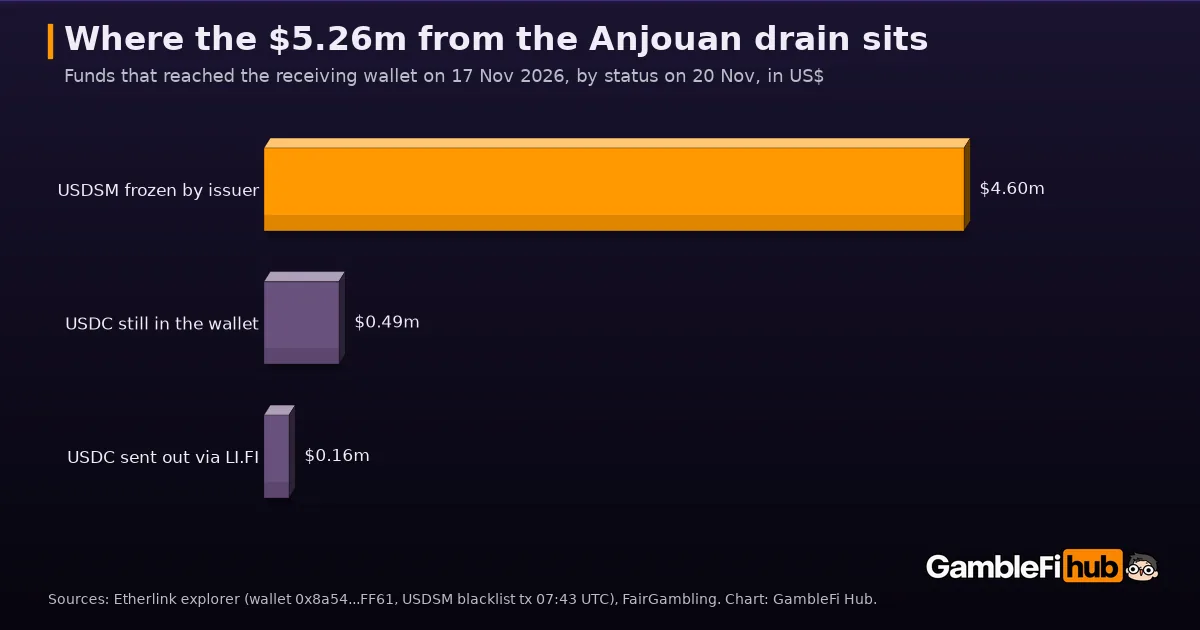
Early on 17 November 2026 a single wallet on Etherlink, the EVM chain built on Tezos, collected about $5.26 million from the shared bankroll of a group of crypto casinos. The brands all sit under one licence from Anjouan, and several of them have shown maintenance pages since. The incident was first documented by the analytics site FairGambling. We went back to the chain itself: every transfer into the receiving wallet is public on the Etherlink explorer, and so is the transaction that froze most of the money at 07:43 UTC the same morning.
One licence, ten domains, one pot
The Anjouan licence register lists ONCHAIN Technologies Ltd under licence ALSI-202411002-FI1, a B2B and B2C licence with ten casino domains, among them Betmode, LuckyCoin, Rollchain, Gambid and Slotified. The register still marks the licence as valid, although the expiry date it prints is 31 October 2026. These sites did not each hold their own reserve. They drew on a common bankroll, a model sold as Bankroll-as-a-Service, in which a platform provider runs the pot and the payout keys and the brands plug in. According to the explorer, the bankroll contracts were deployed by a factory contract whose verified code is named DGBankrollFactory. FairGambling links that factory to the platform provider DeGaming; its report carried no comment from DeGaming. Betmode is the only brand to have spoken so far. In a statement quoted by FairGambling it said unauthorised access had been gained to platform systems, the bankroll and player wallets, that player funds were safe and that its provider had frozen the attacker’s wallet.
Why most of the money stopped
The bankroll was held mostly in USDSM, a dollar stablecoin issued by Stable Mint on Etherlink, not in a native coin. That choice decided the outcome. A stablecoin issuer can block an address from moving its tokens, and at 07:43 UTC the USDSM deployer key called addToBlacklist on the receiving wallet. The USDC in the same wallet is a bridged version on Etherlink that Circle does not control, and part of it has already left. A second Etherlink casino, Dope, also went offline on 17 November; its founder later said that attack failed and the wallets involved were frozen, and FairGambling found no on-chain link between Dope and this case.
Key facts
Licence: Anjouan ALSI-202411002-FI1, ONCHAIN Technologies Ltd, issued 1 Nov 2024, printed expiry 31 Oct 2026, status “valid”, 10 domains.
Attack window: 17 Nov 2026, first transfer 05:05 UTC, last 07:12 UTC.
Freeze: USDSM blacklist on the receiving wallet, 07:43 UTC.
Chain and tokens: Etherlink; USDSM (Stable Mint) and bridged USDC.
Sources: Etherlink explorer, Anjouan register, FairGambling, Betmode statement via FairGambling.
Our numbers
We pulled all 904 incoming token transfers to the receiving wallet from the Etherlink explorer. They came from 882 different addresses and add up to $5,261,383: 4,604,661 USDSM and 656,722 USDC, counting both at one dollar. Six transfers of USDSM in the space of a few seconds just after 06:01 UTC moved $3.88 million, or 74% of the total. At the other end, 782 transfers were under $100 each and together brought in only $14,196, a sign that small player deposit and fee wallets were being swept one by one. From the first transfer to the freeze took 2 hours and 38 minutes, and the blacklist landed 31 minutes after the last inflow. The frozen USDSM equals 88% of the haul, and with a total USDSM supply of about 12.68 million it is roughly 36% of every USDSM in existence, stuck in one address. The remaining 12% is the problem: at 12:30 UTC the wallet sent 164,181 USDC through a LI.FI contract, and 492,542 USDC plus 977 XTZ were still there when we checked on 20 November. Measured against the licence, the attack came 17 days after the register’s own expiry date, and three days later the entry still reads valid.
Why it matters for GambleFi
For iGaming token and wider GambleFi projects that sell on-chain transparency, the lesson is practical. Shared bankrolls make it cheap to launch a new crypto casino, and published bankroll addresses let anyone check the reserve. This case shows the other side: ten brands relied on the same contracts and keys, so one compromise took the whole group offline at once. It also shows that what limits the damage is the asset, not the licence. A freezable stablecoin stopped most of the outflow within hours, while the part held in unfreezable bridged USDC is still exposed, much as Ether was in the earlier Duelbits and Gamdom hot wallet hacks. Freezing also cuts both ways: whether players and brands get the USDSM back depends on the issuer, which has not said whether it will reissue the tokens. For background on what an Anjouan licence does and does not cover, see our Anjouan explainer, our look at how casino wallets show up on-chain and the GambleFi FAQ. This is news and data, not investment advice and not a recommendation to use any platform.