
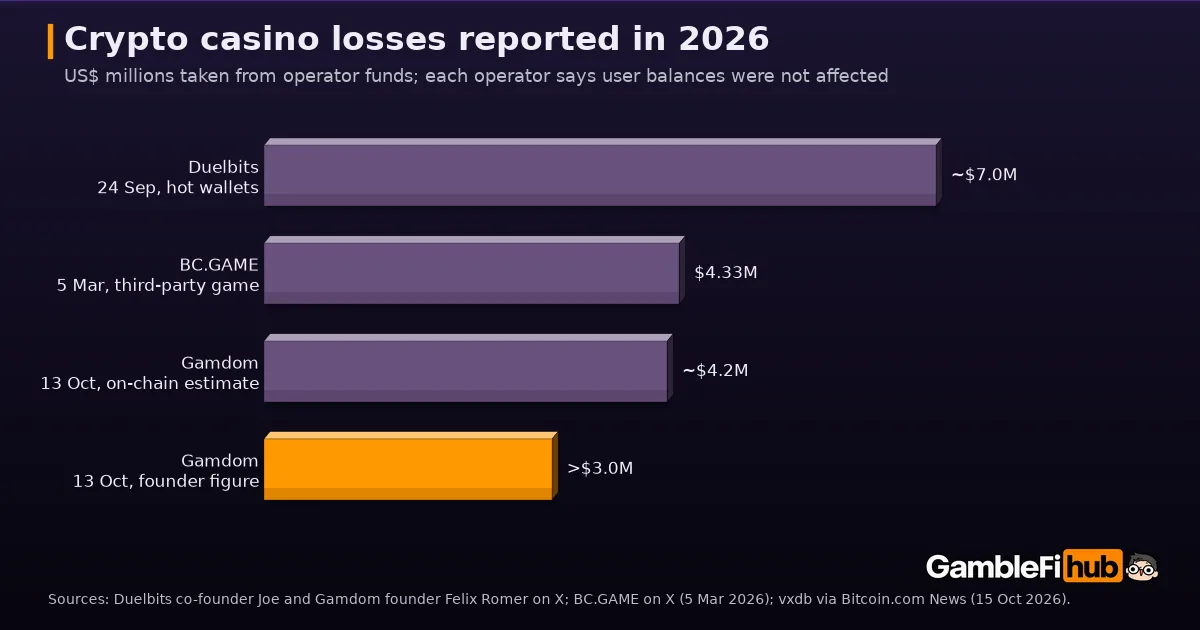
Gamdom is back online after attackers drained its hot wallets on 13 October 2026, making it the second crypto casino in under three weeks to lose millions this way. Founder Felix Romer put the loss at “just over $3m”, while an on-chain researcher counted closer to $4.2 million. On 24 September Duelbits had confirmed a hack of about $7 million, and on 17 October its co-founder said some of the stolen funds had been frozen and offered the attacker a deal. Neither attack has been attributed, and both operators say player balances were not touched.
What happened at Gamdom
Gamdom went offline on the evening of 13 October without giving a reason. In a statement on X the next morning it said staff checking a possible disk failure had found an unauthorised connection on one of its automation servers, and that it had taken all systems offline. “User funds are safe,” the company wrote. Romer later said the breach had targeted the hot-wallet system, that the drain was stopped and that the remaining hot-wallet funds were moved to cold storage. Hot wallets are the online addresses a casino uses to pay withdrawals instantly.
FairGambling, which tracks casino wallets, reported large outflows from Gamdom hot wallets on five blockchains within about an hour that afternoon, mostly to newly created addresses. The tracked balance fell from about $10.5 million to roughly $76,000 in a day, but that drop also includes the move to cold storage, so it is not a measure of the theft. One receiving wallet on Ethereum swapped its USDT and USDC into DAI, a stablecoin with no built-in freeze function. The researcher vxdb put the total at about $4.2 million, according to Bitcoin.com News; Gamdom has not explained the gap with Romer’s figure. The site came back early on 16 October with leaderboards, deposit bonuses and a giveaway, and its relaunch post did not name an attacker.
Duelbits three weeks earlier
Duelbits co-founder Joe confirmed a hack of about $7 million on 24 September and kept the site offline while the team investigated. Duelbits relaunched on 27 September with what it called around $8 million across hot and cold wallets and told users that deposit addresses had changed. Joe said that weekend an official explanation was being prepared; we found no published root-cause report as of 19 October. On 17 October he wrote that some funds were frozen “on some websites / exchanges” and told the attacker to keep $2 million and send back $5 million, or face efforts to recover all of it.
A pattern, not a one-off
The two incidents follow BC.GAME’s loss in March, when, by the operator’s own account, an attacker exploited a vulnerability in a third-party game on the platform; BC.GAME offered a bounty to trace the funds. We list that incident on the BC.GAME risk page. The best-known earlier case is Stake in 2023, which the FBI attributed to North Korea’s Lazarus Group. In each case the money taken was operator money held online to pay withdrawals, and the response came from the operator itself: refilling wallets, asking exchanges to freeze funds and offering bounties. We found no public statement from a regulator on either of the two recent hacks.
Key facts
Gamdom: drained 13 Oct 2026 (outflows about 15:50–16:50 UTC, per FairGambling); loss “just over $3m” (Romer, 14 Oct) or about $4.2M (vxdb: ~$2.2M EVM chains, ~$965k Solana, ~$668k bitcoin, ~$375k Tron); back online 16 Oct, 00:34 UTC.
Duelbits: hack of about $7M confirmed 24 Sep 2026; relaunched 27 Sep with about $8M in hot and cold wallets; 17 Oct offer: keep $2M, return $5M.
BC.GAME: 5 Mar 2026, $4,326,700 taken via a third-party game; $500,000 bounty.
Stake: about $41M stolen on or about 4 Sep 2023; FBI attribution to the Lazarus Group on 6 Sep 2023.
Why it matters for GambleFi
“User funds are safe” is a statement by the operator, and outsiders cannot check it, because crypto casinos rarely publish audited reserves. A casino that absorbs a multimillion-dollar loss has to cover it from its own treasury, and for platforms with a token, the same treasury often pays for buybacks, burns or staking rewards, as in our report on BC.GAME’s BC Engine. Our project pages, such as Rollbit and Shuffle, list each platform’s reported security incidents. For the basics, start with what GambleFi means in practice or our GambleFi FAQ. This is a report on security incidents, not advice on where to play.