
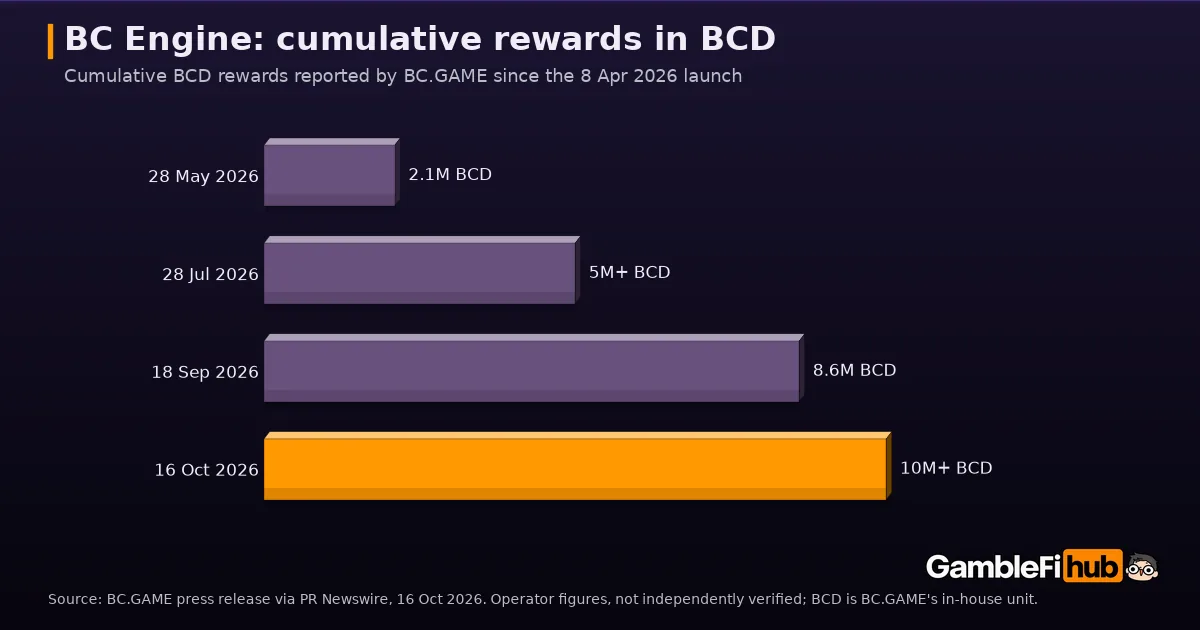
BELIZE CITY — BC.GAME says its BC Engine reward system has paid out more than 10 million BCD in the six months since it launched on 8 April 2026. In a press release on 16 October, the operator put the figure at the equivalent of more than US$10 million and said it counts rewards already settled, not projected returns or changes in the $BC price. BCD is BC.GAME’s own in-house unit, and the figures have not been independently verified. The milestone comes in a year in which two national authorities have acted against the brand.
How BC Engine works
BC Engine was introduced in April as a staking-style layer on BC.GAME’s rewards. $BC earned through wagering is staked automatically, and eligible holders receive BCD in hourly settlement rounds. In late April the operator added a 1% burn on $BC unstaked within seven days. According to the October release, holders had earned more than 2.1 million BCD by 28 May, more than 5 million by 28 July and 8.6 million by 18 September. The release also says partners including BC Originals, Croco Gaming and BETBY now run “Engine Nodes” that feed the reward pool, and that BC.GAME strengthened what it calls its regulated presence in Mexico this year. The release does not say how much of the reward pool comes from platform revenue. On CoinGecko, $BC traded at about $0.039 on Monday morning, with a market capitalisation of about $124 million and roughly $83,000 in 24-hour volume.
Sweden and Sri Lanka
On 29 June 2026 Sweden’s gambling regulator, Spelinspektionen, banned Twocent Technology Limited from offering gambling in Sweden without a licence, with immediate effect. The decision says a check of bc.game on 18 June found affiliate marketing on Swedish-language websites and promotion through content creators on a video-streaming platform. It names Twocent, a Belize company, as the owner and operator of bc.game and eleven related domains, and says Twocent holds an Anjouan licence, ALSI-202410011-FI, and did not respond when invited to comment. On 5 August Sri Lanka’s Ministry of Digital Economy announced an order to block 24 gambling sites, bc.game among them, in the first enforcement action under the Gambling Regulatory Authority Act of 2025, as reported by The iGaming Europe. The Telecommunications Regulatory Commission of Sri Lanka told service providers to block access with immediate effect. Neither action names BC Engine or the $BC token. Both concern access to the site in those countries.
Growth and enforcement side by side
BC.GAME has been running since 2017, and we could find no audited accounts published for the brand. Its scale is visible mainly through its own figures, such as the BC Engine totals, and through the actions of regulators in countries where it is not licensed. Its token programme is growing at the same time as its access in some markets is narrowing. Those two things are not in contradiction, because rewards are paid to existing holders wherever they play from, but together they show the gap between what a token dashboard records and what a regulator allows. Background on the brand, its token contracts and its licensing is on our BC.GAME project page.
Why it matters for GambleFi
Reward schemes like BC Engine are the clearest example of how crypto casinos now try to tie a token to platform activity. Until there is independent reporting, that link rests on figures the operator publishes itself. Enforcement continues meanwhile, from Michigan’s cease-and-desist letters to offshore sites to the Curaçao register entry covered in our report on Rollbit’s licence status. For the basics of tokens and platforms, start with what GambleFi means in practice. This is a news report, not investment or betting advice, and does not recommend any operator or token.