
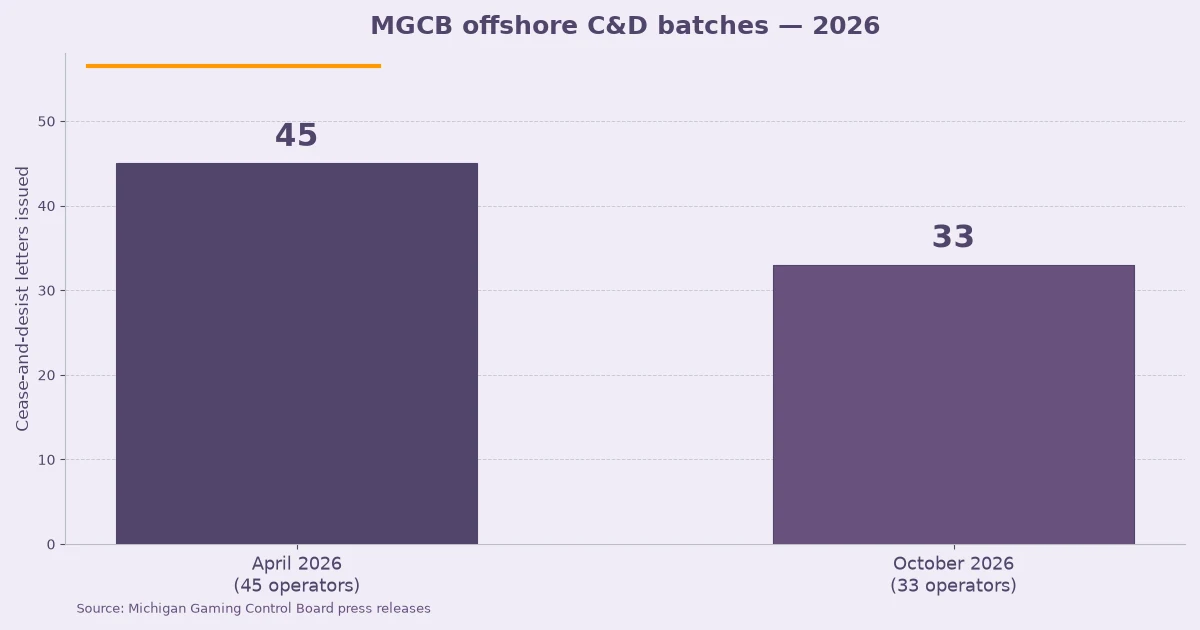
DETROIT — On 8 October 2026 the Michigan Gaming Control Board (MGCB) said it had issued cease-and-desist letters to 33 offshore gambling operators that were illegally offering online casino games, sweepstakes-style games and sports betting to Michigan residents. The same release warns that players who have joined Michigan’s self-exclusion programmes are not protected on unlicensed sites. Named recipients include Cryptoplay, mBit Casino, Azartzona Casino, Basepoker, BingoMania, BitofGold, Del Oro Casino, DetectiveSlots, Donbet, Exclusive Casino, Genie Jackpot, Guangzhou Snail Interactive Technology Co., Ltd., Immersion Casino Online, iWild Casino, JacksPay, Jurassic Slots, L0tt0, Lucky Charm Sweep, Lucky Rebel, Magicianbet, Odds Maker, Raging Bull Slots, Regal Casino and Sportsbook (also known as Wager Street), Ronin Slots, Runewager, Slot Paradise, Sloto Tribe, Sloto’Cash Online Casino, Spin Dinero, SpinsTopia, Stardust, SunnySpins Casino and The Online Casino. MGCB investigations determined each was offering those products without a Michigan licence. This article does not link to those operators and does not rank or promote them.
Self-exclusion ends at the state line
Licensed Michigan operators must honour the Internet Gaming and Sports Betting Responsible Gaming Database, which lets people voluntarily ban themselves from online gambling. Offshore operators have no such obligation. A person who has chosen to step away can still open an account, deposit and bet on an unlicensed site, often without realising the site sits outside Michigan law. MGCB Executive Director Henry Williams put the point plainly: “Choosing to self-exclude is one of the hardest and most courageous decisions a person can make, and in Michigan’s legal market, that choice is respected.” He added that offshore sites “don’t respect it,” will take a deposit from someone who has asked for help, and leave the MGCB with no way to help that person get money back. The 33 letters, he said, put operators on notice that Michigan residents are not an untapped market.
AGA figures cited by the MGCB
The release cites an August 2025 American Gaming Association analysis: Americans wager $673.6 billion a year with illegal and unregulated operators, including offshore sites, and the illegal market has grown 22% since the AGA’s 2022 report. On the same study, the share of online casino players who use only legal sites fell from 52% in 2022 to 24% in the latest figures, while nearly half now play on both legal and illegal sites. The MGCB also notes AGA estimates of $84 billion wagered with illegal bookies and offshore sportsbooks in the study year, and that one in ten sports bettors wager exclusively through illegal sources. Those numbers are the AGA’s, relayed by the MGCB; they are not independent GambleFiHub measurements.
April’s 45 letters, then October’s 33
The 8 October announcement builds on an April 2026 MGCB notice that the board had sent cease-and-desist letters to 45 offshore operators over a four-month period. The chart above compares those two public batches: 45 in April and 33 in October. Under the Lawful Internet Gaming Act, the Lawful Sports Betting Act and related state statutes, companies must be licensed by the MGCB to offer internet gaming or sports wagering in Michigan. Operators that ignore cease-and-desist directives may face further enforcement with the Michigan Department of Attorney General. Players on offshore sites, the board adds, have no access to Michigan self-exclusion, deposit limits or other responsible-gaming tools required of licensed operators, and no MGCB recourse if winnings are withheld or an account is closed.
Why it matters for GambleFi
State C&D waves sit next to other enforcement stories we track. The UKGC’s £5m Grosvenor settlement showed how AML and source-of-funds failures land on licensed bricks-and-mortar groups; the CFTC event-contract swap package draws a federal line around sportsbooks and casino-style products. Michigan’s letters are a first-party state action against unlicensed offshore access, with self-exclusion as the stated consumer risk. Readers who want the broader token-and-platform frame can start with what GambleFi means in practice. For Michigan residents, the board points to the authorised-operator list at Michigan.gov/MGCB and tip channels on the same release; this post sticks to the MGCB text and does not advise anyone to play.