
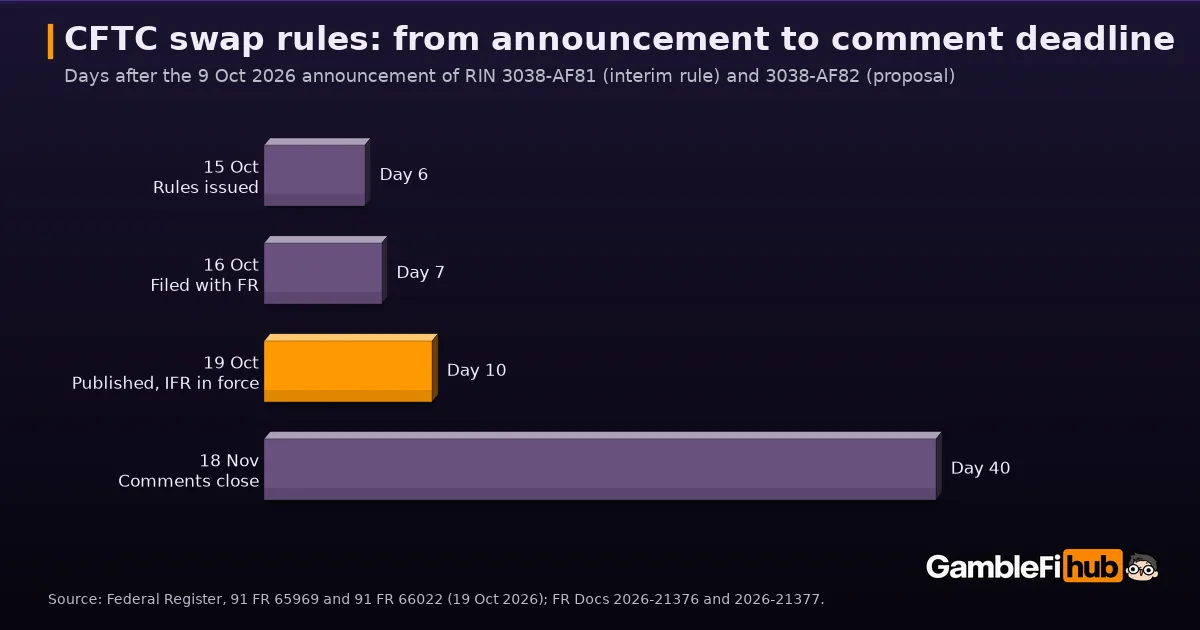
WASHINGTON — The CFTC’s rule that keeps casino-style gambling out of the federal definition of a “swap” took effect today, 19 October 2026, the day it was published in the Federal Register (91 FR 65969, FR Doc. 2026-21376). The published text shows the carve-out is narrower than the 9 October headlines suggested. It covers only wagers accepted by operators licensed under state or tribal law, and only when the product is not traded on an exchange. The companion proposal that would define event contracts as swaps appeared the same day (91 FR 66022). Comments on both are due by 18 November 2026.
What the rule text says
The interim final rule (RIN 3038-AF81) adds a new paragraph on casino-style gambling products to the definition of “swap” in 17 CFR 1.3. A product is excluded when two conditions are both met. First, it is offered by a person licensed or otherwise authorised to offer gambling or accept wagers under the law of a US state, or of a federally recognised tribe under the Indian Gaming Regulatory Act, acting within that licence, and the product is regulated as gambling under that law. Second, it is not traded on a board of trade, an organised exchange, a swap execution facility or any other market where trades are executed multilaterally or subject to individual negotiation.
Where both conditions are met, the rule gives three examples: sports wagers accepted by a licensed sportsbook; wagers on table games, slot machines and other electronic gaming devices at a licensed casino; and other licensed games of chance such as bingo, pool wagering, lotteries and raffles. The rule states that these classifications apply for the purposes of the Commodity Exchange Act only; tax treatment is left to the Internal Revenue Code and IRS guidance.
Why it took effect without prior comment
An interim final rule applies before the public has commented on it. The Commission relied on the Administrative Procedure Act’s “good cause” exception and pointed to court decisions, including a Ninth Circuit panel’s reading of the swap definition, that it says threaten its exclusive jurisdiction over event contracts listed on designated contract markets (DCMs). The text cites Arizona’s criminal case against a DCM, Minnesota’s attempt to ban prediction markets by statute and New York’s bid for emergency relief against a DCM. It also cites Pew Research Center figures of $24 billion in trading volume on two prediction markets in April 2026. Both documents were issued on 15 October; the voting summaries record Chairman Selig voting in favour and no commissioner voting against.
What it leaves open for crypto casinos
The exclusion is written for gambling offered under state or tribal law. A Curaçao or Anjouan licence, the kind many crypto casinos cite, is neither, so those sites are not covered by this carve-out. The CFTC is explicit that this does not turn them into swaps. The rule says nothing in it should be read to imply that a product failing the exclusion “is necessarily a swap”, and a footnote names “a casual bet between friends” and “a casino-style sportsbook illegally operating in a State that prohibits gambling” as examples of transactions that may still not be swaps. The upshot is that offshore casino and sportsbook products gain no federal derivatives status from the package. Our project pages, for example on Rollbit and Shuffle, list the licences each platform cites.
The second condition matters for peer-to-peer betting exchanges, where users match bets against each other rather than against a house. Products traded multilaterally fall outside the carve-out by its own terms, which describes the model of onchain exchanges such as SX Bet. The interim rule names no onchain betting platform and does not say how such products are treated. The proposal published alongside it would define event contracts, including sports-related ones, as swaps, which would bring contracts listed on CFTC-registered exchanges more firmly under federal derivatives law.
What happens next
Comments on the interim rule (RIN 3038-AF81) and the proposal (RIN 3038-AF82) are due by 18 November 2026. They can be filed through Regulations.gov, by mail or by hand delivery, and the CFTC says it publishes comments without removing personal or business information. The Commission can then revise the interim rule, which stays in force in the meantime, and decide whether to finalise the proposal. The rules are already in front of judges: Novig’s complaint against Missouri, filed on 16 October, cites both, as we reported in our post on Novig’s suit over Missouri’s cease-and-desist deadline. For the 9 October announcement and the court split behind it, see our report on the CFTC’s event-contract swap rule and casino exclusion.
Why it matters for GambleFi
The carve-out draws a federal line that many crypto projects blur. Licensed gambling stays with states and tribes, and event contracts on registered exchanges go to the CFTC; offshore crypto casinos are covered by neither part of the package. For the basics, start with what GambleFi means in practice or our GambleFi FAQ. This is a report on a federal rule, not legal or betting advice.