
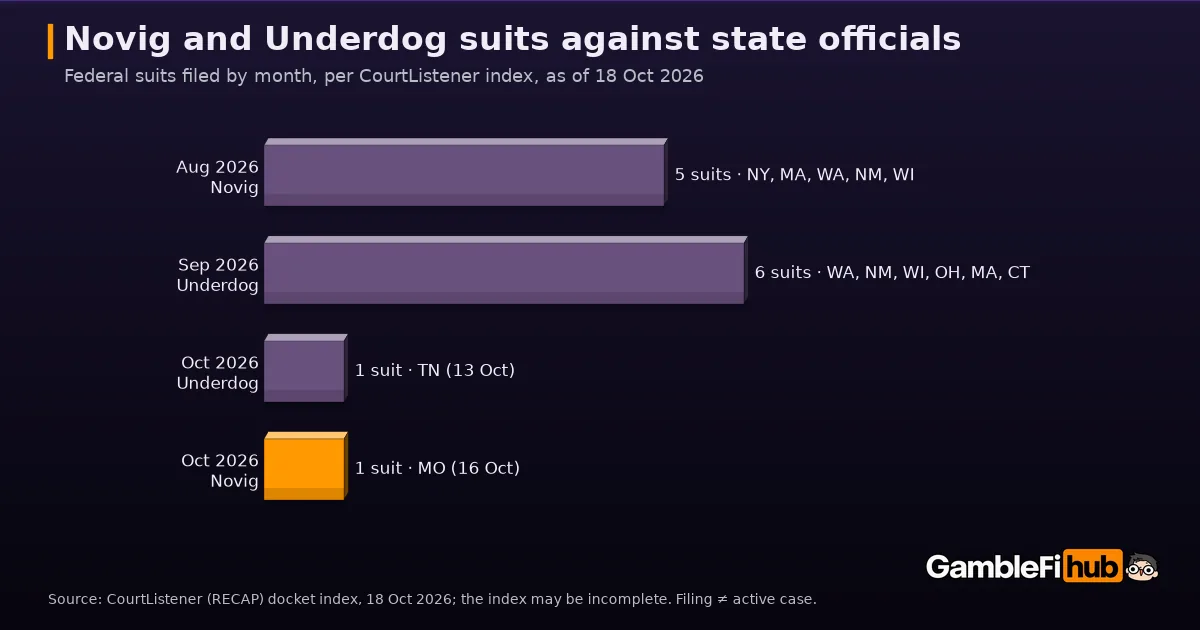
ST. LOUIS — Novig has sued Missouri’s attorney general and its gaming regulators in federal court, a day before the deadline in a cease-and-desist letter over its sports event contracts ran out. The complaint in Ludlow Exchange, LLC d/b/a Novig v. Hanaway (E.D. Mo., No. 4:26-cv-01780) was filed on 16 October 2026. It names Attorney General Catherine L. Hanaway, Missouri Gaming Commission Executive Director Michael A. Lear and Commission Chair Jan M. Zimmerman, each in their official capacity, and asks for a declaratory judgment and a preliminary and permanent injunction. As of this morning the court docket lists the complaint, an entry of appearance, a disclosure statement and a process-server notice. There has been no ruling.
What Missouri demanded
On 17 September 2026 the Attorney General’s Office announced cease-and-desist letters to six companies: Polymarket, Kalshi, Crypto.com, Novig, Underdog and Robinhood. The office says sports “event contracts” offered to Missourians are unlicensed sports wagering under state law, that they are not “swaps” under the federal Commodity Exchange Act, and that any company offering sports wagering in Missouri must be licensed by the Missouri Gaming Commission, pay the required taxes and fees and keep out anyone under 21. According to the complaint, Novig’s letter gave it 30 days, until 17 October, to stop offering sports event contracts to Missouri customers or obtain a Commission licence, or face enforcement. Missouri voters approved sports betting through Amendment 2 on 5 November 2024, and the regulated market launched on 1 December 2025. The complaint describes the framework as a 10% wagering tax on adjusted gross revenue plus licence fees of up to $500,000.
Novig’s case
The CFTC designated Ludlow Exchange as a designated contract market (DCM) on 16 June 2026. Novig argues that its event contracts are swaps under the Commodity Exchange Act, that Congress gave the CFTC exclusive jurisdiction over swaps traded on a DCM, and that Missouri’s constitutional and statutory betting rules are therefore preempted as applied to it. The complaint cites both CFTC actions of 9 October 2026: the proposed rule (RIN 3038-AF82) that would define swaps to include event contracts, including sports-related ones, and the interim final rule (RIN 3038-AF81) that excludes casino-style gambling products, such as sportsbook wagers and casino games, from the swap definition. It also says the CFTC expects an amended rule on whether sports-related contracts are in the public interest to become final by the end of November. The filing also describes an earlier attempt at state licensing. Colorado’s Division of Gaming approved an internet sports betting operator licence for a Novig affiliate on 21 September 2023, and the product launched there that October. Colorado had not adopted rules for exchange wagering, and the company withdrew from the state in April 2024 and asked to surrender the licence in March 2025. Novig uses that history to argue that state-by-state licensing does not fit an exchange model. None of these claims has been tested in court yet.
Part of a wider set of filings
Missouri is not the first state Novig has taken to court. Per the CourtListener index as of 18 October 2026, Ludlow Exchange has filed six federal suits against state officials since 4 August 2026, in New York, Massachusetts, Washington, New Mexico, Wisconsin and now Missouri. Underdog Exchange DCM has filed seven since 8 September, in Washington, New Mexico, Wisconsin, Ohio, Massachusetts, Connecticut and, on 13 October, Tennessee. Not all of them are live disputes: Novig’s Massachusetts case was stayed on a joint motion to stay and stipulation of voluntary dismissal, and its New Mexico case was stayed on a joint motion. The chart above counts filings, not active cases, and the index may be incomplete. Among the Novig and Underdog filings in the index, the Missouri complaint is the only one aimed at Missouri so far.
Why it matters for GambleFi
The Missouri case puts the CFTC’s 9 October line in front of another federal judge: event contracts treated as swaps on one side, casino-style gambling excluded on the other. We set out that package in our post on the CFTC’s event-contract swap rule and casino exclusion. A ruling on Novig’s request would indicate whether a federal designation can override a state that already runs its own licensed sports-betting market. Missouri’s move also fits the wider enforcement picture we track, from Michigan’s 33 cease-and-desist letters to offshore sites to Brazil’s bet-refund wind-down. For the wider token-and-platform frame, start with what GambleFi means in practice. This is a report on a court filing, not legal or betting advice. In Missouri, legal sports wagering runs through operators licensed by the Missouri Gaming Commission.