
BRASÍLIA — The window for Brazilian banks to return money left on shut-down betting platforms closed on 14 October 2026. From 15 October, under the Ministry of Finance’s timetable, Caixa Econômica Federal acts as intermediary wherever a bank could not complete a refund for operational reasons. The government has not yet published a final count of what was paid back. The last official figures, released on 10 October, said more than R$1 billion had been returned and R$159 million was still to be refunded. The refunds follow Provisional Measure (MP) 1.394/2026 of 25 September, which banned fixed-odds betting nationwide, covering sports betting and online games, including when offered from abroad to people in Brazil. Other lottery types authorised by law are not covered. As a provisional measure, MP 1.394 still has to be approved by Congress within the legal deadline to stay in force.
How the wind-down ran
The Finance Ministry’s schedule set out each step. From 25 September no new money could enter the platforms’ transaction accounts. Bettors could withdraw voluntarily until 23:59 on 5 October, and from 6 October the sites and apps had to be unavailable. On 6 and 7 October platforms had to tell financial institutions each bettor’s remaining balance by CPF (taxpayer ID), together with the bank account the deposits came from. Banks were to refund between 9 and 14 October. Separately, the Secretariat of Prizes and Betting (SPA) published Portaria 3.005/2026 on 2 October. It required the former licensees to report final balances to the SPA through its SIGAP system by 7 October and set 15 December 2026 as the deadline to settle the financial and regulatory obligations from their operating period. The SPA says those obligations survive the end of the authorisations.
The figures, each on its own date
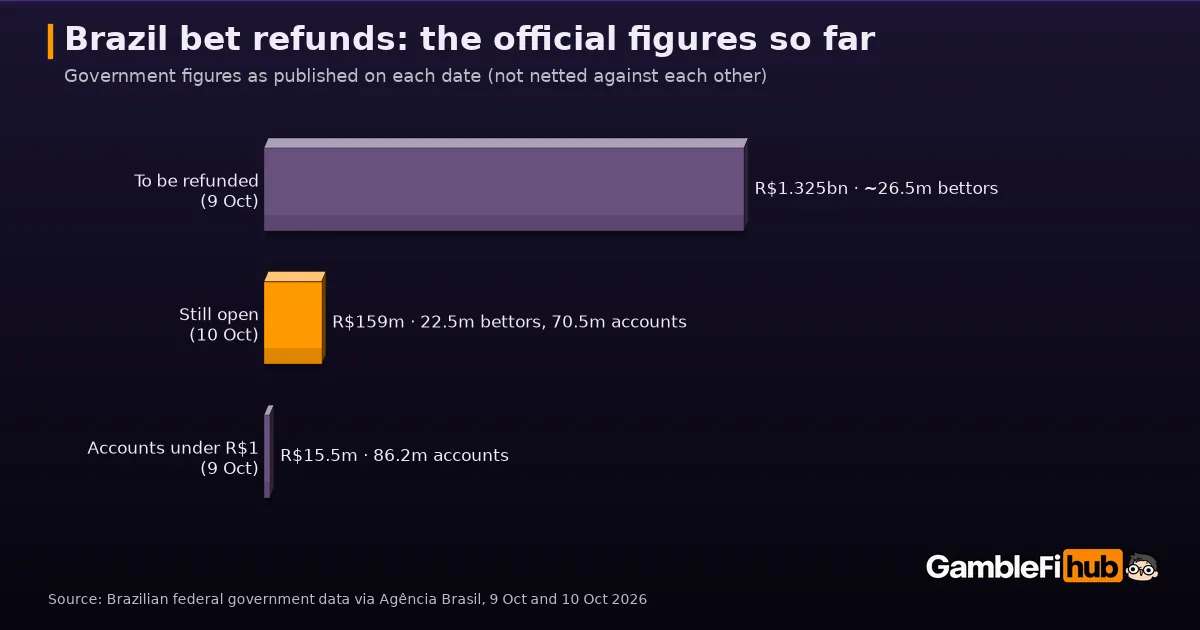
On 9 October Agência Brasil reported that banks were starting to return about R$1.325 billion to roughly 26.5 million bettors. Government data cited the same day showed 86.2 million accounts holding between R$0.01 and R$0.99, worth R$15.5 million combined; there are more accounts than people because one bettor can hold accounts on several platforms. On 10 October, figures the operators sent to the federal government put the amount still to be refunded at R$159 million, across 22.5 million bettors and 70.5 million accounts. That release said the balance had fallen “from R$1.2 billion”, not from the R$1.325 billion cited a day earlier, so the two days’ totals should not be subtracted from each other; the chart above shows each figure as published. According to the operators’ 10 October data, 90% of the remaining accounts had less than R$1 to receive and 97% less than R$10. Finance Minister Dario Durigan said, as reported on 9 October, that about 40 CPFs with high balances were under review for possible irregularities, including suspected money laundering.
Eight firms, the AGU and Caixa
By 10 October eight companies had still not sent banks the data needed to refund their customers, and the Attorney General’s Office (AGU) said it would go to court to force them to hand it over. As of this morning we found no public record that the suit has been filed, and no updated government tally since 10 October. The Finance Ministry says guidance for bettors in the Caixa phase will come through official channels. Enforcement against unlicensed sites runs in parallel: between 25 September and 9 October the government referred 16,627 illegal betting sites for blocking and asked platforms to remove 3,691 pages, profiles, channels, groups and servers, including 1,027 Telegram groups with about 18.5 million members and 115 TikTok profiles with roughly 459,000 followers.
Why it matters for GambleFi
Brazil is a rare case of a large regulated betting market being switched off rather than tightened, and the refund mechanics show what an orderly exit can look like on bank rails: balances matched to CPFs, money sent back to the account it came from, and a state bank as fallback. The published rules say nothing specific about crypto, and this post does not infer any. The story sits next to other enforcement actions we track, from Michigan’s cease-and-desist letters to offshore sites to the UKGC’s £5m Grosvenor settlement and the CFTC’s event-contract swap package. For the wider token-and-platform frame, start with what GambleFi means in practice. This is not advice: bettors waiting for a balance should rely on official government and bank channels, and the 9 October report warns that no fee is needed to receive a refund.