
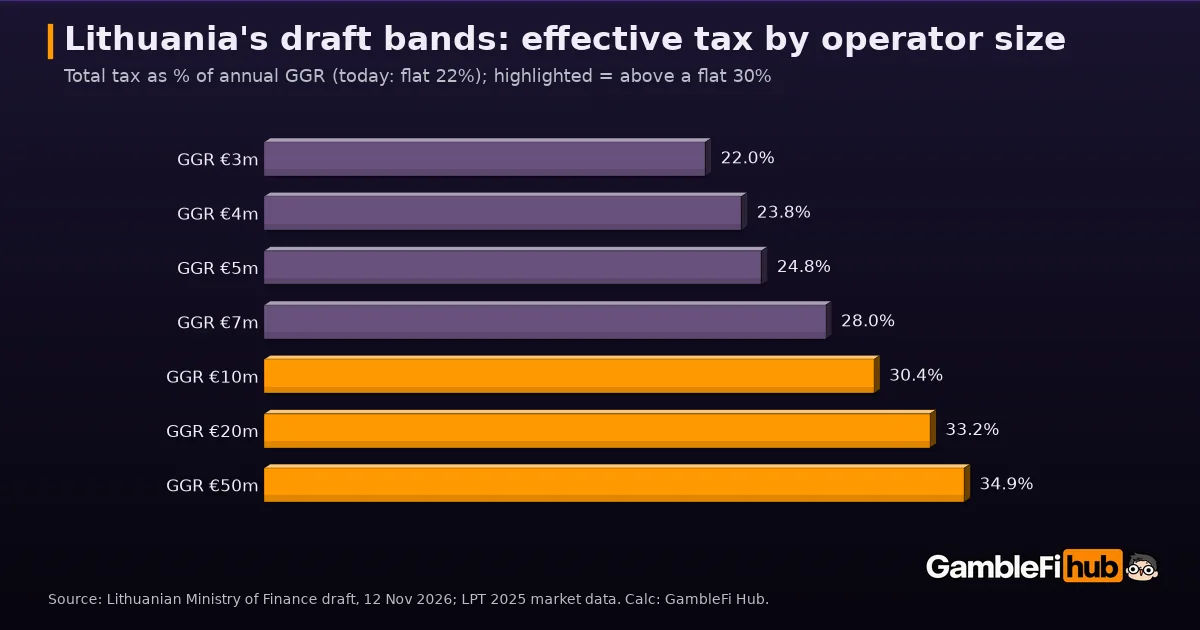
Lithuania’s Ministry of Finance has sent a draft amendment to the Law on Lottery and Gaming Tax to state bodies and market representatives for comment. It would replace the flat 22% tax on gross gaming revenue (GGR) with three marginal bands: 22% on the first €3m, 29% on the slice from €3m to €5m and 36% on everything above €5m. The tax on lottery operators would rise from 18% to 20%. The ministry’s 12 November release puts the gain at “up to EUR 36 million” a year on 2025 figures.
What the draft changes
Only the part of revenue inside each band pays that band’s rate, so crossing €5m does not make the whole bill 36%. According to LRT, citing ELTA, operators would pay quarterly on account and then recalculate the tax on full-year revenue, which means the thresholds work on annual GGR, not per quarter. The new rates would start on 1 July 2027 and first apply to the third quarter of 2027. The ministry plans to send the bill to the government with the revised 2027–2029 budget, after which the Seimas still has to pass it, so rates and dates can still change.
The draft covers slot machines, table games, bingo, totalisator, betting and remote gambling. It follows a coalition council decision to raise gambling and lottery taxes. In September the government opposed a separate MP’s bill for a flat 30% gambling rate and 25% on lotteries, pointing to the rise from 20% to 22% that took effect in 2025.
Key facts
Draft bands: 22% up to €3m GGR, 29% from €3m to €5m, 36% above €5m; lotteries 20% (now 18%).
Start: 1 July 2027, quarterly prepayments, annual recalculation.
Market in 2025: €274.1m GGR, of which €202.4m remote and €71.7m land-based; 12 licensed companies (Gaming Control Authority).
Tax paid in 2025: €86.9m, of which €57.6m from gambling operators and €29.3m from lotteries.
Ministry estimate: up to €36m more a year.
Our numbers
We applied the bands to operators of different sizes (see chart). An operator with €3m of GGR sees no change. At €5m the effective rate is 24.8%, at €10m 30.4%, at €20m 33.2% and at €50m 34.9%. Above €5m the extra tax compared with today follows one formula: 14% of GGR minus €0.56m. Above about €9.3m of GGR, an operator would pay more under the bands than under the flat 30% the government rejected in September.
The Gaming Control Authority does not publish revenue per company in its 2025 market tables, but the formula makes the total easy to bracket. Whatever the split of the €274.1m between the 12 companies, the extra gambling tax lands between €31.6m (every company above €5m) and €37.8m (all revenue at one company). Adding two points on €167.2m of lottery tickets brings in about €3.3m more. The ministry’s “up to €36m” therefore sits near the bottom of our €35m to €41m range, which fits a market where most licensees already clear €5m. If they all do, gambling tax on 2025 revenue would be about €91.9m, an average of 33.5% instead of 22%. These are full-year figures on reported GGR; the taxable base and payment timing differ slightly (gambling operators actually paid 21% of GGR in 2025), and 2027 would only see half a year.
Why it matters for GambleFi
Higher tax on licensed operators widens the price gap with sites that never apply for a Lithuanian licence. The regulator’s list of illegal operators held 2,017 web domains at the end of 2025, 208 of them added that year. Crypto casinos and iGaming token (GambleFi) platforms that accept Lithuanian players without a local licence are not part of this tax base at all. Our licence check of 17 iGaming token platforms shows which licences they do hold. Other markets lean on enforcement instead: see Sweden’s ban on a crypto casino and Bulgaria’s planned ad ban. The GambleFi FAQ explains how token-based platforms differ from licensed operators. This is a report on a draft law and public statistics, not tax or legal advice.