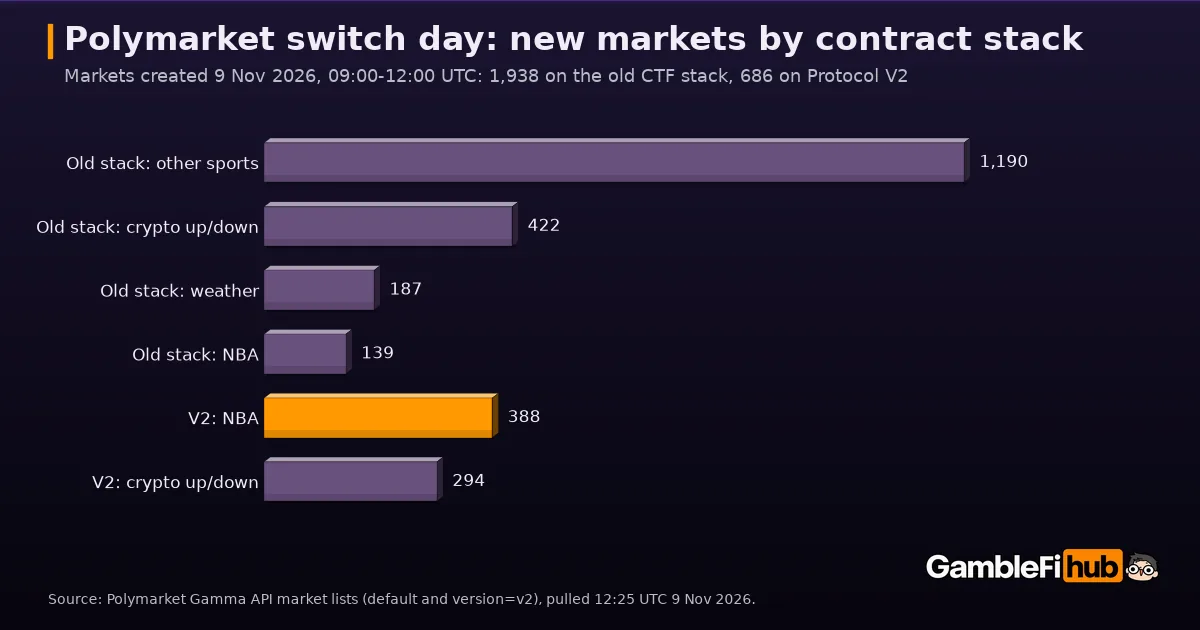
Polymarket’s developers set Monday, 9 November, as the day net-new markets move to Protocol V2, the contract stack that replaces the Gnosis Conditional Tokens Framework (CTF) the onchain venue has run on since launch. By midday Berlin time the switch was visible but far from complete. Between 10:00 and 13:00 CET, Polymarket’s public Gamma API listed 686 markets created on V2 and 1,938 created on the old CTF contracts, our count from both market lists pulled at 13:25 CET.
The plan Polymarket published
The developer account announced Protocol V2 on 5 October, with canary markets from 5 to 30 October and net-new markets “tentatively” switching on 2 November. On 30 October it moved the release to 9 November “to keep midterms week clear” and said a final schedule, including exact timings and the order in which markets migrate, would follow within days. We found no such schedule among the account’s posts up to 13:25 CET today; its latest posts, from 6 November, cover breaking changes on 12 November and the shutdown of its RTDS price feeds on 30 November.
The migration guide says app and website users need no technical migration beyond approval prompts, and that existing CTF holdings are not converted. For integrators the changes are deeper. V2 orders are signed against a new ExchangeV3 contract with signing-domain version “3”, V2 balances sit in a separate PositionManager ledger, and splits, merges and redemptions go through a Router. The contract guide says positions are counted in six-decimal pUSD units and that CTF approvals do not carry over. Bots must pick a V2 position ID or a CTF token ID depending on each market’s version, according to the SDK guide.
What switch day looks like onchain
Gamma returns CTF markets by default and Protocol V2 markets only when queried with version=v2; V2 slugs start with “polyv2”. In our window the V2 list held 388 NBA markets, 294 crypto up/down markets and four others. The CTF list held 1,190 markets across other sports, 422 crypto up/down markets, 187 weather markets and 139 NBA markets. Every NBA game we found on V2 also has a CTF event with its own markets, and the five- and 15-minute up/down series for BNB, Dogecoin, Hype, Solana, XRP and Zcash ran on both stacks. Bitcoin, Ethereum, gold and silver up/down markets appeared only on the old stack.
So the migration is running in parallel rather than as a cutover, at least for now. Traders can hold the same game or price window on two different contracts with separate order books. Polymarket may still publish its schedule or move more categories later today; these counts are a snapshot, not a final tally.
Key facts
Switch date: 9 November 2026 for net-new markets (moved from 2 November on 30 October).
Window counted: markets created 10:00–13:00 CET (09:00–12:00 UTC), 9 November.
Protocol V2: 686 markets (NBA 388, crypto up/down 294, other 4).
Old CTF stack: 1,938 markets (other sports 1,190, crypto up/down 422, weather 187, NBA 139).
Holdings: existing CTF positions are not converted; app users only confirm approvals.
Next dates: breaking changes 12 November, 00:00 UTC; RTDS price feeds off 30 November, 00:00 UTC.
Sources: V2 migration guide, contract guide, PolymarketDevs, 30 October, Gamma API.
Why it matters for GambleFi
Polymarket is the largest onchain prediction market, and its contracts are what wallets, aggregators and front ends such as Jupiter’s Polymarket parlays on Solana build on. A new collateral path, a new position ledger and a new exchange contract change the plumbing under every one of them. The international venue now sits beside a regulated U.S. arm we compared in Polymarket US versus the onchain venue, while traditional books such as DraftKings are spending heavily on event contracts of their own.
For iGaming tokens — the GambleFi coins of onchain casinos and betting exchanges such as SX Bet — the switch is a reminder that settlement contracts are product risk, not background. Our earlier look at Polymarket’s UMA disputes and the 41-venue volume map give more context. This is a data snapshot of public API listings, not investment advice. The GambleFi FAQ explains how prediction markets differ from crypto-casino tokens.