
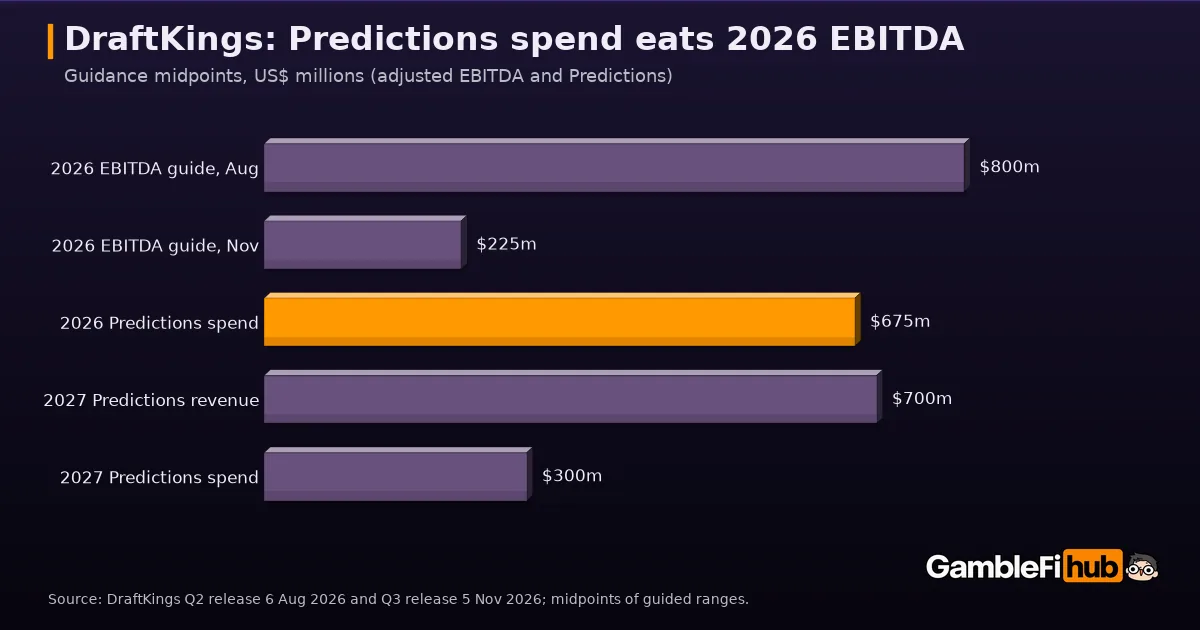
DraftKings now expects to spend $650 million to $700 million of adjusted EBITDA on its prediction-market business in 2026, and it cut its full-year adjusted EBITDA guidance to $175 million to $275 million to make room. In its third-quarter release of 5 November, the Boston company said Predictions revenue will be “immaterial” this year because new-customer promotions offset the lion’s share of gross revenue. For 2027 it guides $650 million to $750 million of Predictions revenue and a further $250 million to $350 million of investment.
The guidance cut
In its second-quarter release on 6 August, DraftKings maintained the 2026 outlook it first gave on 7 May: revenue of $6.5 billion to $6.9 billion and adjusted EBITDA of $700 million to $900 million. Three months later revenue guidance is $6.35 billion to $6.55 billion and adjusted EBITDA guidance is $175 million to $275 million. At the midpoints that is a drop from $800 million to $225 million. The company says the change primarily reflects the larger Predictions investment, and it still expects $875 million to $925 million of adjusted EBITDA from its core sportsbook, iGaming and other businesses.
DraftKings expects $175 million to $225 million of the Predictions investment to fall in the fourth quarter. Subtracting that from the full-year range leaves about $475 million at either end, which implies roughly that much was spent in the first nine months; that is our arithmetic, not a figure DraftKings published. The third quarter shows the cost: adjusted EBITDA was a loss of $316.9 million against a loss of $126.5 million a year earlier, and sales and marketing expense rose to $605.7 million from $360.4 million.
What DraftKings says it is buying
Third-quarter revenue rose 16 percent to $1.329 billion. Chief executive Jason Robins said more than 1.6 million customers had engaged with Predictions this year, and monthly unique payers rose about 13 percent to 4.1 million. The company reports prediction-market revenue inside its sports line, together with online and retail sportsbook revenue, so the release does not break out a Predictions revenue figure for the quarter.
For 2027 DraftKings guides total revenue of $7.35 billion to $7.75 billion and adjusted EBITDA of $800 million to $1.0 billion, which it says includes $300 million of Predictions investment at the midpoint. Core revenue is guided at $6.7 billion to $7.0 billion; the gap to total revenue matches the Predictions revenue range. Those are company forecasts, not results.
The legal exposure in the 10-Q
The quarterly report filed on 6 November describes how the business is built. DraftKings Predictions launched in December 2025 as an introducing broker under CFTC oversight and has operated as a futures commission merchant since August 2026. The group also runs Railbird Exchange LLC, a designated contract market doing business as DKeX, and makes markets on DKeX and other exchanges. That puts the broker, the exchange and a market maker inside one group.
The same filing lists three suits aimed at Predictions. On 28 July Michael Chan filed a putative class action in federal court in Massachusetts alleging that sports event contracts are unlawful in eight states, including California, Florida and Texas. On 3 August Jason Gordon, Arie Weissman and Johnny Harris filed a similar complaint covering 15 states, including Utah. On 9 October the Seminole Tribe of Florida sued in Broward County, alleging that Predictions and Pick6 are prohibited gambling and that its 2021 compact gives the tribe the exclusive right to offer that kind of gambling in Florida. DraftKings says it cannot estimate the possible loss in the class actions.
Key facts
FY2026 Predictions investment: $650m–$700m adjusted EBITDA, of which $175m–$225m in Q4.
FY2026 guidance: revenue $6.35bn–$6.55bn (was $6.5bn–$6.9bn); adjusted EBITDA $175m–$275m (was $700m–$900m); core adjusted EBITDA $875m–$925m.
FY2027 guidance: revenue $7.35bn–$7.75bn; adjusted EBITDA $800m–$1.0bn; Predictions revenue $650m–$750m; Predictions investment $250m–$350m.
Q3 2026: revenue $1.329bn (+16%); adjusted EBITDA −$316.9m; sales and marketing $605.7m; 4.1m monthly unique payers.
Structure: introducing broker from December 2025, FCM since August 2026; DKeX (Railbird Exchange LLC) is a DCM.
Suits: Chan (28 Jul, D. Mass.), Gordon et al. (3 Aug, D. Mass.), Seminole Tribe (9 Oct, Broward County).
Sources: Q3 release, Q2 release, Form 10-Q.
Why it matters for GambleFi
A licensed U.S. sportsbook is now budgeting hundreds of millions of dollars a year for event contracts. Kalshi’s fundraising, which we covered in its $40bn valuation round, is the other side of that race, and our map of 41 prediction-market venues shows how concentrated volume already is. DraftKings is spending into the same legal fight: Utah has charged Kalshi and its founders, California tribes won an injunction against Kalshi sports contracts on their land, and the CFTC wants exchanges to drop state geoblocks within 30 days.
For iGaming tokens — the GambleFi coins issued by onchain casinos and betting exchanges such as SX Bet — the competition is now a well-funded, CFTC-registered stack rather than only crypto-native venues like the Polymarket parlays on Solana. This is a report on company filings and guidance, not investment or legal advice. The GambleFi FAQ explains how event-contract venues differ from crypto-casino tokens.