
SALT LAKE CITY — Utah’s attorney general has filed criminal charges against KalshiEX LLC and its two co-founders, chief executive Tarek Mansour and chief operating officer Luana Lopes Lara. The charging document, an information dated 28 October 2026, was filed in the Third Judicial District Court in Salt Lake County and lists 14 counts. One is a second-degree felony for a pattern of unlawful activity. Twelve are third-degree felonies for online gambling promotion. One is a class A misdemeanor for general gambling promotion. All of them are allegations, and none has been tested in court.
The whole case rests on a small test. According to the sworn probable-cause statement by Special Agent Scott Eggerman of the attorney general’s office, he opened a Kalshi account under an undercover name with an undercover Visa debit card and a Utah address, phone number and bank. Between 13 and 24 September he placed 12 sports wagers while in Salt Lake County or Davis County. Each felony count matches one of those wagers.
What the agent bet, and what Kalshi charged
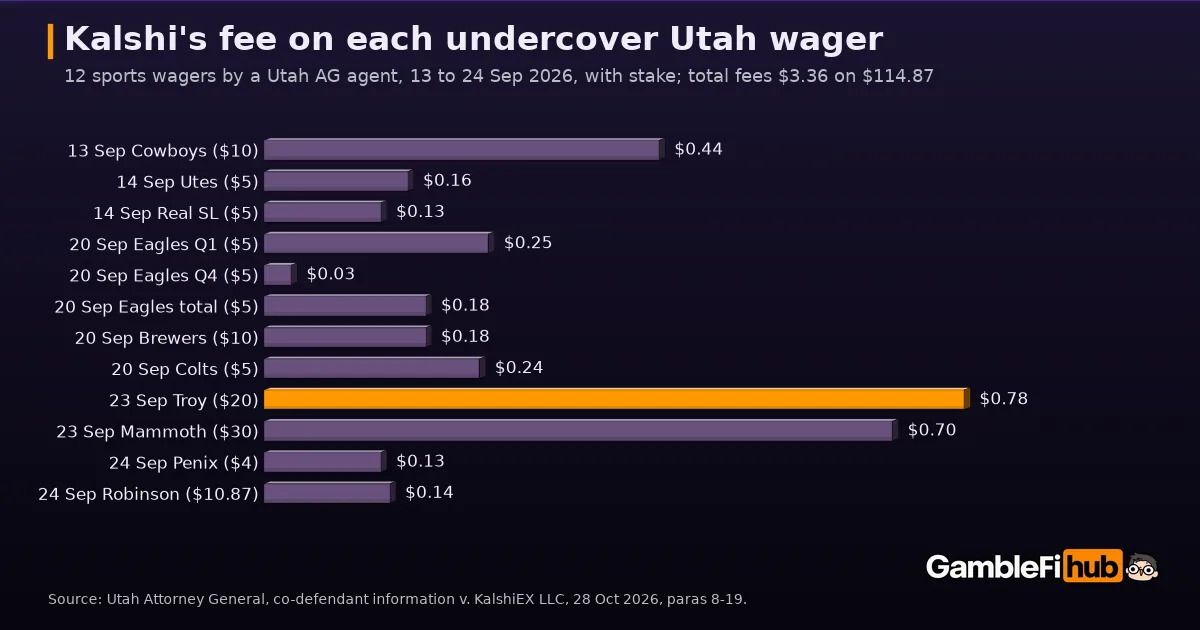
The wagers covered NFL, college football, MLS, MLB and NHL games: a $10 bet on the Cowboys to beat the Giants, quarter scores and the total in one Eagles–Titans game, and player props on Michael Penix Jr.’s passing yards and Bijan Robinson’s rushing yards. Stakes ran from $4 to $30, $114.87 in all. The filing lists Kalshi’s fee on each, from $0.03 to $0.78 and $3.36 in total, or 2.9% of the money staked (see chart). The share was smallest on the contract the platform priced at an 89% chance and largest on long shots priced at 25% to 34%, which fits the fee formula we compared in our Kalshi and Polymarket fee check. Going by the amounts the declaration gives, the agent won six bets and lost six, for a net loss of about $25.
The statement says Kalshi made the agent confirm his location through location services before the first bet, and that he truthfully confirmed he was in Utah. That detail is central to the state’s argument that Kalshi knew where the customer was.
Why the founders are named
The counts are written against KalshiEX as a company, under a Utah provision that holds a corporation liable when its board or senior managers authorise or “recklessly tolerate” the conduct. Mansour and Lopes Lara are named as co-defendants. The declaration relies on public recordings of both: it says Mansour has described direct control over Kalshi’s business decisions and staff, and Lopes Lara has said operations are centralised on her and that she oversees product, engineering, markets and marketing. On that basis the state alleges that both took part in running the business through a pattern of unlawful activity.
The court fight behind it
Kalshi sued Utah first. Its federal case, filed on 23 February 2026 in the District of Utah, asked the court to rule that federal commodities law preempts the state’s gambling ban. According to the information, Judge Robert J. Shelby granted summary judgment to the state on 4 August, and the Tenth Circuit refused an injunction pending appeal on 8 September. The undercover bets began five days later. The state says Kalshi kept serving Utah customers after both rulings.
The criminal case comes eight days after the state’s civil case. On 20 October the attorney general filed a civil suit against Kalshi and Susquehanna, and on 26 October the CFTC and the US government sued Utah in federal court to stop it enforcing state gambling law against CFTC-regulated exchanges. Kalshi is fighting similar battles elsewhere, including its suit against Missouri and its Supreme Court petition.
Press reports add the two sides’ statements, which are not in the filing. Reuters quoted Attorney General Derek Brown: “Calling it a ‘prediction market’ doesn’t change what it is, and being federally registered doesn’t put a company above the law.” AP reported that Kalshi called the charges a “crazy overreach” and said Utah was “playing politics”. AP also reported that the office did not say what penalties it would seek.
Key facts
Case: State of Utah v. KalshiEX LLC, with Tarek Mansour and Luana Lopes Lara as co-defendants; Third Judicial District Court, Salt Lake County; AGO No. 9465862; information dated 28 October 2026.
Counts: 1 pattern of unlawful activity (second-degree felony, Utah Code 76-17-407); 12 online gambling promotion (third-degree felony, 76-9-1404); 1 general gambling promotion (class A misdemeanor, 76-9-1405).
Evidence cited: 12 undercover wagers, 13–24 September 2026, Salt Lake and Davis counties; $114.87 staked, $3.36 in Kalshi fees.
Earlier rulings cited: KalshiEX v. Cox, D. Utah 2:26-cv-00151 (summary judgment for Utah, 4 August 2026); Tenth Circuit denial of injunction pending appeal (8 September 2026).
Sources: Utah Attorney General co-defendant information and declaration of probable cause (28 October 2026); statements as reported by Reuters and AP (28 October 2026).
Why it matters for GambleFi
Criminal counts against named founders raise the stakes far above civil fines or cease-and-desist letters, and Utah built them on a dozen bets worth $115 placed from inside the state. The same approach would be easy to use against onchain sports books such as SX Bet or crypto casinos such as Shuffle and Rollbit, which have no CFTC registration to point to. For how prediction markets differ from iGaming token (GambleFi) platforms, see the GambleFi FAQ. This is a report on a court filing, not legal or betting advice.