
Utah Attorney General Derek Brown sued Kalshi in state court on 20 October 2026, and named the trading firm Susquehanna as a defendant alongside it. The verified complaint, filed in the Third Judicial District Court for Salt Lake County, says Kalshi’s sports, election, politics, culture and mentions contracts are gambling bets that Utah law prohibits. The state asks the court to stop those contracts in Utah and to make the defendants give up what they earned there. Kalshi says it answers to federal law.
Who is being sued
The defendants are Kalshi Inc., KalshiEX LLC, Kalshi Klear Inc., Kalshi Klear LLC and Kalshi Trading LLC, plus Susquehanna International Group, LLP and Susquehanna Government Products, LLLP. The complaint describes Susquehanna Government Products as Kalshi’s first dedicated institutional market maker, from around April 2024. It says the Susquehanna entities and Kalshi Trading routinely take the opposite side of retail bettors’ positions, which in the state’s words means Susquehanna “accepts gambling wagers from members of the public”.
That makes the market makers, not only the exchange, targets of the claims. The five counts are public nuisance, unjust enrichment, civil conspiracy, declaratory judgment and injunctive relief.
What Utah wants
The state seeks preliminary and permanent injunctions against the contract categories it calls “Illegal Wagers”, enforced through a third-party geolocation provider approved by the court. It also asks for restitution and damages, an accounting and disgorgement of amounts received from Utah, abatement of the nuisance, punitive damages and fees. “Today we are asking the court to stop sports, elections, politics, culture and mention bets here in Utah, and to use a court-approved geolocation provider to enforce this,” Brown said, KUER reported.
The state’s numbers
The complaint leans on Kalshi’s own court filing. A declaration from Kalshi’s head of markets, dated 25 February 2026, put Utah accounts at 55,819, of which 32,940 had fully completed sign-up. The state says Utah accounts then held more than five million wagers, about 1.11% of Kalshi’s roughly $451.29 million in open positions.
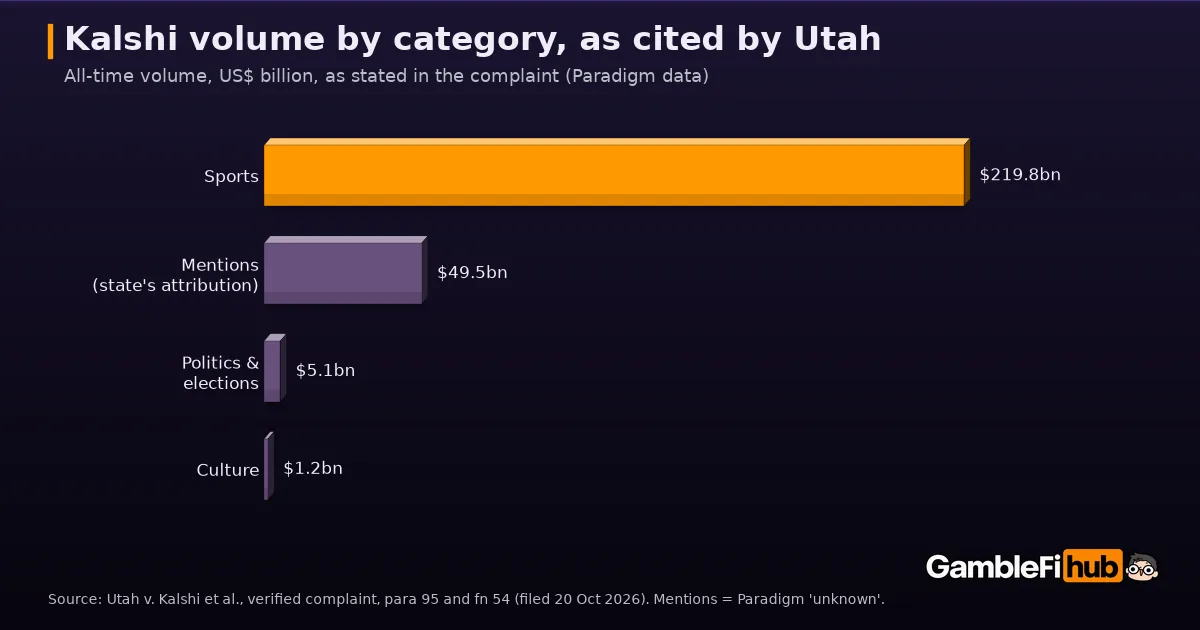
From there the state estimates, as it labels them, that Kalshi earned between $30,591,600 and $61,183,200 in fees from Utah accounts through 19 October 2026. It separately estimates at least $5.5 million in gambling profits from Utah residents as of May 2026. Both are the state’s estimates and have not been tested in court. The complaint also cites Paradigm data putting $219.8 billion of Kalshi’s all-time volume in sports, against $5.1 billion in politics and elections.
The federal fight behind it
The suit follows Kalshi’s own federal case against the state. In KalshiEx LLC v. Cox, a federal court in Utah ruled against Kalshi on 4 August 2026, and a request for an injunction pending appeal was denied on 8 September. The appeal is before the Tenth Circuit. Kalshi told KSL the state case does not affect that appeal: “Kalshi answers to federal law, and no single state should have a veto over it.”
Key facts
Court: Third Judicial District Court, Salt Lake County, Utah; verified complaint and jury demand, filed 20 Oct 2026 (no case number on the filed copy).
Plaintiff: Derek Brown, Utah Attorney General, for the State of Utah.
Defendants: five Kalshi entities, Susquehanna International Group, LLP, Susquehanna Government Products, LLLP.
Counts: public nuisance, unjust enrichment, civil conspiracy, declaratory judgment, injunctive relief.
Related case: KalshiEx LLC v. Cox, No. 2:26-cv-00151 (D. Utah), ruling 4 Aug 2026, on appeal to the Tenth Circuit.
Why it matters for GambleFi
Utah names not only the exchange but also the firm that supplies its liquidity, and asks a state court to order geolocation, the step Kalshi told the federal court would be costly and slow to build. If market makers face liability state by state, the counterparties that keep sports contracts liquid could pull back. On-chain books such as SX Bet rely on the same kind of liquidity. Our earlier reports cover Crypto.com’s suit against Missouri and the CFTC and CME fight over Kalshi’s crypto perpetuals, and the GambleFi FAQ explains the basics. This is a news report, not betting advice.