
The Commodity Futures Trading Commission has told a federal court that CME Group has no right to challenge the agency's approval of crypto perpetual futures, because CME has not shown that the new contracts cost it anything. In a reply brief filed on 16 October 2026 in Chicago Mercantile Exchange v. Selig in the US District Court for the District of Columbia, the CFTC uses CME's own trading data and earnings-call remarks to argue that the exchange lacks standing. If the court agrees, the case ends before anyone rules on whether perpetuals are futures or swaps.
What CME is challenging
On 29 May 2026 the CFTC approved Kalshi's Bitcoin perpetual contract as a futures product and adopted a policy statement that lets exchanges self-certify similar crypto perpetuals. CME sued on 18 June. Its complaint argues that a contract with no expiry date is a swap under the Dodd-Frank definition and should carry the stricter rules that come with that label. It says Kalshi went on to self-certify more perpetuals, including on Ether, Solana, XRP, Chainlink and Sui, and cites a CNBC report that Kalshi's perps passed $1 billion in volume within a week of launch.
CME says it has standing as a competitor: the contracts are built to win the retail traders who use its own crypto futures, so more competition is the injury.
The CFTC's answer: show the harm
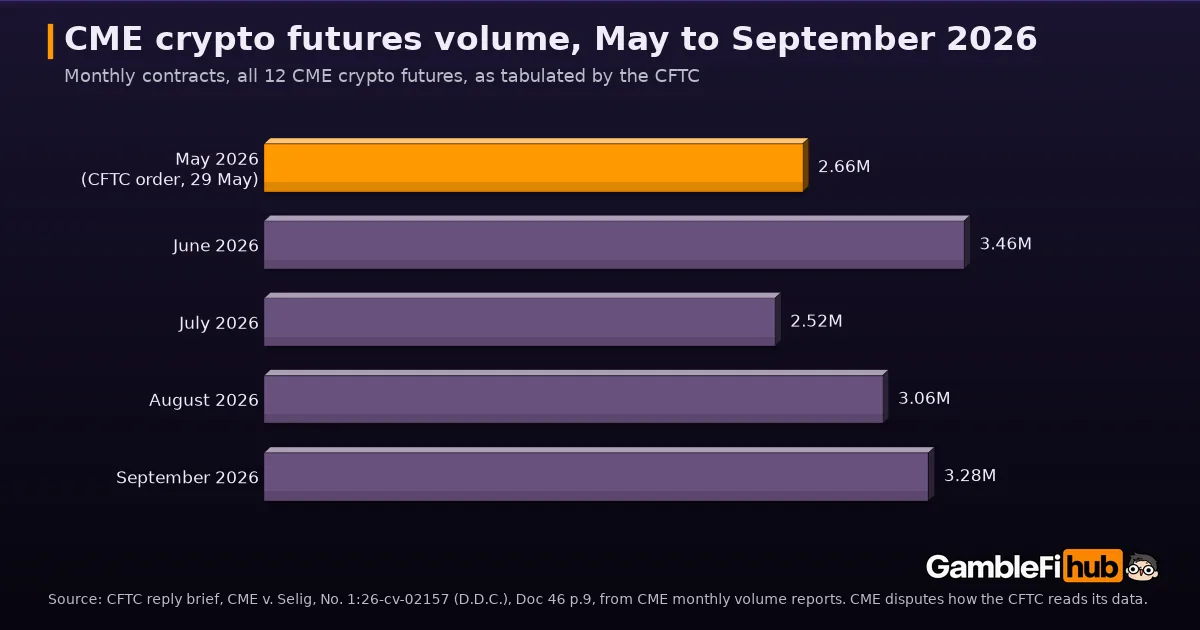
The agency's reply says competition alone is not enough and that a competitor must make a concrete showing of financial injury. Perpetual futures have traded in the US for more than four months, the brief notes, and CME's volumes have gone up, not down. It reprints a table built from CME's monthly volume reports covering all twelve CME crypto futures, shown in the chart above. Only one product, Link futures, traded less in September than in May.
The brief also quotes CME's second-quarter 2026 earnings script. There, CME said that 94% of its volume in the first half of 2026 came from institutional customers, that it had “not heard demand from our customers” for perpetuals, and that its “crypto futures volume is up over 7-fold in the past 3 years, despite the existence of crypto perpetuals.” CME has the technology and contract specifications ready, the CFTC adds, but has chosen not to launch. “CME cannot have it one way with the Court and another way with the investing public on earnings calls,” the agency writes.
CME's opposition, as quoted in the reply, says the volume data “at best paints an incomplete picture, and at worst is intentionally misleading,” and that its standing should be judged as of the day it filed suit. The Hyperliquid Policy Center has filed an amicus brief supporting the CFTC.
What happens next
Judge Colleen Kollar-Kotelly has not ruled on the motion to dismiss. Under her scheduling order, the parties file cross-motions for summary judgment on the merits in November, followed by amicus briefs and oppositions in December. Writing about the brief, CoinDesk quoted TD Cowen analyst Jaret Seiberg, who thinks CME may still have the edge and warns that continued growth in perps during the case “could create complications in trying to unwind this market if the CME prevails.”
Key facts
Case: Chicago Mercantile Exchange Inc. v. Selig, No. 1:26-cv-02157-CKK (D.D.C.), complaint filed 18 Jun 2026.
Challenged action: CFTC order approving Kalshi's BTCPERP contract and a policy statement on self-certifying crypto perpetuals, both 29 May 2026.
Latest filing: CFTC reply in support of its motion to dismiss for lack of standing, Doc 46, 16 Oct 2026.
CME crypto futures volume (CFTC table): 2,660,960 contracts in May 2026; 3,282,530 in September 2026 (+621,570).
Schedule: summary-judgment cross-motions 20 Nov 2026; amicus briefs 4 Dec; oppositions 14 Dec.
Why it matters for GambleFi
Perpetual futures are the regulated, exchange-listed version of the leverage that offshore crypto casinos now sell next to slots, as our report on 1000x leverage in crypto casinos shows; Rollbit is one example. If CME wins, Kalshi's perps and any copies could be pushed into the swap regime. If the CFTC wins on standing, the product stays a future without a ruling on the core question. The same agency is also redrawing the line between event contracts and gambling, covered in our posts on the event-contract swap rule and the casino carve-out now in force. For the basics, see our GambleFi FAQ. This is a news report, not trading advice.