
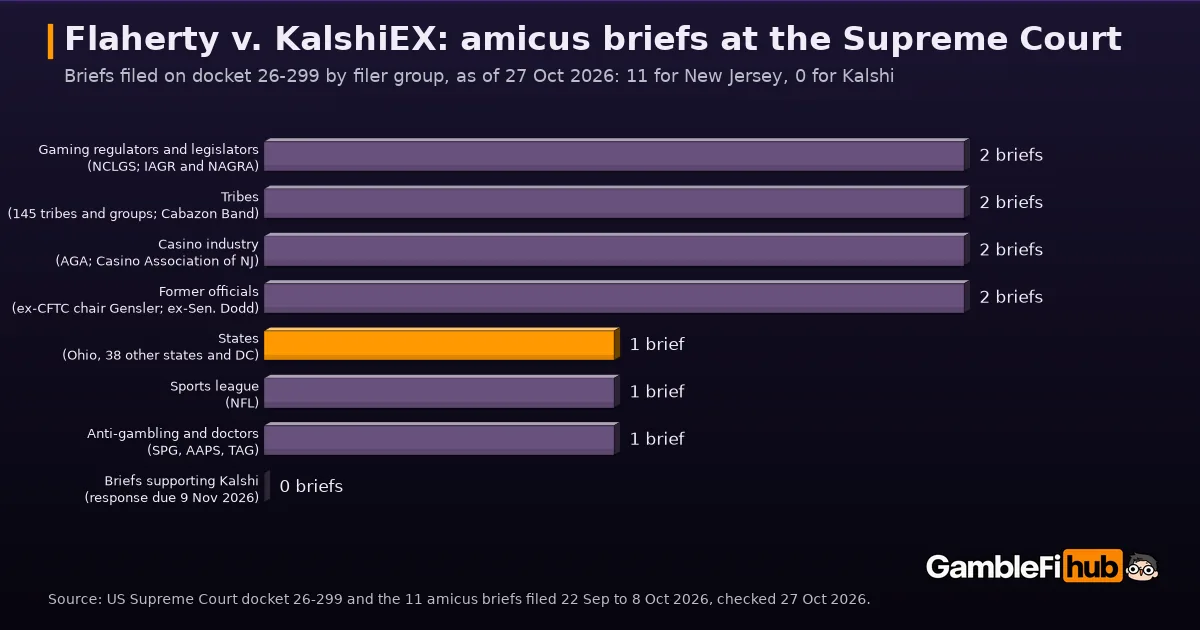
The biggest legal question for US prediction markets is now on the Supreme Court’s desk, and so far only one side has shown up. New Jersey’s petition in Flaherty v. KalshiEX, No. 26-299, has drawn 11 amicus briefs, and all 11 ask the Court to take the case and back the state. Kalshi has until 9 November to file its response, after the Court granted it a month’s extension from 8 October.
The petition, filed on 2 September, asks one question: whether the 2010 Dodd-Frank Act “preempted States from regulating sports bets” offered on markets registered with the CFTC. The Third Circuit said yes, by a 2–1 vote on 6 April 2026, and kept an injunction against New Jersey in place. On 28 August the Ninth Circuit ruled the other way in KalshiEX v. Assad. New Jersey calls that a “direct, acknowledged, and irreconcilable split” and counts more than 20 lower-court decisions, divided 18–4 against the companies.
Who filed, and what they argue
The largest brief comes from Ohio, 38 other states and the District of Columbia. It describes a “regulatory turf war with the CFTC” and says prediction markets cannot strip states of their power over gambling “through relabeling and window-dressing”. Counting New Jersey, 40 states and DC are on the record for the petition. The 10 states not on the brief are Alaska, Florida, Georgia, Indiana, Kentucky, Montana, North Dakota, Tennessee, Texas and Washington.
Two briefs come from people who wrote the law the case turns on. Gary Gensler, CFTC chairman from 2009 to 2014, says “as someone who was there” that Congress “did not transfer jurisdiction over sports betting from the States to the CFTC”. Former Senator Christopher Dodd, who introduced the bill, says Congress “did not set out to authorize nationwide sports betting through derivatives markets”.
The NFL says that on the first Sunday of this season $1.8 billion of $3.3 billion in prediction-market volume, more than half, was tied to its games. The American Gaming Association says the Third Circuit’s reading “has thrown that system into chaos”. A coalition of 130 federally recognised tribes and 15 tribal organisations says tribes spend more than $450 million a year on gaming regulation, and the Cabazon Band says Kalshi offers mobile sports betting on its reservation, where the tribe has made it illegal. The remaining briefs come from gaming legislators (NCLGS), the regulators’ associations IAGR and NAGRA, the Casino Association of New Jersey, and Stop Predatory Gambling with two partner groups.
Key facts
Case: Flaherty v. KalshiEX, LLC, No. 26-299; petition filed 2 Sep 2026, docketed 8 Sep 2026.
Decision under review: Third Circuit, 6 Apr 2026, 2–1 for Kalshi (172 F.4th 220). Opposite ruling: Ninth Circuit, KalshiEX v. Assad, 28 Aug 2026.
Amicus briefs: 11, filed 22 Sep to 8 Oct 2026, all supporting New Jersey; none for Kalshi yet.
Next date: Kalshi’s response due 9 Nov 2026 (extended from 8 Oct).
Counsel of record: Sundeep Iyer (New Jersey Attorney General’s office); Neal Katyal (Milbank) for Kalshi.
Why it matters for GambleFi
If the Court takes the case, its answer decides whether a CFTC licence is enough to offer sports contracts nationwide, or whether exchanges need state approval like any sportsbook. That covers Kalshi, Polymarket’s US exchange and every venue that hopes to follow them. Until then the fights stay state by state: Utah has sued Kalshi and Susquehanna, Polymarket US is suing Ohio, and on 23 October Kalshi filed a pre-emptive suit against Louisiana. Leagues are hedging too; the NBA just signed with the CFTC while the NFL backs the states. Onchain sports exchanges behind iGaming tokens (GambleFi tokens), such as SX Bet, sit outside both systems. Background: the CFTC’s event contract swap rule and the GambleFi FAQ. This is a news report, not legal, financial or gambling advice.