
Polymarket US has sued Ohio’s attorney general and the members of the Ohio Casino Control Commission in federal court, two weeks after the regulator told it to stop offering sports event contracts in the state. The complaint in QCX LLC v. Wilson (S.D. Ohio, No. 2:26-cv-01502) was filed on 16 October 2026, the day the letter’s deadline ran out. It argues that Ohio’s sports-gaming licence rules discriminate against out-of-state businesses and are preempted by the Commodity Exchange Act.
What Ohio demanded
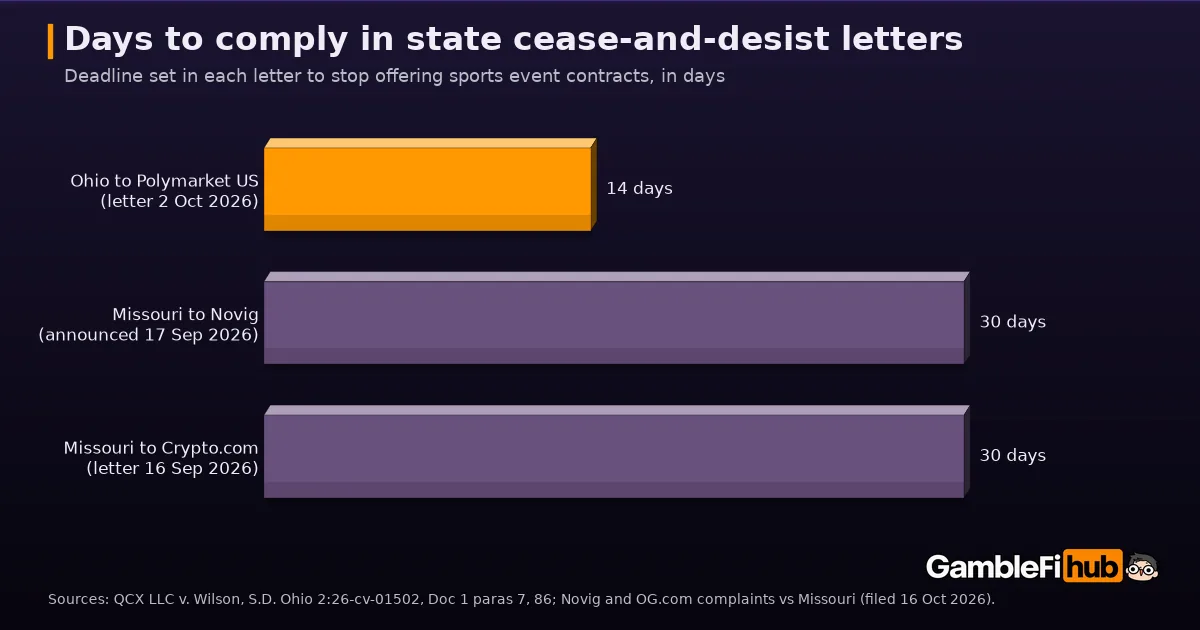
According to the complaint, the Commission’s letter of 2 October demanded that Polymarket US “immediately cease and desist from offering” sports event contracts to people in Ohio “without a license issued by the Commission”, and confirm compliance in writing within 14 days. The letter says “Polymarket is operating online sports gaming” and is “clearly engaged in bookmaking or facilitating bookmaking in violation of Ohio civil and criminal law”.
It warns of administrative, civil, nuisance or criminal actions, and of a civil penalty equal to the money Polymarket “unlawfully obtained or retained” from people in Ohio. The complaint says the Commission sent the same letter to “Polymarket US and nine other businesses”, and that it cited the Sixth Circuit’s 25 September ruling in Kalshi’s case against Ohio.
The Commerce Clause argument
The new element is the attack on how Ohio hands out licences. The complaint says type A online sports-gaming licences go only to applicants with an operational place of business or a sports-gaming facility in Ohio, with preference for casinos, racinos and professional sports organisations. The Commission may license no more than 25 such proprietors unless the market “needs” more, and other operators can only run online books on a proprietor’s behalf.
The servers that accept wagers must sit in Ohio, and licensees may take bets only from people physically in the state. Polymarket US calls these rules “protectionist” and says it could not get a licence even if it tried. It also points to a 2025 Commission letter warning licensees that partnering with prediction markets could put their own licences at risk.
The preemption argument
The second count is the one other exchanges have run: Polymarket US is a CFTC-designated contract market, and Congress gave the CFTC exclusive jurisdiction over swaps traded on such markets. The complaint says the Sixth Circuit decided Kalshi’s case “against a different legal landscape”, before the CFTC’s 9 October interim final rule and proposed rule on event contracts as swaps. It notes that the Kalshi ruling is still open to rehearing and certiorari. Polymarket US asks for a declaratory judgment and preliminary and permanent injunctions.
Key facts
Case: QCX LLC, d/b/a Polymarket US v. Wilson et al., No. 2:26-cv-01502 (S.D. Ohio, Eastern Division), filed 16 Oct 2026.
Defendants: Ohio Attorney General Andy Wilson, the Commission’s interim executive director and its seven commissioners, in their official capacities.
Counts: Commerce Clause; preemption under the Commodity Exchange Act.
Relief sought: declaratory judgment, preliminary and permanent injunctions, fees and costs.
Docket: summons and notices of appearance entered 19 Oct 2026; no ruling as of 21 Oct.
Why it matters for GambleFi
Ohio’s letter set a 14-day clock, against the 30 days Missouri gave Novig and Crypto.com, and all three exchanges answered in federal court on the same day. If the Commerce Clause claim works, it would hit the in-state licensing model itself, not just its application to event contracts. Our earlier reports cover Novig’s suit against Missouri, Crypto.com’s OG exchange, Utah’s case against Kalshi and the CFTC’s event-contract swap rule. Offshore on-chain books such as SX Bet sit outside this fight, and the GambleFi FAQ covers the basics. This is a report on a court filing, not legal or betting advice.