
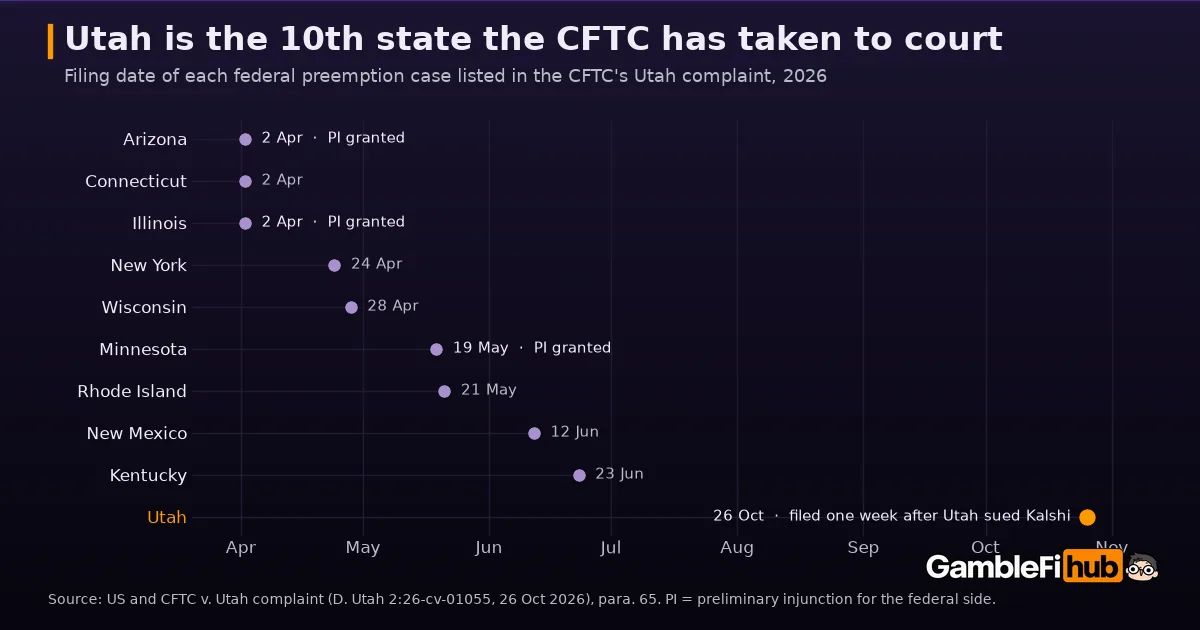
The Commodity Futures Trading Commission and the United States sued the State of Utah and its Attorney General Derek Brown in federal court on 26 October 2026. The 33-page complaint, filed in the US District Court for the District of Utah (case 2:26-cv-01055), asks the court to block Utah’s state-court gambling case against Kalshi and to bar any further state investigations of CFTC-regulated exchanges. The CFTC announced the suit a day later.
Utah filed its own case only six days earlier. As we reported, Brown sued Kalshi and the trading firm Susquehanna on 20 October in the Third Judicial District Court for Salt Lake County (Brown v. Kalshi, No. 260908356). The federal complaint is aimed directly at that case.
What the CFTC is asking for
The complaint asks for two things. First, a declaration that Utah’s gambling laws are preempted and invalid “as applied to transactions listed, offered, or executed on CFTC-regulated DCMs”, meaning designated contract markets such as Kalshi. Second, a preliminary and permanent injunction that stops Utah from investigating CFTC-regulated entities “and their affiliates and partners” or enforcing state law against those transactions. That wording would cover Susquehanna, which Utah sued as a market maker on Kalshi, and it reaches future investigations as well as the pending case.
The laws named are Utah’s gambling chapter (Utah Code §§ 76-9-1401 to -1408), its ban on election wagers (§ 20A-1-606) and the public nuisance claim the state brought under § 78B-6a-102(2). The CFTC argues all three kinds of preemption: express, because the Commodity Exchange Act gives it “exclusive jurisdiction” over swaps traded on a DCM; field, because Congress built a complete federal scheme; and conflict, because CFTC rules require exchanges to give “impartial access” to eligible users nationwide, which Utah would force them to break by shutting out its residents. If every state could act alone, the complaint says, exchanges “would face the prospect of 50 regulators”.
“Utah seeks to shut down prediction markets across a wide variety of markets,” CFTC Chairman Michael Selig said in the release. The complaint is signed for the Justice Department’s Civil Division and for the CFTC’s General Counsel, Tyler Badgley.
Ten states, three injunctions so far
The complaint lists nine earlier preemption cases. Arizona, Connecticut and Illinois were filed on 2 April 2026, New York on 24 April, Wisconsin on 28 April, Minnesota on 19 May, Rhode Island on 21 May, New Mexico on 12 June and Kentucky on 23 June. In Rhode Island the case cited is one Kalshi brought itself (KalshiEX v. Furcolo). The CFTC says preliminary injunctions for the federal side have been entered in Arizona, Illinois and Minnesota, and the Wisconsin case is now on appeal at the Seventh Circuit. The release adds that the agency has also filed briefs in four federal courts of appeal and one state supreme court.
Utah is the first new state on that list since Kentucky in June. The complaint also leans on the CFTC’s interim rule published on 19 October, which keeps state-licensed casino and sportsbook wagers outside the definition of a swap, and on its integrity deals with the NBA, MLB and NHL as proof that the agency already polices these markets.
Key facts
Case: United States and CFTC v. State of Utah and Derek Brown, D. Utah, No. 2:26-cv-01055, filed 26 Oct 2026.
Target: Brown v. Kalshi, No. 260908356 (Utah 3rd District Court, Salt Lake County), filed 20 Oct 2026 against five Kalshi entities and two Susquehanna entities.
Relief sought: declaration of preemption; preliminary and permanent injunction against Utah investigations and enforcement.
CFTC preemption cases: 10 states incl. Utah; preliminary injunctions in Arizona, Illinois and Minnesota.
Other filings (per CFTC): briefs in 4 federal courts of appeal and 1 state supreme court.
Sources: CFTC press release 9315-26 (27 Oct 2026); complaint dated 26 Oct 2026.
Why it matters for GambleFi
Utah’s case is a broad test of the CFTC’s view that event contracts on a registered exchange are swaps, not bets: according to the federal complaint, the state wants to stop Kalshi’s election, politics, culture and mentions contracts as well as sports. No court has ruled on the new suit yet, and the state case against Kalshi stays open until one does. The same question is waiting at the Supreme Court, where New Jersey has asked the justices to take up its Kalshi case and 11 amicus briefs back the state; Kalshi’s response is due on 9 November. For how prediction markets differ from onchain casinos and iGaming tokens, see the GambleFi FAQ.