
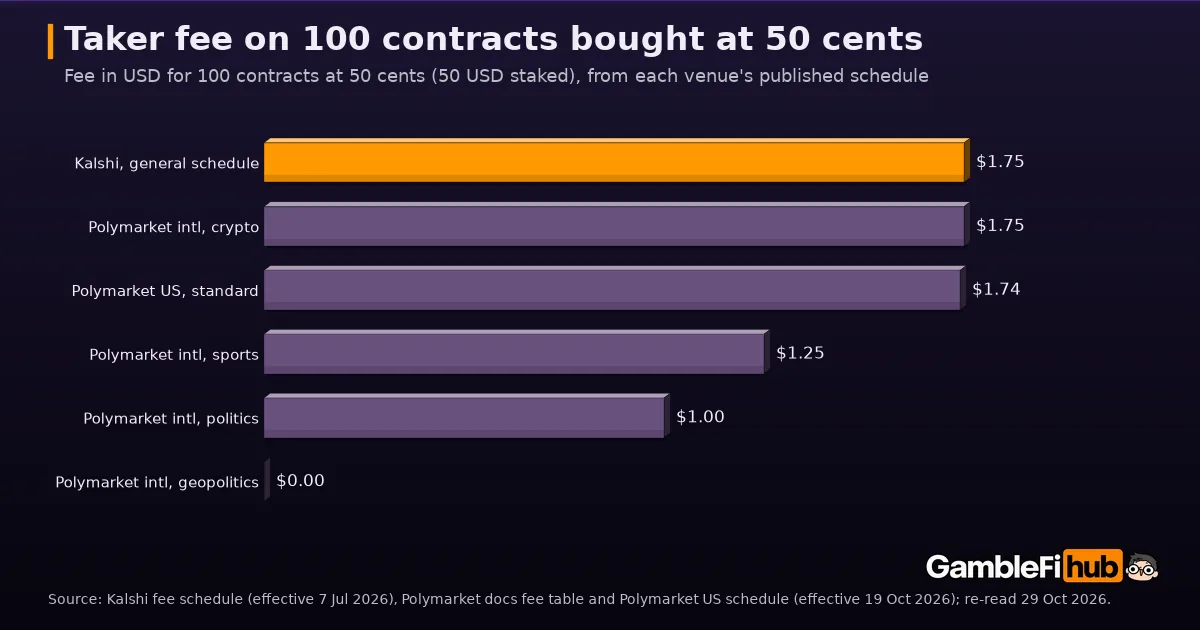
We read the published fee schedules of Kalshi and Polymarket on 29 October 2026 and worked out what a taker pays. At a price of 50 cents, 100 contracts cost $1.75 in fees on Kalshi’s general schedule and on Polymarket’s international crypto markets, $1.74 on Polymarket US, $1.25 on international sports, $1.00 on international politics and finance, and nothing on geopolitics, which Polymarket lists as fee-free. All three schedules use the same shape, fee = rate × contracts × price × (1 − price), so the fee is highest at 50 cents and falls toward zero at 1 cent and 99 cents.
The rates
Kalshi’s fee schedule, last updated 7 July 2026, sets a general taker rate of 0.07, rounded up to the next hundredth of a cent, with a maker rate of 0.0175 on markets where maker fees apply; ten series in its table carry a multiplier of 0, among them year-end Bitcoin and Ether price ranges and a gambling-repeal market. Polymarket’s international fee table sets rates by category: 0.07 for crypto, 0.05 for sports, economics, culture and weather, 0.04 for politics, finance, mentions and tech, 0 for geopolitics and 0.05 for combos. Polymarket US, whose schedule took effect on 19 October 2026, uses a coefficient of 0.0695 (0.10 for table tennis) and a separate, steeper curve for combos, which it raised at 10 pm ET on 28 October 2026: a 100-contract combo at 50 cents now costs about $2.00 in taker fees, up from $1.92.
Cheap contracts cost more, as a share of the stake
Because the formula uses price × (1 − price), the fee as a share of money staked is rate × (1 − price). A taker buying at 10 cents pays 6.3% of the stake at Kalshi’s 0.07 rate, 3.5% at 50 cents and 0.7% at 90 cents. Measured against the most the contract can still pay, the picture reverses: at 90 cents the fee of 0.63 cents is 6.3% of the 10 cents of possible gain. At Polymarket’s 0.04 politics rate the same trades cost 3.6%, 2.0% and 0.4% of stake.
Makers and rebates
Makers who leave resting orders pay no fee on Polymarket’s international site and receive a rebate of 15% to 25% of the fees collected in a category (none on combos). On Polymarket US, maker rebates run from 0.0035 to 0.0104 of the same price curve, roughly 5% to 15% of the taker fee, depending on prior-month maker volume, and takers can earn back 3% to 30% of fees paid by monthly volume. Kalshi charges no fee on resting orders unless a market carries a maker fee, as its schedule states.
Key facts
Sources: Kalshi fee schedule PDF (kalshi.com/docs/kalshi-fee-schedule.pdf, effective 7 July 2026); Polymarket documentation, Trading > Fees (international) and Trading > Fee Schedule (Polymarket US, effective 1:00 PM ET, 19 October 2026); all re-read 29 October 2026.
Fee per 100 contracts at 50 cents: Kalshi $1.75; Polymarket crypto $1.75; Polymarket US $1.74; sports $1.25; politics, finance, mentions, tech $1.00; economics, culture, weather $1.25; geopolitics $0.
Polymarket US combos: fee = C × p × [0.0695 × (1 − p) + 0.085 × (1 − p)4] since 28 October 2026 (was 0.06), about $2.00 per 100 at 50 cents.
Fee at 10 cents (100 contracts): $0.63 at 0.07 and 0.0695, $0.45 at 0.05 and $0.36 at 0.04.
Calculation: our own arithmetic from the published formulas, checked against the fee tables on the venues’ pages.
Not covered: perpetual-futures fees, deposit and withdrawal fees, spreads and slippage, and fee changes for specific events.
How to read it
A fee schedule is only part of what a trade costs: the gap between bid and ask and the depth of the book can matter as much, and this post does not compare them. Each venue can also change rates for single markets or events, so the figures here are the standard published rates, not a quote for a particular contract.
Why it matters for GambleFi
Fees are one of the few costs a prediction market publishes up front, much as a crypto casino publishes its house edge, which our game mechanics guide explains for iGaming tokens and GambleFi games. For where Kalshi and Polymarket volume actually sits, see our category split and the venue count, and for more figures the statistics page. This is a data report, not investment advice.