
ST. LOUIS — Kalshi has sued Missouri’s attorney general and the Missouri Gaming Commission in federal court, three days before the extended deadline in the state’s cease-and-desist letter runs out. The complaint in KalshiEX LLC v. Hanaway was filed in the Eastern District of Missouri on 27 October 2026. It names Attorney General Catherine Hanaway, the Commission, its executive director Michael A. Leara and all five commissioners, each in their official capacity.
Kalshi asks the court to declare that Missouri’s gambling and sports wagering laws are preempted as applied to its exchange, and for a temporary restraining order, a preliminary injunction and a permanent injunction against enforcing them. The complaint makes one claim, under the Supremacy Clause. No ruling had been reported by 28 October.
Why Kalshi filed now
The attorney general’s letter of 16 September gave Kalshi 30 days to stop offering sports event contracts to Missourians, or to get a Commission licence, pay state taxes and fees and shut out anyone under 21. According to the complaint, the office extended the deadline on 15 October to 30 October. On 27 October, Kalshi says, Missouri’s Solicitor General told the company the state could not agree to hold off enforcement, and Kalshi sued the same day.
Kalshi says the licence route does not exist for it. Missouri allows only two direct mobile sports wagering licences, and both have gone to Circa Sports and DraftKings, approved by the Commission on 29 April 2026. The other licences are reserved for casino operators, pro sports teams and their partners. The complaint also lists what is at stake: Missouri law allows administrative fines of $50,000 per violation, or $100,000 for violations from the same set of events, and promoting gambling in the first degree is a Class E felony.
Third exchange to sue, and a split in the courts
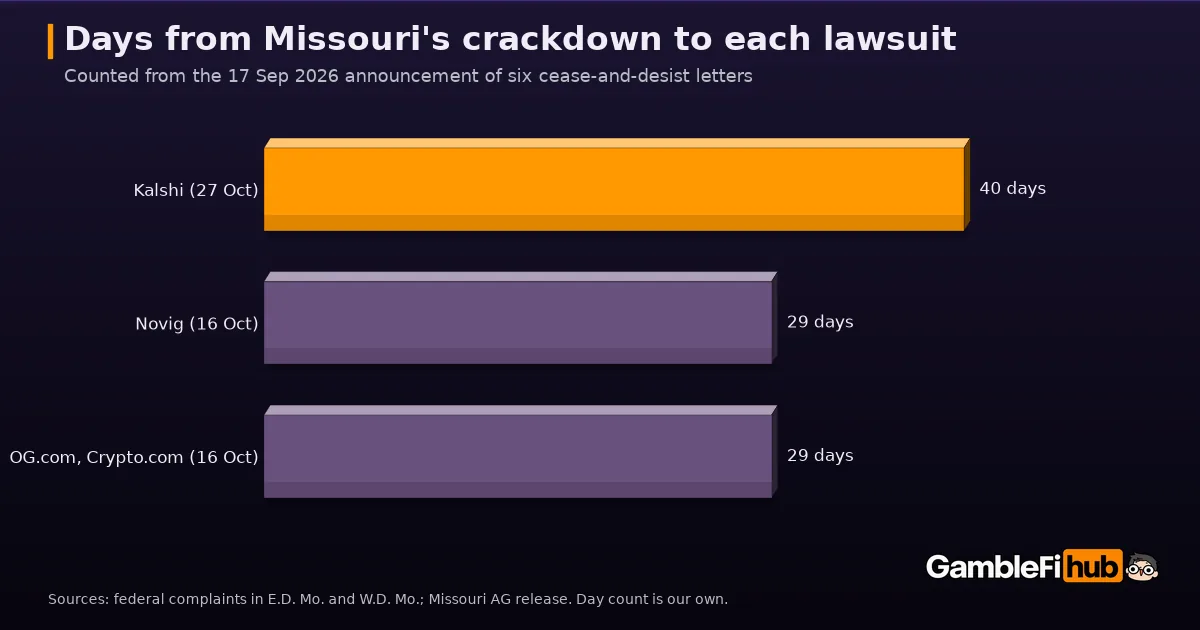
Missouri announced letters to six companies on 17 September: Polymarket, Kalshi, Crypto.com, Novig, Underdog and Robinhood. Novig and Crypto.com’s exchange OG.com both sued on 16 October, as we reported in Novig’s case and OG.com’s case. Kalshi waited 11 days longer, under its extension (see chart).
The complaint relies on the Third Circuit, which upheld Kalshi’s injunction against New Jersey. It also concedes the other side: the Sixth Circuit held on 25 September that Kalshi’s contracts are not swaps and that federal law does not preempt Ohio or Tennessee gambling rules, and the Ninth Circuit found Kalshi’s sports contracts likely are not swaps either. Hanaway signed an amicus brief on 7 October asking the Supreme Court to take up the New Jersey case (our report on the briefs). Kalshi also points to the CFTC’s October rules on the swap definition (explained here) and to the regulator’s own suits against ten states, most recently Utah.
Key facts
Case: KalshiEX LLC v. Hanaway et al., E.D. Mo. No. 4:26-cv-01860, filed 27 October 2026.
Relief sought: declaratory judgment; temporary restraining order, preliminary and permanent injunction.
Deadline: 16 October, extended to 30 October 2026.
Penalties cited: $50,000 per violation, $100,000 for violations from the same events; Class E felony for promoting gambling.
Other Missouri suits: Novig (E.D. Mo. 4:26-cv-01780) and OG.com (W.D. Mo. 4:26-cv-00969), both 16 October 2026.
Sources: Kalshi’s complaint (27 Oct 2026); Missouri Attorney General letter to KalshiEX LLC (16 Sep 2026). The account of the extension and the Solicitor General’s call is Kalshi’s.
Why it matters for GambleFi
The fight is about whether CFTC-regulated exchanges answer to state gambling law at all. Offshore crypto casinos and iGaming token platforms (GambleFi) have no such federal shield, so a state that wins here gains a tested route to treat any unlicensed sports product as illegal wagering. Missouri’s age rule matters too: Kalshi lets 18-year-olds trade, and its new $2,500 deposit cap for under-21s does not close that gap. For how GambleFi platforms differ from prediction markets, see the GambleFi FAQ. This is a report on court filings, not legal or betting advice.