
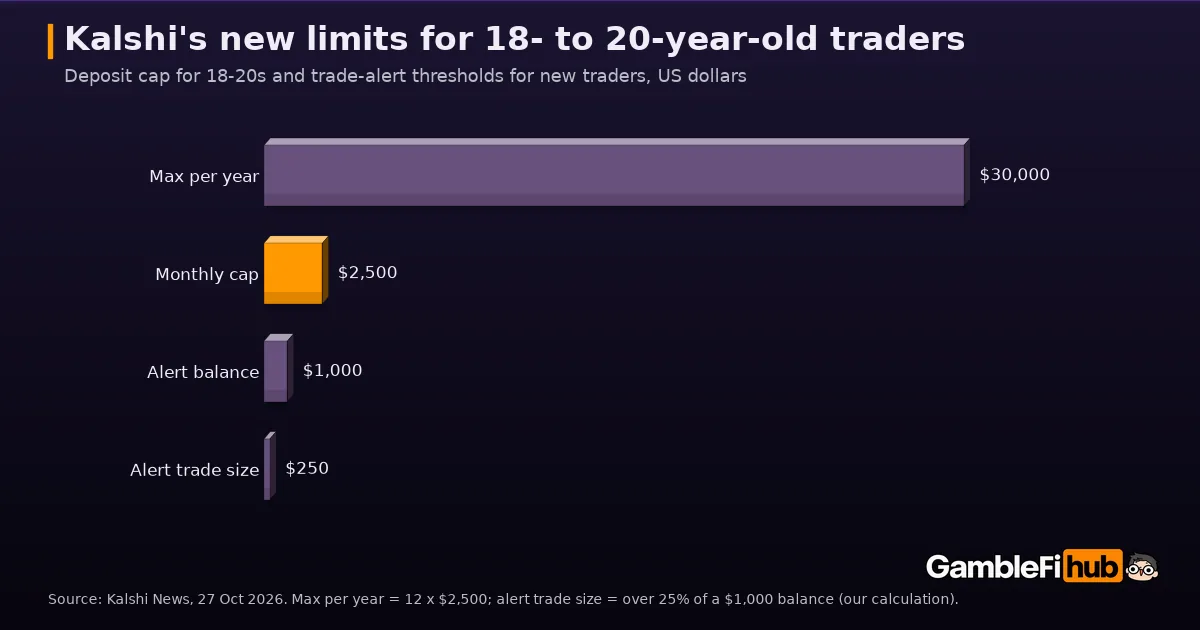
Kalshi will put every account belonging to an 18- to 20-year-old on a default deposit limit of $2,500 a month, the exchange said in a company post on 27 October 2026. The change is rolling out “in the coming days” and comes with a second tool: new traders with a balance above $1,000 will see an alert when they put more than a quarter of it into a single trade.
Kalshi frames the step as an extension of existing safeguards. Young adult accounts are moved automatically into what the company calls special accounts, with responsible trading education built in. Traders under 18 are rejected at the identity check, as before.
What changes, in numbers
At the cap, an 18- to 20-year-old can add at most $30,000 to a Kalshi account in a year (our calculation, 12 times $2,500). The trade alert fires at the $1,000 balance mark for any single position above $250 (see chart). Kalshi calls the deposit cap a default. The post does not say whether a young trader can raise it, how losses are counted, or how many accounts it covers. Kalshi does not publish an age split of its users.
The other measures are softer. Kalshi says it watches for risky patterns and escalates from sending education material to blocking trades. After the first trade, 18- to 20-year-olds are shown time and money limit tools and offered confidential mental health support via Birches Health. Parents or other relatives can get live alerts on how much and how often a young adult trades through a feature called Inner Circle. Kalshi also named two partners, Parent ProTech and ConnectSafely, which will publish parents’ guides to prediction markets, and it now shows an ID check tool on its homepage so adults can confirm no one is trading under their identity.
The age gap is part of the legal fight
Age is one of the clearest gaps between prediction markets and licensed sportsbooks. Kalshi is regulated by the CFTC and, in the words of co-founder Luana Lopes Lara, is open only to traders 18 and older “like the stock exchange”. State-licensed sportsbooks in Missouri, by contrast, must keep out anyone under 21. Missouri spelled out the conflict in the cease-and-desist letter Attorney General Catherine Hanaway sent Kalshi on 16 September. It says Kalshi’s member agreement lets anyone at the “age of majority” in their state trade, which in Missouri is 18, while state rules give licensed sportsbooks an “affirmative duty” to stop anyone under 21 from placing a wager. The letter told Kalshi to stop or get licensed, pay state taxes and shut out under-21s. Local outlet MOScout reported on 28 October that Kalshi has now sued Hanaway in federal court; we have not seen that complaint.
A $2,500 cap does not close that gap: an 18-year-old in Missouri can still trade sports contracts on Kalshi but could not bet at a licensed Missouri sportsbook. What it does is give Kalshi a concrete answer when states and lawmakers argue that the product harms young people. That argument now runs through several courts at once, including Utah, where the state sued Kalshi on 20 October and the CFTC sued the state back (federal complaint), as we covered in Utah’s suit and the CFTC’s response. In Congress, three Democrats asked Kalshi and Polymarket about VIP perks, with answers due on 5 November (our report).
Key facts
Deposit limit: default $2,500 per month for every account held by an 18- to 20-year-old.
Trade alert: new traders with a balance over $1,000 who put more than 25% of it into one trade.
Minimum age on Kalshi: 18, enforced by identity verification.
Partners: Parent ProTech and ConnectSafely (parents’ guides); Birches Health (mental health support).
Announced: 27 October 2026; rolling out in the following days.
Sources: Kalshi News (27 Oct 2026); Missouri Attorney General cease-and-desist letter to KalshiEX LLC (16 Sep 2026); MOScout (28 Oct 2026, secondary).
Why it matters for GambleFi
Onchain casinos and iGaming token platforms (GambleFi) answer to offshore licences, not to US state age rules. A CFTC-regulated exchange now applies a hard default for young adults while it argues in court that states cannot regulate it at all. If federal regulators or courts start to treat such limits as the norm, the gap in player protection between regulated prediction markets and crypto casinos becomes easier to see. For how GambleFi platforms differ from prediction markets, see the GambleFi FAQ.