
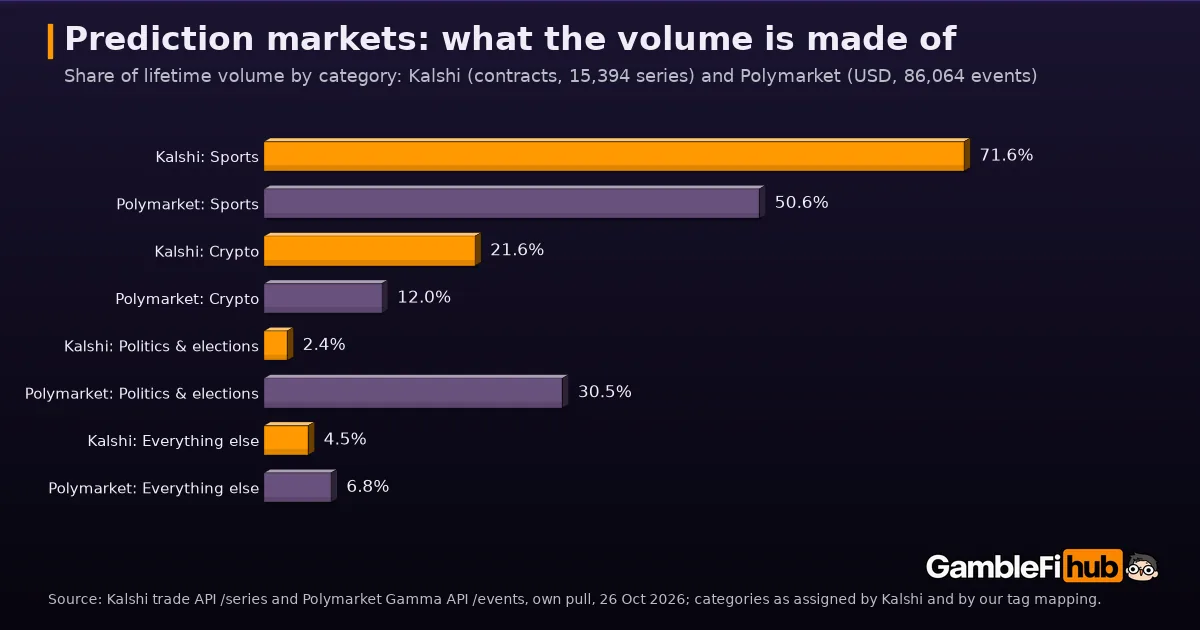
Sports are 71.6% of all contracts ever traded on Kalshi and 50.6% of the lifetime volume of Polymarket, according to our pull of both public APIs on 26 October 2026. Crypto is the second-largest block on Kalshi (21.6%) and politics and elections are the second-largest on Polymarket (30.5%). On Kalshi, politics and elections together are 2.4%. One single Kalshi series, the 15-minute “Bitcoin price up or down” contracts, accounts for 14.3% of everything ever traded there. We counted what trades, not who trades it or how much money is at risk.
Kalshi: 15 series carry 61%
The Kalshi API lists 15,394 series, 11,904 of them with volume, adding up to 198.0 billion contracts. Sports are 141.7 billion (71.6%), crypto 42.7 billion (21.6%), elections 3.3 billion (1.7%), commodities 2.4 billion (1.2%) and politics 1.3 billion (0.7%). After 15-minute Bitcoin (28.3 billion contracts, 14.3%) come NBA games (12.1 billion), MLB games (10.8 billion), the daily Bitcoin above/below series (8.8 billion), NFL games (8.3 billion) and ATP tennis matches (7.8 billion). The 15 largest series together are 60.9% of all volume. Our weekly look at the crypto contracts covers that series in dollars.
Polymarket: politics still 30%
We pulled 86,064 Polymarket events with at least about $96,000 of lifetime volume and sorted each into a category from its tags, in a fixed order: sports (including esports), crypto, politics and elections, then world, economy, culture and science. Sports are 50.6%, politics and elections 30.5% (events tagged US presidential election alone are 9.1% of all Polymarket volume), crypto 12.0% and everything else 6.8%. Over the last 30 days the mix is different: sports 41.5%, politics and elections 28.7% and crypto 21.4%, so crypto’s share of recent volume is well above its lifetime share.
Key facts
Source: Kalshi trade API /series?include_volume=true (volume_fp, lifetime contracts, category as assigned by Kalshi) and Polymarket Gamma API /events (lifetime volume and volume1mo in USD, tags), both pulled on 26 October 2026.
Kalshi (198.0 billion contracts): sports 71.6%, crypto 21.6%, politics and elections 2.4%, everything else 4.5%; largest series KXBTC15M 14.3%; top 15 series 60.9%.
Polymarket (86,064 events): sports 50.6%, politics and elections 30.5%, crypto 12.0%, everything else 6.8%; 30-day mix sports 41.5%, politics and elections 28.7%, crypto 21.4%.
Units differ: Kalshi volume is in contracts, which each pay $1 if they resolve in the holder’s favour, and Polymarket volume is in US dollars, so the two columns compare mix, not size. Polymarket’s event volume field also does not reconcile with DefiLlama’s venue totals, so we publish no dollar total.
Not covered: events below about $96,000 on Polymarket, Polymarket US as a separate venue, and the share of volume that is market-making or wash trading, which neither API shows.
How to read it
Because contracts are counted rather than dollars, categories whose contracts trade at very low or very high prices count for more or less than they would in dollars, and our Polymarket categories depend on tags we did not assign, so a few percentage points either way would not change the picture. The picture is that volume on both venues comes mostly from sports and, on Kalshi, from short-term crypto contracts, not from election forecasting. That matters for regulators, who treat sports event contracts and election contracts differently, as in our posts on the thin midterm markets and on Polymarket’s two venues.
Why it matters for GambleFi
The iGaming token (GambleFi) sector is built on casino and sports betting revenue, and prediction markets now draw the same sports and short-term crypto activity onto regulated exchanges and on-chain venues. Where that volume sits is one measure of how much competition the sector faces. See also our statistics page and the FAQ. This is a data report, not betting or trading advice.