
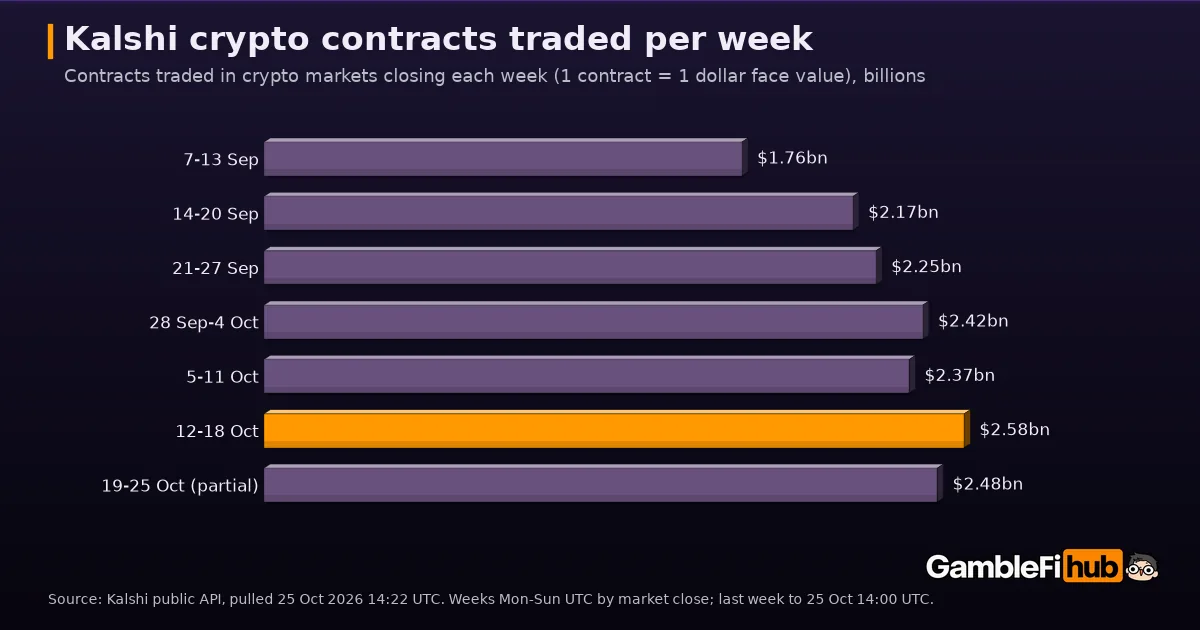
Kalshi’s crypto markets traded about $2.58bn of contracts in the week of 12–18 October 2026, and about 90% of that was in 15-minute markets, according to our sum of the exchange’s public market data. It fits reports of a record $2.7bn week of crypto prediction-market volume across Kalshi and Polymarket, published on 24 October by Crypto Briefing and Bitcoin.com News. Neither article names the exact week or shows its working, so we rebuilt the Kalshi side ourselves.
What we counted
We pulled every market in Kalshi’s Crypto category (278 series, 48 of them with markets closing in the window) that closed between 7 September and 25 October 2026 and added up the contracts traded in each, grouped by the Monday-to-Sunday (UTC) week in which the market closed. Each contract pays $1 if it settles in the buyer’s favour, so contracts traded equal face value, which is the “weekly notional volume” the press reports use. A 15-minute market closes within a quarter of an hour of opening, so the week it closes in is also the week it traded.
Fifteen-minute Bitcoin does most of the work
In the week of 12–18 October, Kalshi’s 15-minute series traded $2.33bn of the $2.58bn. The Bitcoin 15-minute market alone traded $1.97bn, 77% of the total, and all Bitcoin series together $2.21bn, about 86%. That matches Crypto Briefing’s line that Kalshi’s Bitcoin contracts “alone generated over $2 billion in a single week”. The next biggest 15-minute series were Ethereum ($135m), XRP ($60m) and Solana ($56m). The largest single 15-minute Bitcoin market that week traded 6.1 million contracts.
The 15-minute share has crept up: 85.1% in the week of 7–13 September, 90.3% in 12–18 October and 90.5% so far in 19–25 October. Bitcoin.com News reports that 86% of Kalshi’s $8.17bn September crypto volume came from 15-minute markets, in line with our weekly figures for September (85% to 88%). The 15-minute markets are a tiny part of the listings: of roughly 420,000 crypto markets that closed in the week of 12–18 October, 9,296 were 15-minute markets. Almost all the rest were hourly price-range and above/below strikes, which together traded $250m.
Does it add up to $2.7bn?
Kalshi’s crypto total for 12–18 October is $2.58bn, about $0.12bn short of the $2.7bn combined figure. Crypto Briefing says Polymarket’s US arm reported roughly $92m to $101m of 15-minute Bitcoin volume in its first full week, which would leave room for it, but the articles do not say which week the record covers, so this is a consistency check and not a reconciliation. Polymarket’s own crypto volume is not in our numbers. The current week, 19–25 October, stood at $2.48bn by Sunday afternoon (UTC) with the last hours still to close, so 12–18 October is still the highest complete week in our data.
Key facts
Source: Kalshi public API (markets endpoint), all series in the Crypto category, pulled 25 October 2026 at 14:22 UTC.
Contracts traded by closing week: 7–13 Sep $1.76bn; 14–20 Sep $2.17bn; 21–27 Sep $2.25bn; 28 Sep–4 Oct $2.42bn; 5–11 Oct $2.37bn; 12–18 Oct $2.58bn; 19–25 Oct $2.48bn (partial, to 25 Oct 14:00 UTC).
15-minute share: 85.1% (7–13 Sep) to 90.3% (12–18 Oct).
Bitcoin series, 12–18 Oct: $2.21bn, of which the 15-minute market $1.97bn.
Limits: only markets that had closed by the pull are counted; crypto markets filed under other Kalshi categories are not; face value is not money staked.
What face value does not tell you
Face value overstates the cash involved. A contract bought at 40 cents puts 40 cents at risk, so the dollars actually staked in a week are lower than the figure above. The data also say nothing about how many traders there are, how much any of them win or lose, or how much of the volume is one party trading back and forth. They show where the activity sits, and it sits in one product.
Why it matters for GambleFi
Short-dated crypto price bets are one of the fastest-growing products on regulated venues, with Phantom now routing US users to Kalshi and Polymarket’s US exchange outtrading its onchain venue. None of the iGaming tokens we track is a claim on Kalshi’s fees: an iGaming token (also called a GambleFi token) draws its burns, staking rewards or revenue share from a casino or sportsbook, as explained in our game mechanics guide. It does show where crypto-native betting turnover is going, a useful yardstick next to the token data on our statistics page. This is a data report, not betting or investment advice.