
Phantom, the self-custody crypto wallet best known on Solana, began rolling out prediction markets to users in the United States on 23 October 2026, with access expanding over the following weeks. The markets come from Kalshi, a CFTC-registered exchange, and are traded inside the Phantom app, the company’s General Counsel Kevin Jacobs wrote on Phantom’s blog. It is Phantom’s first US integration with Kalshi.
The regulatory route
Phantom is not registered with the CFTC. In March, CFTC staff issued Staff Letter 26-09, a no-action letter saying Phantom would not need to register as an introducing broker to give users access to regulated markets, subject to conditions. Phantom says it was the first passive software provider to receive that relief, and that the CFTC extended the same relief to similar software providers industry-wide in September. Under the arrangement, Kalshi approves and holds the trading accounts and executes the trades; Phantom supplies the interface, the identity-verification flow and the movement of funds, according to its help centre.
How it works
Users must verify their identity before the first trade. They can pay from their Phantom Cash balance or with any Solana token; Cash-funded trades are gasless, while token-funded trades need a little SOL for network fees. The prediction fee is $0.02 per contract: $0.01 for Phantom and $0.01 for Kalshi’s exchange fee, plus a variable network fee for moving funds to Kalshi. Winnings and cash-outs return to the user’s Cash account through Stripe. Positions show up as Solana SPL “outcome tokens”, which Phantom says can only be cashed out or claimed through its app. Phantom’s disclosures add that Kalshi shares part of its exchange fees with Phantom, that Phantom has agreed to give Kalshi’s markets prominent placement for a period after launch, and that Phantom does not act as house or market maker.
State limits
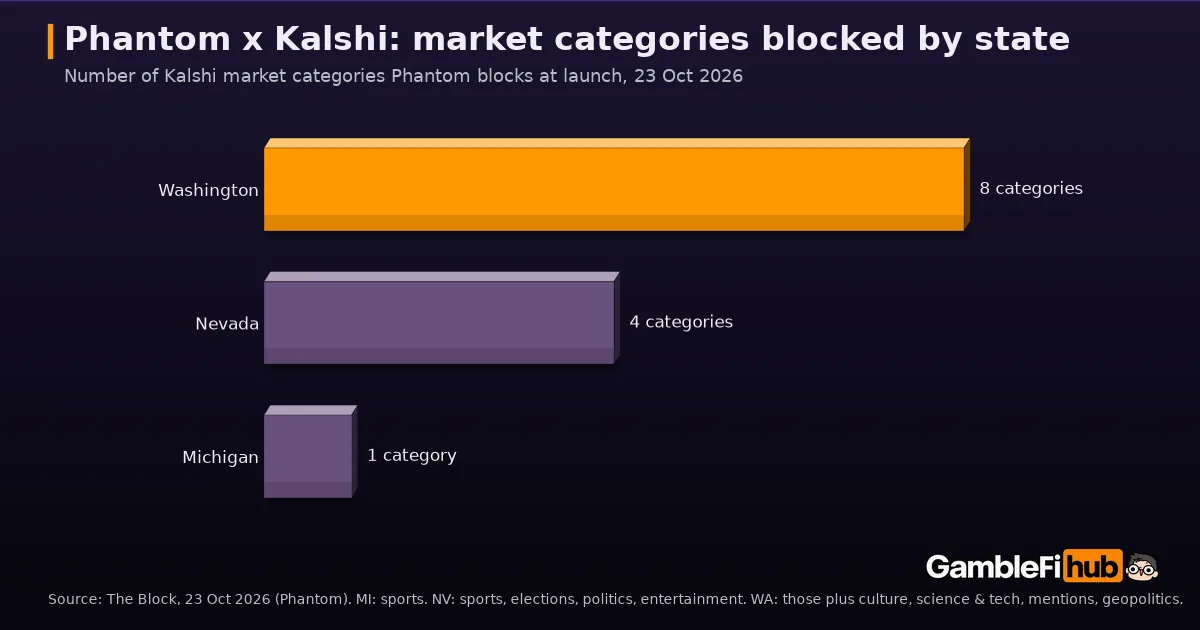
Kalshi is fighting several US states over whether its markets are gambling. According to The Block, Phantom will block sports markets in Michigan; sports, elections, politics and entertainment in Nevada; and those four plus culture, science and tech, mentions and geopolitics in Washington. The Block reports that those limits could change as the court cases develop. Phantom told the outlet it was “confident and comfortable” with the launch despite the state lawsuits.
Key facts
Launch: rollout from 23 Oct 2026, US users, Phantom mobile app.
Exchange: KalshiEX LLC (CFTC-registered DCM), clearing via Kalshi Klear LLC.
Legal basis: CFTC Staff Letter 26-09 (March 2026), no introducing-broker registration for Phantom.
Fees: $0.02 per contract ($0.01 Phantom, $0.01 Kalshi) plus a network fee.
Funding: Phantom Cash (CASH stablecoin) or any Solana token.
Blocked at launch: Michigan 1 category, Nevada 4, Washington 8 (The Block).
Why it matters for GambleFi
A large crypto wallet now puts a CFTC-regulated exchange next to the tokens its users already hold, and positions settle as onchain tokens even though Kalshi keeps custody of the trading funds. That blurs the line between regulated event contracts and the onchain betting products built around an iGaming token, also called a GambleFi token. Expect the state fights to follow: Utah has sued Kalshi, Ohio is pressing its licensees to cut ties with unlicensed prediction markets, and Taiwan has blocked Kalshi and Coinbase. Our Polymarket report covers the onchain rival, SX Bet is a fully onchain betting exchange we track, and the GambleFi FAQ covers the basics. This is a news report, not financial or gambling advice.