
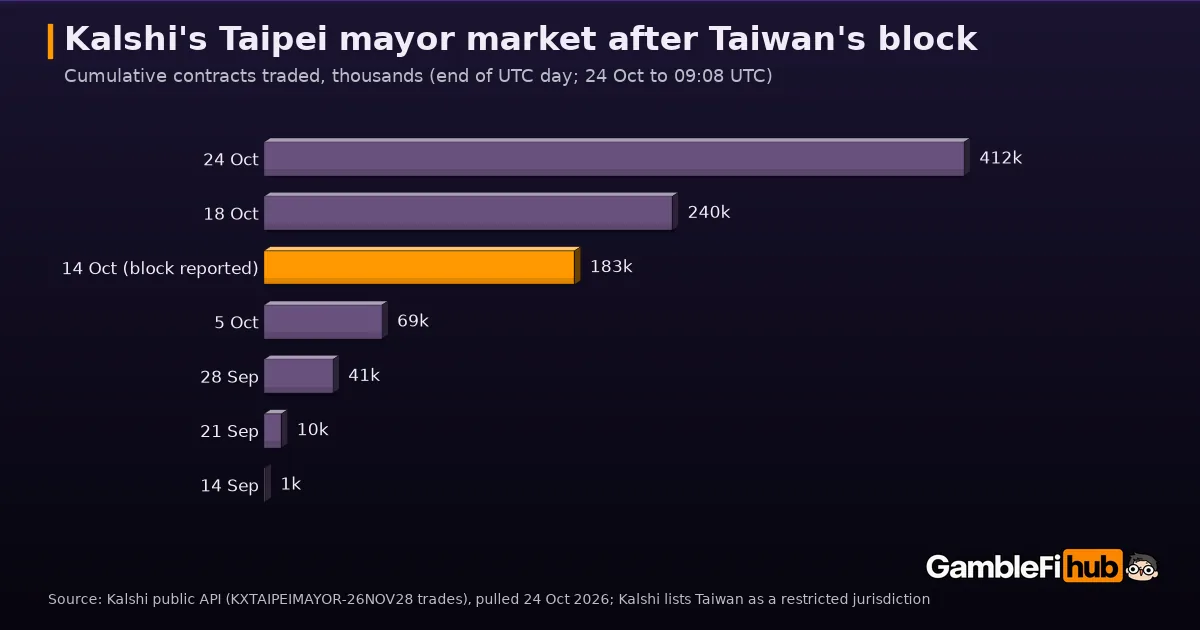
A court in New Taipei City has ordered Taiwan’s communications regulator and internet registry to block domestic access to the websites of Kalshi and Coinbase, about six weeks before the 28 November local elections. Some users found coinbase.com unreachable from around midday on 14 October, Crypto Briefing reported; the Coinbase app reportedly kept working. Trading on Taiwan’s races has continued. Kalshi’s own public data show 182,690 contracts traded on its Taipei mayor market by the end of 14 October (UTC). By the morning of 24 October the total was 411,901, so 56% of all trading in that market took place after the block was reported.
What the court ordered
According to a ruling seen by Bloomberg and reported by the Taipei Times, the New Taipei District Court authorised the block at the request of the Criminal Investigation Bureau. The bureau said the sites were suspected of violating the Public Officials Election and Recall Act and that it sought the restrictions to protect election integrity and prevent “overseas interference”. Taiwanese authorities have not alleged that Coinbase or Kalshi handled funds from China. A Coinbase spokesperson said the company was aware of access issues for some users in Taiwan and was investigating, and a Kalshi spokesperson said it does not allow trading in Taiwan, The Straits Times reported. We found no report of the block being lifted as of 24 October. Crypto Briefing gives the court reference as 115年度聲扣字第55號 and links the order to Coinbase’s prediction markets, which in the US are offered through Kalshi.
Article 103-1 of the Election and Recall Act makes betting on an election or recall outcome punishable by up to six months in prison, short-term detention or a fine of up to NT$100,000, and it applies explicitly to betting over the internet. Anyone who provides a venue or organises such betting for profit faces up to five years in prison and a fine of up to NT$500,000.
Kalshi: Taiwan was already restricted
Kalshi’s member agreement lists Taiwan among its restricted jurisdictions: people domiciled or located in Taiwan may not trade its event contracts. The trading volume below therefore says nothing about where the traders are; it shows that a market on a Taiwanese election kept growing on a US-regulated exchange after Taiwan cut off access.
What Kalshi’s data show
We summed every public trade in Kalshi’s four Taiwan local-election events through its trades API on 24 October at 09:08 UTC. The Taipei mayor market opened on 5 September and recorded its first trades on 12 September. It had about 69,300 contracts by 5 October, 182,690 by the end of 14 October and 411,901 by the morning of 24 October, an increase of 125% in under ten days. The busiest days all came after the block: 55,682 contracts on 20 October, 45,771 on 22 October and 32,793 on 19 October. Open interest stood at 292,816 contracts. The New Taipei mayor market had 47,472 contracts, Kaohsiung 26,253 and the party-winner market for the 22 mayor and magistrate races 12,318.
Across the four events, cumulative trading rose from 232,907 to 494,949 contracts between 14 and 24 October. Valued at each trade’s price, that is about $247,000 of contracts in total, of which about $138,000 traded after 14 October.
Polymarket is larger and was blocked earlier
Polymarket lists all 22 races and a party-winner market. On 24 October its Gamma API showed about $2.63 million of combined volume, $1.80 million of it on the Taipei mayor market and $313,000 on the party-winner market, which opened in December 2025. Taiwan first blocked Polymarket’s domain at DNS level in December 2023, and the domain stopped resolving again in May 2026, BlockTempo reported.
Prosecutors follow the wallets
The block comes after months of prosecutions of individual bettors on Polymarket. In April the Taichung District Prosecutors Office said it had found four bettors on the party-winner market and offered rewards of up to NT$5 million for tips on election betting. In May the Qiaotou District Prosecutors Office indicted a Kaohsiung man and seized 746.79 USDC; according to BlockTempo he had bet 742.96 USDC on the party-winner market through a VPN and a MetaMask wallet, and prosecutors identified him by matching his wallet to KYC records at the Taiwanese exchange MAX. In other cases, such as a bet of just under 7 USDC handled by the Hsinchu office, prosecutors deferred prosecution.
Key facts
Order: New Taipei District Court, at the Criminal Investigation Bureau’s request; coinbase.com unreachable for some users from 14 Oct 2026.
Law: Election and Recall Act, Art. 103-1: up to 6 months for bettors, up to 5 years and NT$500,000 for organisers.
Kalshi Taipei mayor: 182,690 contracts by end of 14 Oct (UTC), 411,901 on 24 Oct; 56% traded after the block was reported.
Kalshi, four Taiwan events: 494,949 contracts, about $247,000 at trade prices.
Polymarket, 23 Taiwan events: about $2.63M volume, $1.80M on Taipei.
Kalshi position: Taiwan is a restricted jurisdiction in its member agreement; it says it does not allow trading there.
Why it matters for GambleFi
Taiwan treats an election market as gambling, wherever the exchange is licensed and whether it settles in dollars or in USDC on a blockchain. A domain block is easy to work around, but the Polymarket cases show the other route: prosecutors trace onchain payments to regulated exchanges and their KYC records. The same pressure is building elsewhere, from Utah’s lawsuit against Kalshi to the CFTC’s probe of candidates trading their own races. Prediction markets are growing alongside the iGaming tokens we track, and our Polymarket report shows how far trading has already shifted to its CFTC-regulated US venue; our game mechanics guide explains how token-based casino products work. This is a data report, not legal advice.