
COLUMBUS — Ohio’s casino regulator has turned its prediction-market crackdown on the companies it already licenses. In a letter sent on 20 October 2026, the Ohio Casino Control Commission told sportsbooks, fantasy operators, suppliers and other licensees to “immediately cease” any services to businesses offering sports event contracts in Ohio without a state licence, and to confirm by 30 October that they have done so. The letter was first reported by the newsletter The Event Horizon, and interim executive director Andromeda Morrison confirmed it at the Commission’s meeting on 21 October, according to Legal Sports Report and CDC Gaming.
Who the letter covers
The notice reaches well beyond the exchanges themselves. According to RG.org and Legal Sports Report, it defines licensees to include fantasy contest operators, sports gaming proprietors, management services and mobile management services providers, suppliers, key employees of those companies, certified independent integrity monitors, certified independent testing laboratories, and applicants for any of these licences. The Commission says it is “deeply concerned by reports” that some licensees support unlicensed event-contract operators through liquidity provision and market making, integrity monitoring, and equipment, data security and other technology services.
“The continued facilitation or support of illegal gambling activity, or the affiliation with illegal operators, by a commission licensee raises significant suitability concerns,” the notice reads, as quoted by CDC Gaming. “As you are aware, maintaining suitability is a continuing obligation of licensure.” Licensees that do not comply could face reopened suitability investigations and suspension or revocation of their licences. The 30 October date is a reporting deadline; the services are meant to stop at once, and igaming.org reports that licensees must keep records supporting their answers.
The broker exception
The letter makes one exception. Licensees that also act as futures commission merchants or introducing brokers, the firms that route customer orders to CFTC-regulated exchanges, are treated as compliant as long as they block customers in Ohio from directly or indirectly reaching sports event contracts listed on designated contract markets. Morrison told commissioners the notice follows the Commission’s earlier guidance from August 2025 and restates its “long-held position” that sports event contracts are being offered “outside the confines of Ohio law”.
Key facts
Regulator: Ohio Casino Control Commission; notice signed by interim executive director Andromeda Morrison.
Sent: 20 October 2026; confirmed at the Commission meeting on 21 October.
Demand: stop services to unlicensed sports event-contract operators immediately; confirm compliance by 30 October 2026.
Services named: liquidity provision and market making, integrity monitoring, equipment, data security and other technology services.
Risk: reopened suitability investigations, suspension or revocation.
Exception: futures commission merchants and introducing brokers that block Ohio customers from sports event contracts.
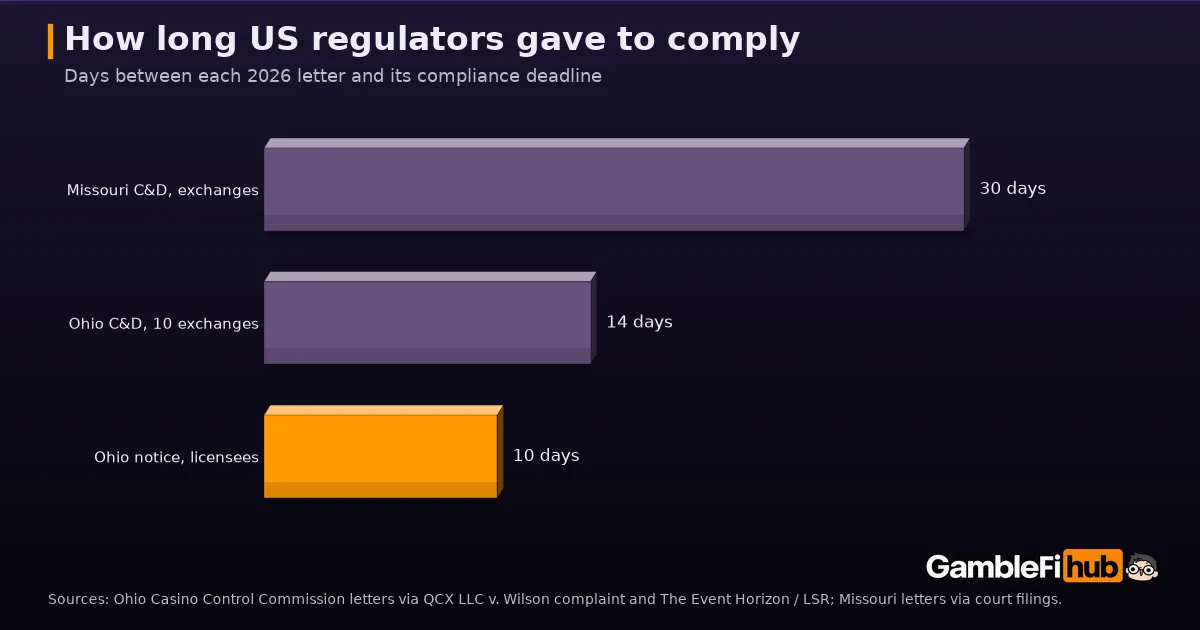
Earlier step: cease-and-desist letters to 10 exchanges and brokers on 2 October, with a 14-day deadline.
From exchanges to their suppliers
The notice is the second Ohio step this month. On 2 October the Commission sent cease-and-desist letters to 10 prediction-market operators and brokers, including Polymarket’s US entity, Robinhood and Coinbase, after the Sixth Circuit’s 25 September ruling in Kalshi’s case against the state. Polymarket US answered on the 16 October deadline with a federal lawsuit, covered in our report on how Polymarket US sued Ohio over sports-gaming licences. Missouri gave Novig and Crypto.com’s OG exchange 30 days in its letters; Ohio’s licensees now get ten. Federally, the CFTC’s interim rule keeping casino-style games out of the swap definition took effect on 19 October, as explained in our report on the carve-out.
Why it matters for GambleFi
Prediction markets depend on the same back office as sportsbooks: market makers, odds and data feeds, integrity monitors and testing labs. By targeting those suppliers, a state can squeeze exchanges it cannot license without winning in court first. Onchain betting markets and the platforms behind an iGaming token (also called a GambleFi token) use far fewer licensed intermediaries, which keeps them out of reach of letters like this one but also outside the regulated US market. For an onchain betting exchange, see our SX Bet profile; the GambleFi FAQ covers the basics. This is a regulatory report, not legal or betting advice.