
WILLEMSTAD — Curaçao’s gaming regulator has set its first dated rules for how the crypto casinos it licenses handle iGaming tokens (also called GambleFi tokens), stablecoins and wallets. The Curaçao Gaming Authority (CGA) Crypto Policy Guideline, dated June 2026, says licensees “must not themselves function as an exchange, payment services provider, or VASP”. Some rules apply immediately, the next set is due in December 2026 and the rest by June 2027. The filing channel broke down, though: the CGA postponed portal deadlines on 2 October, said on 7 October that its licensing portal would not return, and says an interim portal launched on 19 October.
What the guideline requires
Operators may accept crypto “for gambling services only”. They must not convert crypto to crypto or fiat for users, offer trading, swapping or exchange services, or offer “custody, transfer, or wallet services outside gambling-related transactions”. The CGA calls crypto currencies high risk and asks for an asset-by-asset risk assessment; it prefers fiat-backed regulated stablecoins. For meme coins and other highly speculative tokens, the guideline asks operators to classify assets by their liquidity and volatility, governance and ecosystem maturity, and financial-crime risk. Wrapped or bridged tokens whose underlying asset cannot be verified may not be accepted, and the CGA reserves the right to prohibit whole “token types, or transaction mechanisms”.
Withdrawals should by default go to the same wallet and in the same asset as the deposit. Other wallets are allowed if they are whitelisted and verified as the customer’s, and other assets if the conversion runs through a regulated VASP. “Players cannot transfer amounts to each other on the platform.” All wallets must belong to the licensed entity or an approved group or payment entity; personal, owner-linked and employee wallets are banned, and player, operational and treasury funds must sit in separate wallets.
Four phases
The guideline’s transition section sets four steps. With immediate effect, it bans sanctioned wallets, mixers, prohibited crypto assets, personal or owner-linked wallets and operators acting as exchanges, payment providers or VASPs. Within three months, by September 2026, each licensee had to upload its own crypto policy to the CGA portal. Within six months, by December 2026, licensees must complete documented crypto risk assessments, VASP due diligence, wallet ownership controls, transaction monitoring procedures and staff training. Within 12 months, by June 2027, they must have wallet segregation, blockchain analytics, reconciliation, withdrawal whitelisting or equivalent controls and audit-ready records. The CGA “may require earlier implementation where material risks are identified”.
A month without a portal
The September upload fell into the CGA’s portal crisis, which we covered in our report on the portal breach. On 2 October the CGA said that “deadlines for the submission of documentation through the CGA portal are being postponed until the portal becomes available again”. On 7 October it announced that the portal would not return. Its statement of 19 October said a temporary portal was scheduled to launch that day, pending security testing, and a notice on the CGA homepage now says the interim online gaming portal was launched on 19 October. As of 23 October the CGA had not published new dates for the postponed crypto policy filings. The December and June steps are internal controls rather than uploads, and the guideline itself has not been withdrawn: it is listed among the current policies on the CGA’s online gaming page.
Tokens in the licence conditions
The CGA’s conditions for indefinite-term online gaming licences, effective since 17 December 2025, already set the frame for casino tokens. Article 9 says virtual currencies accepted as stakes “must be tradable on internationally licensed virtual currency exchanges”, that the licensee may not exchange currencies in the player account or exchange virtual currencies for fiat, and that “it is prohibited to offer investment alternatives to players”. The next sentence adds: “This does not prevent the issuance/purchase of in-game tokens.” Prizes must be paid in the currency used to play. Neither document names operators’ own tokens, and neither defines where an in-game token ends and an investment alternative begins.
Who it applies to
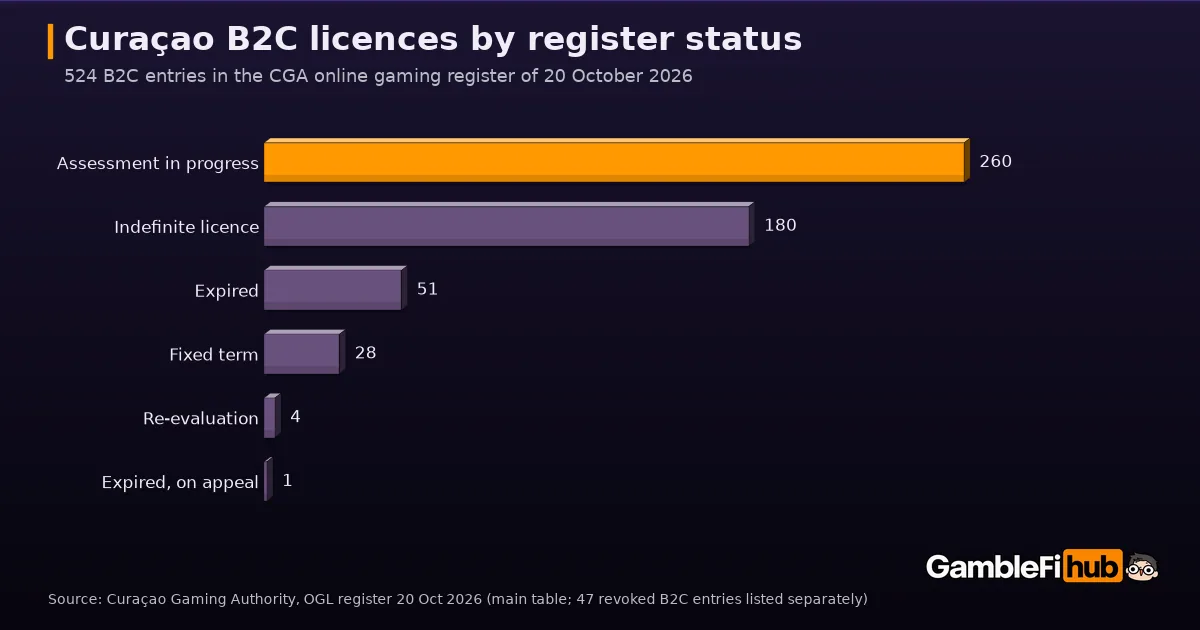
The CGA register of 20 October 2026 lists 524 B2C entries in its main table: 180 indefinite licences, 260 with an assessment in progress, 4 in re-evaluation, 28 fixed-term licences, 51 expired and 1 expired under administrative appeal. A separate table lists 47 revoked B2C licences. Seven of the 17 projects we track are linked to entries in that register. Shuffle’s operator Natural Nine B.V. holds an indefinite licence. The entries for BetFury (Universe B Games B.V.) and Fairspin (Techcore Holding B.V.) show an assessment in progress. DedPrz’s DG Innovations B.V. has a fixed term to 25 November 2026. The Rollbit entry for Bull Gaming N.V. is expired and under administrative appeal, and the licence of MIBS N.V., which Sweden’s regulator links to TG.Casino and Wall Street Memes Casino, is listed as expired.
Key facts
Document: CGA Crypto Policy Guideline, June 2026, published on cga.cw.
Core rule: licensees must not act as an exchange, payment provider or VASP; no swaps, conversion or non-gambling wallet services.
Assets: asset-specific risk assessment; regulated fiat-backed stablecoins preferred; meme tokens classified by liquidity, governance and crime risk; unverifiable wrapped or bridged tokens barred.
Deadlines: immediate bans; policy upload September 2026; risk assessments and controls December 2026; full wallet and analytics set-up June 2027.
Portal: deadlines postponed 2 Oct 2026; old portal discontinued 7 Oct; interim portal launched 19 Oct (CGA homepage); no new filing dates as of 23 Oct.
Licence conditions (Art. 9): stake currencies must trade on licensed exchanges; “investment alternatives” prohibited; in-game tokens allowed.
Why it matters for GambleFi
Curaçao and Anjouan are the two most common licences among the casinos we track, and the guideline spells out in detail how Curaçao licensees must handle crypto. Many iGaming tokens are built around staking, lotteries or revenue share run on the casino’s own platform; our game mechanics guide lists which mechanism each tracked token uses. The guideline’s liquidity and volatility test for speculative tokens matters too, because several casino tokens trade in thin markets. Whether the CGA treats operators’ own tokens as in-game tokens, speculative assets or investment alternatives is not settled in either document. This is a regulatory report.