
CFTC chair Michael Selig said on 23 October 2026 that the volume traded in political prediction-market contracts is one factor the CFTC weighs, and “it’s certainly a concern”, ahead of the 3 November midterms. Asked by Bloomberg’s Tyler Kendall about “thousands of political contracts” that “don’t have a significant amount of volume”, Selig said volume is one factor the agency and exchanges consider when judging whether a contract can be manipulated. We counted the volume of every House, Senate and governor race on Kalshi and Polymarket to see how thin they are.
What Selig said
Speaking at the CFTC’s Agricultural Commodity Futures Conference in Kansas, in a Bloomberg Talks interview (transcript), Selig said exchanges self-certify contracts and review them for manipulation risk. “I think with the midterm elections, there’s some of these contracts where you might be on the other side politically, you decide to put in some trades and try to boost the numbers,” he said, adding that the CFTC and the exchanges are “always looking for that”. Asked whether any midterm investigations are under way, he said “I can’t speak to any potential investigations”, but that if the CFTC sees manipulation, wash trading or fraud it will “investigate it and if there’s bad activity there we’re gonna prosecute it”. A day earlier its enforcement director said the agency has open probes into candidates who traded on their own races.
House races: thin on Kalshi, thin everywhere on Polymarket
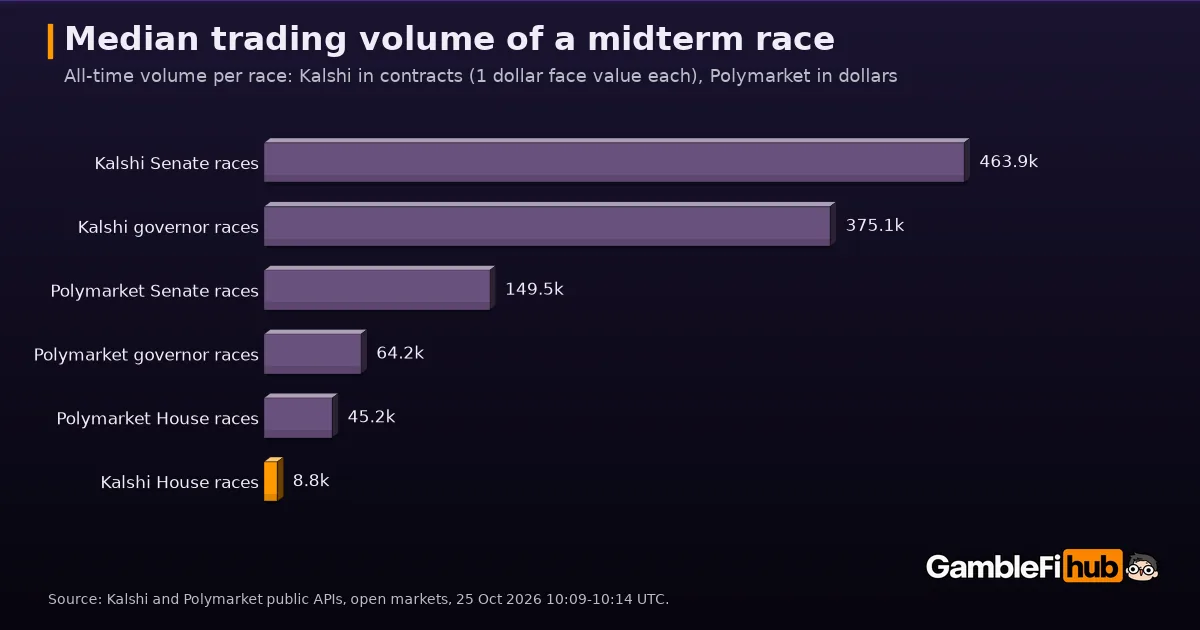
Kalshi lists 420 House district races with open markets. Together they have traded 22.0 million contracts, but the median district has traded 8,807, and 226 of the 420 (53.8%) are under 10,000. Twenty-five are under 1,000, the smallest at 60 contracts. Only two districts have passed one million: TX-15 (3.0 million) and MN-5 (1.2 million). The ten busiest districts hold 37% of the House total.
Polymarket lists 425 House winner markets with $21.2 million traded in total, a similar number to Kalshi’s 22.0 million contracts, though the units differ. Its median district is $45,208, only two are under $10,000, and only the busiest, VA-5, has just passed $250,000 (at $250,306). Per race that is thin: 400 of 425 are under $100,000.
Senate and governor races: volume piles into a few
Statewide races are much busier, but also concentrated. On Kalshi the 32 Senate races have traded 100.7 million contracts, median 463,857, and the ten busiest take 90% of it; no Senate race is under 10,000. Of 36 governor races, the median is 375,126 contracts, 12 have passed a million and 2 are under 10,000. On Polymarket the 34 Senate races have $22.2 million (median $149,469, Texas $6.2 million, top ten 87%) and the 39 governor races $8.4 million (median $64,208, 24 under $100,000).
Key facts
Source: Kalshi public API (open markets) 25 October 2026 10:14 UTC; Polymarket Gamma API (open events) 25 October 2026 10:09 UTC.
Kalshi House: 420 districts, 22.0m contracts, median 8,807, 226 under 10,000, 25 under 1,000, top ten 37%.
Polymarket House: 425 races, $21.2m, median $45,208, 2 under $10,000, 400 under $100,000, top ten 7%.
Kalshi Senate / governor: 32 / 36 races; median 463,857 / 375,126 contracts.
Polymarket Senate / governor: 34 / 39 races; median $149,469 / $64,208.
Units: Kalshi counts contracts (1 dollar face value each) summed over a race’s candidate markets; Polymarket reports dollars traded per event. The two are not like-for-like.
What low volume does and does not show
A small market is cheaper to push around: at the median Kalshi House district, 8,807 contracts is $8,807 of face value. Selig’s own words point to the risk being someone trading to “boost the numbers”. But low volume does not mean anyone has manipulated a market, and our counts cannot show it either way: all-time volume says nothing about who traded or why, and Selig said the exchanges surveil their markets. Volume is lifetime volume, not liquidity at the best prices, and the Kalshi district figures sum several candidates’ markets.
Why it matters for GambleFi
Onchain prediction markets such as Polymarket belong to the GambleFi sector, and they share the weak spot Selig describes: a small pool is cheap to move, and for an election contract the price is what people quote as a probability. The same logic applies to a thinly traded iGaming token, which is why we track liquidity depth next to market cap and explain how these products work in our game mechanics guide. Our look at Polymarket US and its onchain venue covers where the volume is moving. This is a data report, not betting advice.