
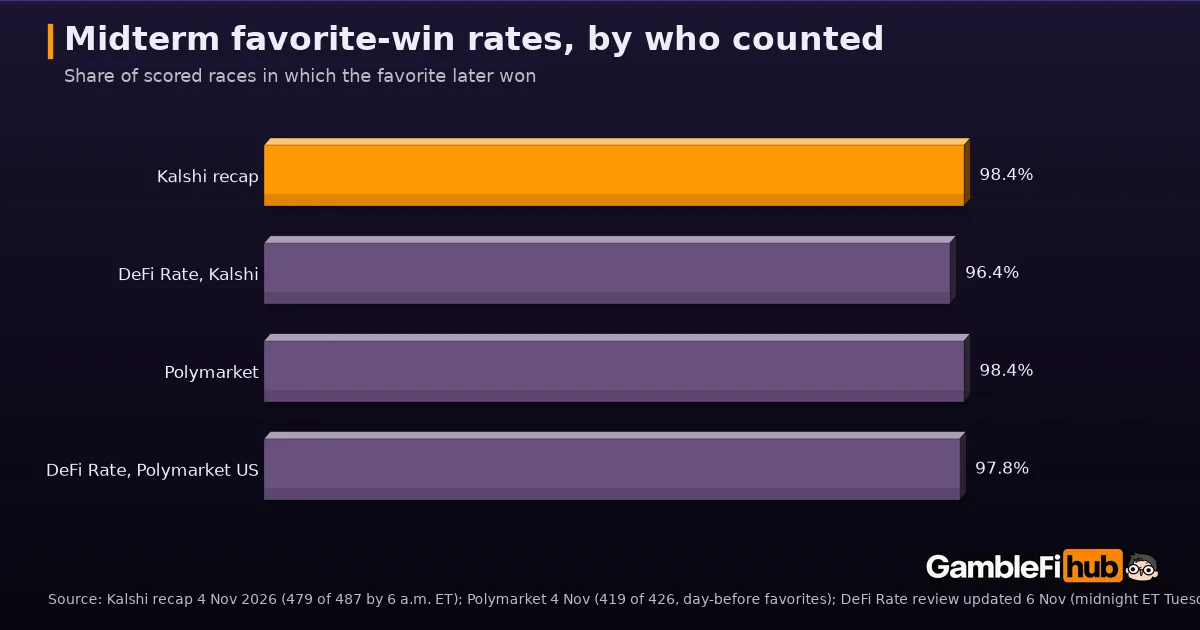
Kalshi says the candidates its traders favored won 479 of 487 U.S. midterm races that had been resolved by 6 a.m. Eastern on 4 November, a combined figure the exchange calls a 98 percent hit rate. In a post the same day, Polymarket said its favorite the day before Election Day won 419 of 426 resolved races, or 98.4 percent. Both scores count how often the higher-priced side later won. They do not measure whether a 53-cent favorite and a 97-cent favorite were equally well priced, and Kalshi’s recap does not say at what time it took the favorites in its table.
What Kalshi put in the table
The 4 November recap, signed by Ben Freeman, breaks the 487 races into six offices: House 356 of 360, Senate 32 of 33, governor 33 of 34, attorney general 26 of 27, lieutenant governor 9 of 10 and secretary of state 23 of 23. Alaska’s Senate race, Mississippi’s Senate race and other House races were still unresolved at that 6 a.m. cutoff. Kalshi says trading on its 2026 midterm markets surpassed $2.5 billion, compared with $1.3 billion for the 2024 election cycle. Those are Kalshi’s own volume figures.
The table’s percentage column does not match the fractions beside it. It prints 95 percent next to the House line, though 356 of 360 is about 98.9 percent, and 94 percent next to the Senate and governor lines, though those fractions are about 97 percent. The combined 479 of 487 does round to 98 percent. Kalshi wrote that traders had favored a “blue tsunami” of at least 230 Democratic House seats and 51 Democratic Senate seats, but had not priced in what it called the “biggest blue wave since 2008,” meaning 250 or more House seats and 56 or more Senate seats.
A second count used a pre-election cutoff
A DeFi Rate review updated on 6 November used prices observed at or before midnight Eastern as Tuesday began, and media-called outcomes through Thursday evening. On that cut, Kalshi favorites won 489 of 507 scored events, or 96.4 percent, and Polymarket US favorites won 408 of 417, or 97.8 percent. The samples are not identical: Kalshi’s scored list includes more state and local offices, and DeFi Rate dropped events that lacked a complete price history. The review notes that Kalshi’s recap “does not clearly identify a single price cutoff for its headline calculation.”
DeFi Rate also recorded Democratic control of the House as Kalshi’s highest-priced outcome at 93.5 percent before the election, and Democratic Senate control at 76 percent. Both matched the reported results. Its Senate hits included several Republican-held seats: James Talarico in Texas at 74 percent, Troy Jackson in Maine at 73 percent, Sherrod Brown in Ohio at 71 percent, Adam Hamilton in Kansas at 62 percent, Josh Turek in Iowa at 53 percent and Abdul El-Sayed in Michigan at 79 percent. It correctly favored Republicans Ashley Moody in Florida at 85 percent and Pete Ricketts in Nebraska at 67 percent.
The misses clustered in Texas and South Carolina
South Carolina was the scored Senate exception in that review. Traders still favored Republican Darline Graham at 67 percent on Kalshi and 68 percent on Polymarket US; Democrat Annie Andrews won. Half of Kalshi’s 18 losing favorites in the DeFi Rate workbook were Texas events. Those included governor Greg Abbott at 60 percent (Gina Hinojosa won), lieutenant governor Dan Patrick at 68 percent (Vikki Goodwin won), attorney general Mayes Middleton at 65 percent, comptroller Don Huffines at 78 percent and Texas Supreme Court Place 8 justice Brett Busby at 83 percent. All of those outcomes are media calls in the review, not certified results.
Better Markets, in a 4 November analysis by Benjamin Schiffrin, argued that misses in competitive races show prediction markets on elections are “nothing more than gambling” and asked the Commodity Futures Trading Commission to outlaw election event contracts. The group illustrated Senate charts for South Carolina, Iowa and Kansas as races Kalshi “did not accurately predict.” DeFi Rate’s midnight-Tuesday snapshot, taken later than some of those charts may show, counted Iowa and Kansas as hits and South Carolina as the Senate miss. The two write-ups are not measuring the same frozen price.
A 99 percent call after counting starts is a different test
Kalshi says markets for control of the House hit a 99 percent likelihood at 8:10 p.m. Eastern and the Senate market passed 99 percent at 9:00 p.m. In a follow-up post, Polymarket said that in 10 key races its 99 percent call beat CNN, Fox News and the Associated Press by a median of 31 minutes, and that its Michigan Senate call came four hours before mainstream media. DeFi Rate treats those election-night jumps as a separate question from picking a winner before anyone counted ballots: the market is then reading returns, not forecasting them.
Kalshi spokesperson Jack Such told CNBC the platform projected a race once a candidate’s odds were above 99 percent and trading on the other side “dried out.” CNBC, which discloses a commercial relationship with Kalshi, also reported that Gina Hinojosa’s odds on Polymarket jumped from 39 percent to 73 percent within five minutes of the first poll closings in Texas. That move is the market updating on incoming votes, the same distinction our earlier comparison of pre-election midterm prices was built around.
Key facts
Kalshi recap (4 November): favorites won 479 of 487 races resolved by 6:00 a.m. ET; Kalshi calls this a 98 percent hit rate.
Kalshi table: House 356/360, Senate 32/33, governor 33/34, attorney general 26/27, lieutenant governor 9/10, secretary of state 23/23.
Still open in that recap: Alaska Senate, Mississippi Senate and other House races.
Kalshi volume: midterm markets surpassed $2.5 billion, versus $1.3 billion for the 2024 cycle (Kalshi’s figures).
Chamber control (Kalshi): House market reached 99 percent at 8:10 p.m. ET; Senate at 9:00 p.m. ET.
Polymarket (4 November posts): day-before favorites won 419 of 426 resolved races (98.4 percent); in 10 key races, 99 percent calls a median 31 minutes before CNN, Fox News and AP; Michigan Senate about four hours.
DeFi Rate (updated 6 November): Kalshi 489 of 507 (96.4 percent); Polymarket US 408 of 417 (97.8 percent); prices at or before midnight ET entering Tuesday.
Sources: Kalshi recap, Polymarket posts, DeFi Rate review, Better Markets analysis, CNBC.
Why it matters for GambleFi
A high favorite-win rate does not settle whether event contracts are federally regulated derivatives or illegal bets. Utah prosecutors have already charged Kalshi and its founders over sports contracts, and Spain still treats prediction markets as gambling. Those fights sit next to the iGaming token market — the GambleFi coins issued by onchain casinos — because both businesses depend on which side of that line a priced outcome falls. Chamber-control volume is one more data point beside our look at 41 prediction-market venues and at how thin some midterm contracts were before election night.
An earlier cycle already produced a sharp miss on Brazil’s runoff, where traders had priced Luiz Inácio Lula da Silva as a long shot; we covered those pre-election odds separately. This is a report on published scorecards, not betting or legal advice. The GambleFi FAQ explains how event-contract venues differ from crypto-casino tokens.