
Spain’s gambling regulator is not carving out a new lane for prediction markets. At MERGE Madrid on 30 October 2026, Director General Mikel Arana told a panel that platforms whose products constitute gambling under Spanish legislation must hold the corresponding licence to operate in Spain. Prediction markets in that bracket without authorisation cannot lawfully offer services there, and Spain takes measures to block access from Spain to the affected platforms.
That line matches the ministry’s May position. It does not announce a dedicated prediction-market licence class, a bill, or a finished ruling on the open Polymarket and Kalshi files.
What May already said
On 26 May 2026 the Ministry of Social Rights, Consumer Affairs and Agenda 2030 published a press note (also in Spanish): the Dirección General de Ordenación del Juego (DGOJ) had opened sanction proceedings against Polymarket and Kalshi for allegedly operating in Spain without the required administrative authorisation, and had ordered a precautionary nationwide block of both websites until a final resolution. The note said the procedure was expected to last about three to four months. It also said Spain treats prediction markets as games of chance when users stake on uncertain future outcomes, so exploitation in Spanish territory requires a specific administrative licence.
Those cases sit under Law 13/2011, Spain’s general gambling statute (BOE-A-2011-9280). The statute already regulates wagering products, including cross-betting style intermediary models in its tax base rules. The May note did not invent a new product class; it applied the existing licence gate.
What MERGE did not close
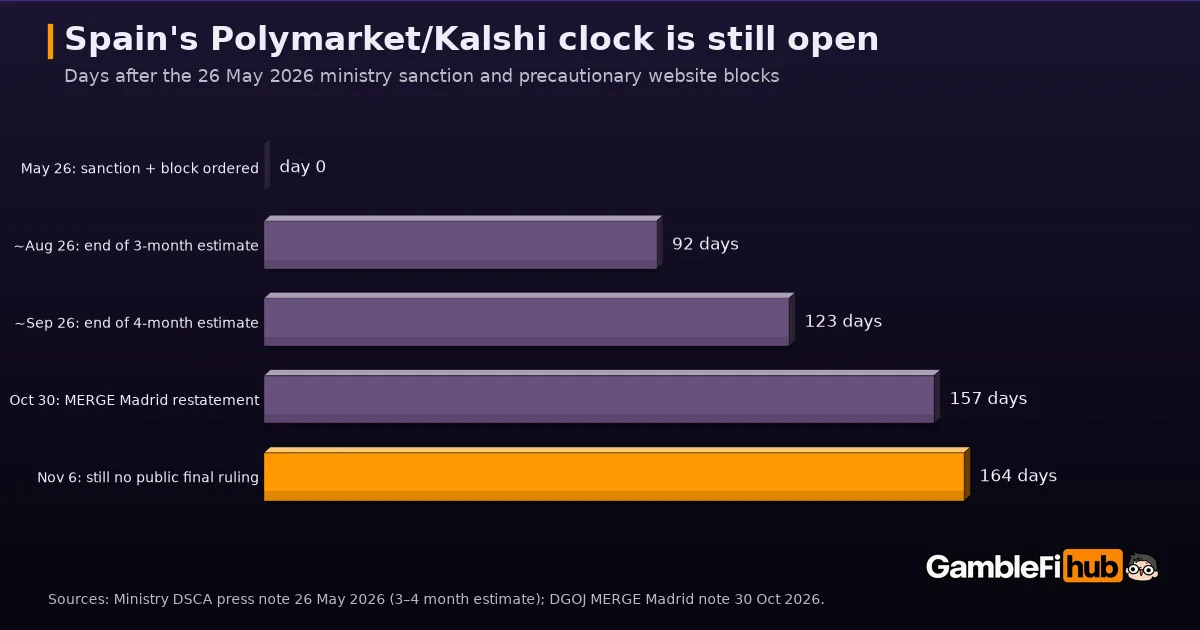
Counting from 26 May, the ministry’s three-to-four-month window pointed roughly at late August to late September 2026. By 30 October — day 157 on the chart — the DGOJ’s MERGE note restated the licence rule and access blocks. It did not publish a final sanction decision for Polymarket or Kalshi. A check of the DGOJ news list through early November still shows no separate final-ruling release for those two May files.
Arana appeared again days later at SiGMA World Roma on 3 November, where the DGOJ note flags the problem of prediction-market platforms claiming their products are not gambling. On 4 November in Halle, DGOJ deputies put prediction markets and blocks of unauthorised platforms on a European regulators agenda. Both are process notes, not case dispositions.
Key facts
MERGE: DGOJ note dated 30 October 2026; DG Mikel Arana on the “Regulatory visions on Prediction Markets” panel.
Rule restated: products that are gambling under Spanish law need the corresponding Spanish licence; unauthorised prediction markets in that bracket cannot lawfully serve Spain; access-blocking measures apply.
May actions: sanction proceedings and precautionary website blocks for Polymarket and Kalshi; ministry estimate of about three to four months to a final resolution (press note 26 May 2026).
Statute: Law 13/2011 (BOE-A-2011-9280); no new dedicated prediction-market licence class announced at MERGE.
Status checked: as of 6 November 2026, no public final ruling located for the May Polymarket/Kalshi files on DGOJ/ministry news pages.
Sources: ordenacionjuego.es MERGE note; dsca.gob.es May press note; BOE Law 13/2011.
Why it matters for GambleFi
Event-contract desks already track U.S. access fights such as the CFTC 30-day impartial-access clock, Polymarket US’s Michigan sports halt, and Taiwan’s Kalshi/Coinbase blocks. Spain is the opposite framing: if the product is gambling under Law 13/2011, it needs a DGOJ licence, not a CFTC-style event-contract path. That classification fight matters for any offshore venue or iGaming token (GambleFi) front end that still reaches Spanish users. Our GambleFi FAQ covers how these platforms fit together. This is a report on regulator statements, not legal or trading advice.