DETROIT — Polymarket US has agreed to stop offering new sports-related event contracts to customers in Michigan. Any open positions that Michigan residents have not closed themselves will be closed by the end of the day Eastern time on 25 November 2026. The Michigan Gaming Control Board announced the deal on 28 October. The operating company, QCX LLC, is the fourth platform to stop sports contracts in the state this year, after Kalshi, Robinhood and Coinbase.
The agreement is a stipulation approved by the US District Court for the Western District of Michigan. In return, the state will not take enforcement action against Polymarket US as long as the company complies. The case itself is not over. Polymarket US sued Michigan officials in March 2026 to stop them enforcing state gaming law. The court refused a temporary restraining order in March and a preliminary injunction in June, and Polymarket’s appeal of that ruling is still pending at the Sixth Circuit.
How Michigan got here
Michigan took a different route against each platform. Against Kalshi, Attorney General Dana Nessel went to state court: Ingham County Circuit Court granted a temporary restraining order on 29 June and a preliminary injunction on 1 September, which requires Kalshi to geofence the state and carries a fine of $500,000 a day for violations. The others had sued Michigan in federal court and lost their injunction requests, so the state negotiated stand-still deals with them.
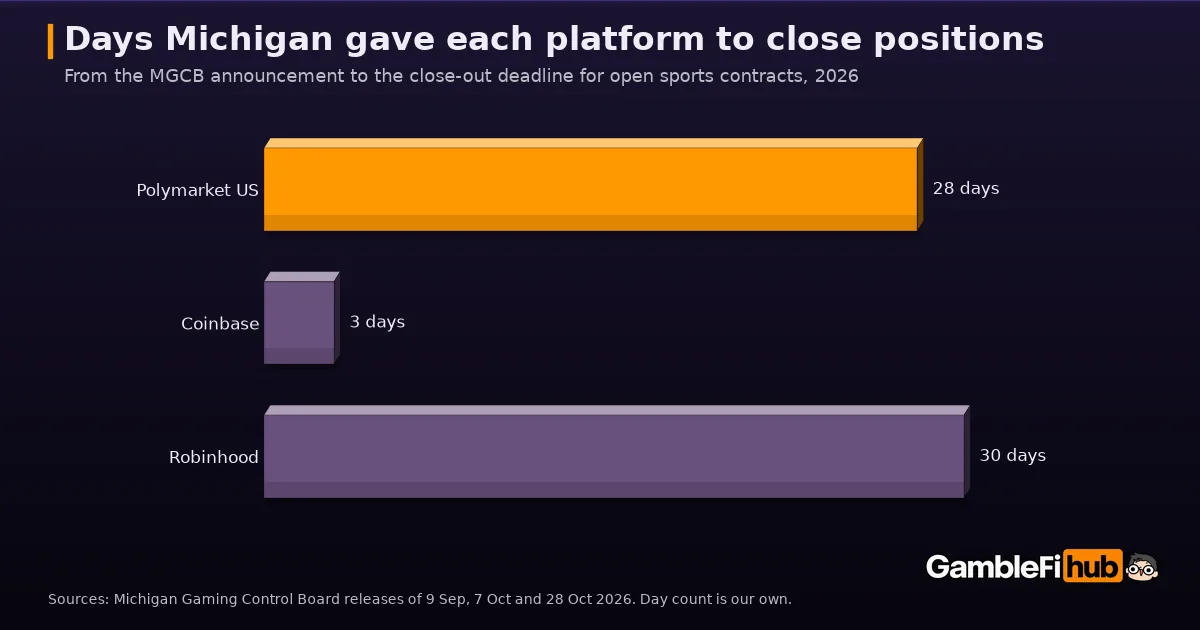
Robinhood stopped new sports contracts at the end of 9 September and had until 9 October to close positions. Under its signed stipulation, the halt covers contracts on any exchange, Kalshi included, and lasts until the Sixth Circuit appeals are finally decided or the Kalshi state-court injunction is dissolved. Coinbase followed on 7 October, with new trading and open positions both ending at 12:00 a.m. Eastern time on 10 October. Polymarket US gets 28 days from the announcement, close to Robinhood’s 30 and far more than Coinbase’s three (see chart). According to the MGCB, the attorney general’s office had told Polymarket US on 10 September that it would sue if the company kept offering sports contracts.
“If you want to offer sports wagering to Michigan residents, you need a Michigan license,” MGCB Executive Director Henry Williams said. The same board sent 33 cease-and-desist letters to offshore sites on 8 October, as we reported in our MGCB letters story.
The appeal that decides it
Polymarket’s appeal (QCX LLC v. Nessel, No. 26-1552) was consolidated with Robinhood’s in July. It is in the same court that held on 25 September, in Kalshi’s Ohio and Tennessee cases, that federal law does not preempt those states’ gambling rules. Polymarket US is fighting the same question in Ohio, where it sued over the state’s sports gaming licence, and Kalshi is fighting it in Missouri (our report). Sports are a large part of these exchanges’ business: Robinhood’s event contracts earned more than its crypto trading in Q3.
Key facts
Company: QCX LLC, doing business as Polymarket US.
Deal: stipulation approved by the US District Court, W.D. Mich.; announced by the MGCB on 28 October 2026.
Terms: no new sports-related event contracts for Michigan customers; open positions closed by end of day ET, 25 November 2026; no state enforcement while compliant.
Appeal: QCX LLC v. Nessel, 6th Cir. No. 26-1552, still pending.
Earlier Michigan actions: Kalshi state-court injunction (1 Sep 2026, $500,000 a day for violations); Robinhood stipulation (W.D. Mich. 1:26-cv-00730, 4 Sep); Coinbase stipulation (E.D. Mich. 4:25-cv-14092, 23 Sep).
Sources: MGCB releases (9 Sep, 7 Oct, 28 Oct 2026); Robinhood stipulation and order (4 Sep 2026); Michigan Attorney General release (2 Sep 2026).
Why it matters for GambleFi
Four of the biggest US event-contract venues now keep their sports products away from Michigan. They did it under court orders and deals, not because a court found that federal law lets the state do it, and that question now sits with the Sixth Circuit. Michigan has also shown it goes after offshore sites. Onchain sports books such as SX Bet and iGaming token (GambleFi) casinos have no CFTC registration to point to at all. For how prediction markets differ from GambleFi platforms, see the GambleFi FAQ. This is a report on regulatory filings, not legal or betting advice.