
Robinhood earned $173 million from event contracts in the third quarter of 2026, up from $27 million a year earlier, according to its Q3 earnings release of 27 October and its quarterly report on Form 10-Q filed on 28 October. Over the same quarter, revenue from crypto trading fell 55% to $120 million. Event contracts are the prediction market positions sold through Robinhood’s Prediction Markets Hub.
It is the second quarter in a row that prediction markets beat crypto at the broker. Using the nine-month totals in the 10-Q, event contracts brought in $104 million in Q1, $156 million in Q2 and $173 million in Q3, while crypto brought in $134 million, $100 million and $120 million. Q1 was the last quarter where crypto was still ahead.
Record 16.4 billion contracts
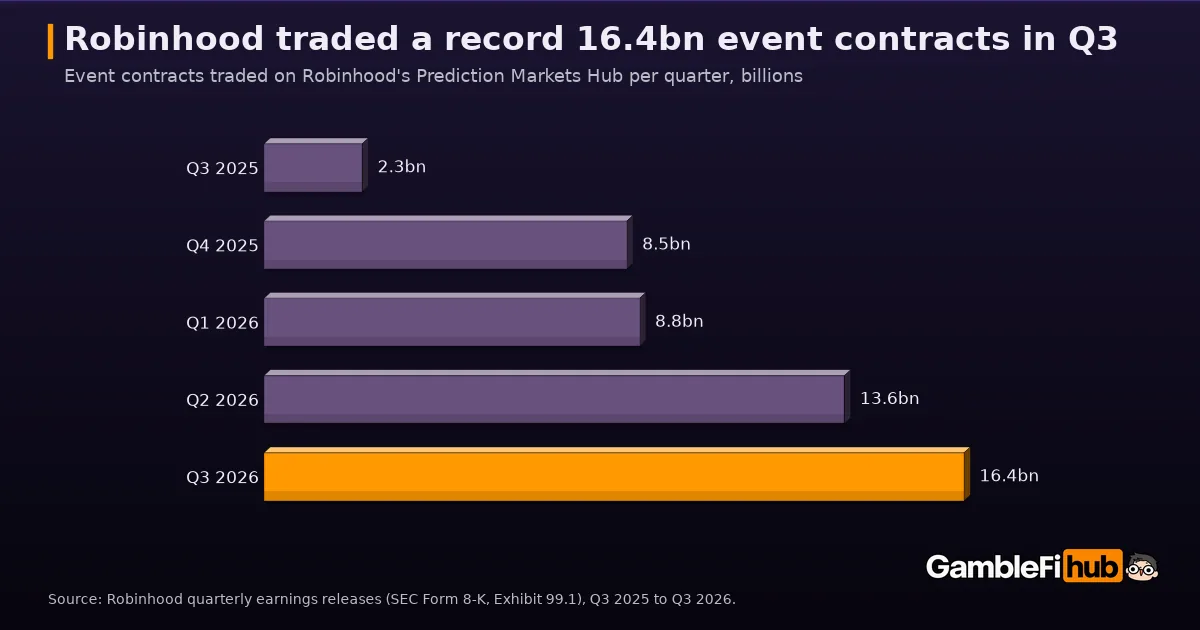
Customers traded a record 16.4 billion event contracts in Q3, more than seven times the 2.3 billion of Q3 2025. Earlier releases put the counts at 8.5 billion in Q4 2025, 8.8 billion in Q1 2026 and 13.6 billion in Q2 2026 (see chart). Robinhood defines the figure as all event contracts bought or sold through the hub; each contract trades in one-cent steps up to $1 and is worth $1 at settlement.
In the 10-Q, Robinhood puts the growth down to “higher trading activity, predominantly in sports-related event contracts”. Event contracts made up 12% of total net revenue of $1.42 billion in the quarter, against 2% a year earlier. Crypto’s share fell from 21% to 8%.
Revenue per contract is slipping
Dividing the reported revenue by the reported contract count gives a rough take per contract. Our calculation, using rounded figures: about 1.17 cents in Q3 2025, 1.18 cents in Q1 2026, 1.15 cents in Q2 2026 and 1.05 cents in Q3 2026. Volume grew 21% from Q2 to Q3, but revenue grew only 11%. Robinhood does not break the drop down; the numbers only show that each contract earned less than in any earlier quarter we can calculate.
Part of the business now runs through Rothera, the CFTC-licensed exchange and clearing house that launched in June and is run through Robinhood’s joint venture with Susquehanna International Group. The release says Rothera passed $100 million in annualized revenue in its first full quarter, with over 6.4 billion contracts traded since launch.
The legal risk sits in the same filing
The 10-Q lists the court fights that come with the growth. Robinhood’s derivatives unit has sued Nevada, New Jersey, Massachusetts, Michigan and Washington to block their gaming laws, and has asked to join the CFTC’s case against Connecticut. In Nevada it stopped offering new sports event contracts from 1 December 2025 under a deal with the state; the Ninth Circuit upheld the denial of an injunction in August 2026 and Robinhood has conditionally asked the Supreme Court to hear the case. The filing also notes that Kalshi is pursuing an interlocutory appeal at the Seventh Circuit in the Ho-Chunk Nation’s tribal gaming case. The CFTC itself has sued ten states, most recently Utah this week.
Key facts
Event contracts revenue: $173m in Q3 2026 (Q3 2025: $27m); $433m in the first nine months of 2026.
Crypto revenue: $120m in Q3 2026, down 55% year over year.
Event contracts traded: record 16.4bn in Q3 2026 (Q2: 13.6bn; Q3 2025: 2.3bn).
Share of net revenue: event contracts 12%, crypto 8% (Q3 2025: 2% and 21%).
Revenue per contract (our calculation): about 1.05 cents in Q3 2026, down from 1.15 cents in Q2.
Rothera: over $100m annualized revenue; over 6.4bn contracts since its June launch.
Sources: Robinhood Q3 2026 earnings release (27 Oct 2026) and Form 10-Q (28 Oct 2026); earlier quarterly releases filed with the SEC.
Why it matters for GambleFi
A listed US broker now earns more from prediction markets than from crypto trading, and most of that activity is sports. That is the same demand onchain casinos and iGaming tokens compete for, but it runs through CFTC-regulated exchanges rather than offshore licences. It also explains why states are fighting so hard: the money is large and growing. For how the market splits across venues, see our volume count across 41 venues and the sports share at Kalshi and Polymarket. For how prediction markets differ from GambleFi platforms, see the GambleFi FAQ.