
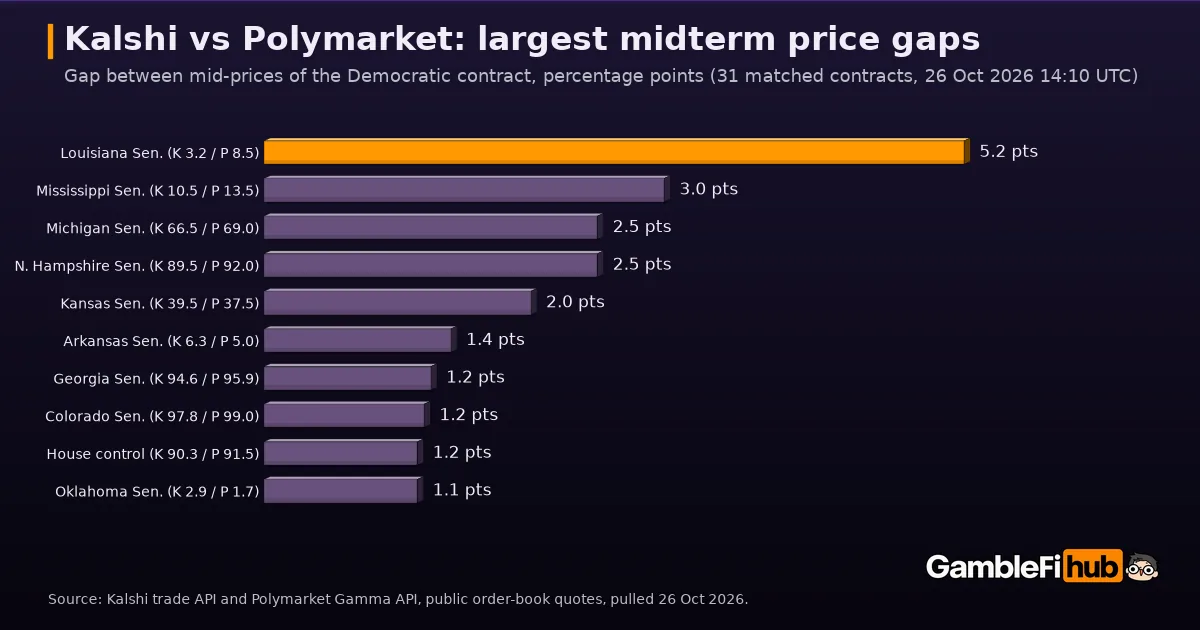
On 26 October 2026 at 14:10 UTC we read the public order books for 33 Democratic midterm contracts that exist on both Kalshi and Polymarket. Thirty-one had a two-sided quote on both venues: control of the House, control of the Senate and 29 state Senate races. The median difference between the two mid-prices is 0.8 percentage points, the mean is 1.0, and 21 of the 31 are within one point. Five contracts differ by two points or more, and one, Louisiana, by 5.2.
How we compared them
For each contract we took the “Democratic” yes side, calculated the mid-price (average of best bid and best ask) on each venue, and subtracted. Kalshi data came from its public trade API (tickers such as SENATEMI-26-D and CONTROLH-2026-D), Polymarket data from its public Gamma API (the international venue). A price of 66.5 means the market implies a 66.5% chance. Idaho and Nebraska were left out because one venue had no two-sided quote.
Where the venues disagree
The largest gaps were Louisiana (Kalshi 3.2, Polymarket 8.5), Mississippi (10.5 and 13.5), New Hampshire (89.5 and 92.0), Michigan (66.5 and 69.0) and Kansas (39.5 and 37.5). In 19 of the 31 contracts Polymarket put the Democratic side higher, in 9 Kalshi did, and 3 matched to the decimal. For the chambers, Kalshi had House control at 90.3 against 91.5 on Polymarket and Senate control at 63.5 against 64.5.
A one-point gap is also the typical width of the order book itself: the median bid–ask spread was 0.8 points on Kalshi and 1.0 point on Polymarket. The quoted ranges did not overlap at all in 12 of the 31 contracts, so a mid-price gap there is a real difference in what traders are willing to pay at that moment, but a small one next to the cost of trading.
Key facts
Snapshot: 26 October 2026, 14:10 UTC; Kalshi trade API (yes_bid_dollars, yes_ask_dollars) and Polymarket Gamma API (bestBid, bestAsk); mid-price = average of bid and ask.
Sample: 31 contracts with two-sided quotes on both venues (House, Senate, 29 state Senate races) out of 33 matched.
Gap: median 0.8 points, mean 1.0, maximum 5.2 (Louisiana); 21 within 1 point, 5 at 2 points or more, 2 at 3 points or more.
Direction: Polymarket higher for the Democratic side in 19, Kalshi higher in 9, equal in 3.
Spread: median 0.8 points on Kalshi, 1.0 on Polymarket; bid–ask ranges did not overlap in 12 contracts.
Not covered: governor races, individual House seats, Idaho and Nebraska Senate, and the Republican side of each market. We did not read each contract’s rulebook line by line, so wording differences between the two venues are possible.
How to read it
Two venues quoting a similar price for the same event is what you would expect when traders can move between them, and the data fits that: most gaps are about one spread wide. A larger gap does not show that one venue is right. The contracts can differ in resolution wording, in how a race with an independent candidate or a runoff is treated, in fees, in the currency used to hold a position, and in how thinly each side is traded. Our earlier check of midterm volume found many races trade very little, and thin books move on small orders. Quotes also change within minutes, so treat these numbers as a snapshot, not a forecast.
Why it matters for GambleFi
Prediction markets sit next to the iGaming token (GambleFi) sector rather than inside it: Kalshi is a CFTC-registered US exchange, while Polymarket runs both a US venue and an international on-chain one. Where those venues price the same event differently is a simple, public way to see how fragmented the market is. For the volume side, see Polymarket US against the on-chain venue and Kalshi’s crypto contracts. This is a data report, not betting or trading advice.