
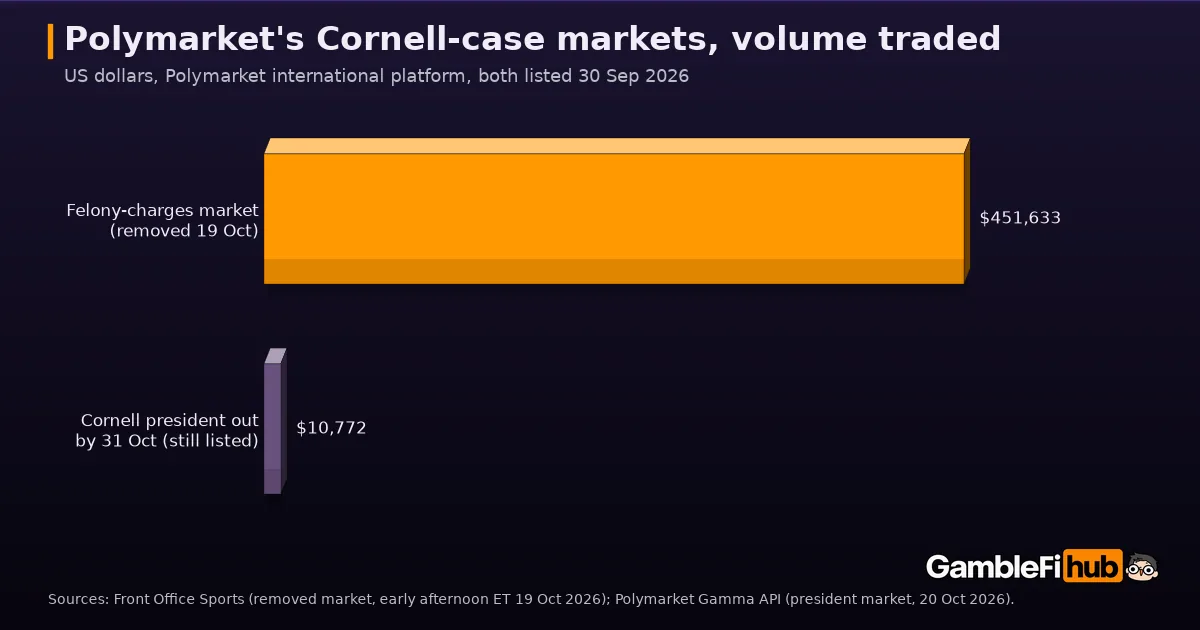
Polymarket has removed a market that let traders bet on whether any of seven men accused in a Cornell University sexual-assault case would be charged with a felony sex crime. The market ran only on Polymarket's international platform, not its US app. Front Office Sports reported on 19 October 2026 that it had drawn $451,633 in volume since it opened on 30 September, with traders pricing a charge before 31 January 2027 at about 28%. Polymarket first defended the market, then took it down after the story ran. The reversal followed public criticism from survivors' advocates.
From defence to removal
The market followed a civil lawsuit filed on 16 September by a Jane Doe plaintiff against Cornell, the Chi Phi fraternity and seven of its members. The Tompkins County district attorney decided not to bring charges in 2024 but has reopened the investigation. Advocates for assault survivors attacked the market on Instagram and urged Polymarket's celebrity ambassadors to distance themselves from it.
A Polymarket spokesperson first told Front Office Sports that the market brought “objective, data-driven insight into how a matter like this is moving through the legal system.” Polymarket removed it later that day. According to The Washington Sun, Polymarket declined to explain why it changed course. The New York Post also reported the removal. A second market, on whether Cornell's president will be out by 31 October, was still listed on 20 October.
What the rules say
In the US, CFTC Rule 40.11 bars registered exchanges from listing event contracts that involve terrorism, assassination, war, gaming or activity unlawful under state or federal law. That rule covers CFTC-registered venues such as Polymarket's US exchange. The international platform where this market ran operates separately from it. Kalshi spokesperson Elisabeth Diana told Front Office Sports that Kalshi “would not consider” such a market.
Kenya has written the line more precisely. Regulation 45 of its Conduct of Gambling Operations Regulations 2026 bars licensees from offering any prediction market without the regulator's prior approval. It also bans markets on proceedings pending before a Kenyan court, on the physical safety, health or death of an identifiable person, and on events contrary to national security, public order or public interest. Licensees must use an approved, independent way to settle outcomes and keep records of every contract.
The Gambling Regulatory Authority now plans a separate licence class for prediction markets in its 2026/27 licensing period. Director General Peter Karimi told Business Daily that the regulator treats prediction markets as gambling. He named geography and cryptocurrency on-boarding as the main problems. No application terms or start date have been published.
Key facts
Removed market: whether any of seven defendants in the Cornell case is charged with a felony sex crime by 31 Jan 2027; Polymarket international platform only; listed 30 Sep 2026, removed 19 Oct 2026.
Volume before removal: $451,633, about 28% on “yes” (Front Office Sports, 19 Oct 2026).
Still listed: Cornell president out by 31 Oct 2026, $10,772 volume (Polymarket data, 20 Oct 2026).
US rule: 17 CFR 40.11(a), event contracts on terrorism, assassination, war, gaming or unlawful activity.
Kenya rule: Gambling Control (Conduct of Gambling Operations) Regulations 2026, L.N. 112, Kenya Gazette Supplement No. 163, 30 Jun 2026, regulation 45(5)–(8).
Why it matters for GambleFi
Prediction markets now come in two kinds: regulated exchanges with written listing rules, and offshore, crypto-funded platforms where the operator sets its own limits. This removal shows how the second kind works. Here, public pressure did the job a listing rule does on a regulated exchange. That gap is what states and regulators keep pointing to in the fights over event contracts, from the CFTC's casino carve-out to the Crypto.com exchange's suit against Missouri. For the basics, see our GambleFi FAQ. This is a news report, not betting advice.