
BC.Game, the crypto casino behind the BC iGaming token, has taken its in-house Video Poker and single-player Baccarat games offline after confirming that their card shuffle was biased against players. The problem was first published on 17 November by the testing group ProvablyFair.org. On 19 November, BC.Game chief executive Ali “Ako” Muhanned wrote on X that the company’s own investigation had confirmed the bias and that its simulations were consistent with the report. BC.Game is paying 1,916,155.68 USDT in compensation, about $1.9m, and is replacing the shuffle in both games.
What the shuffle did
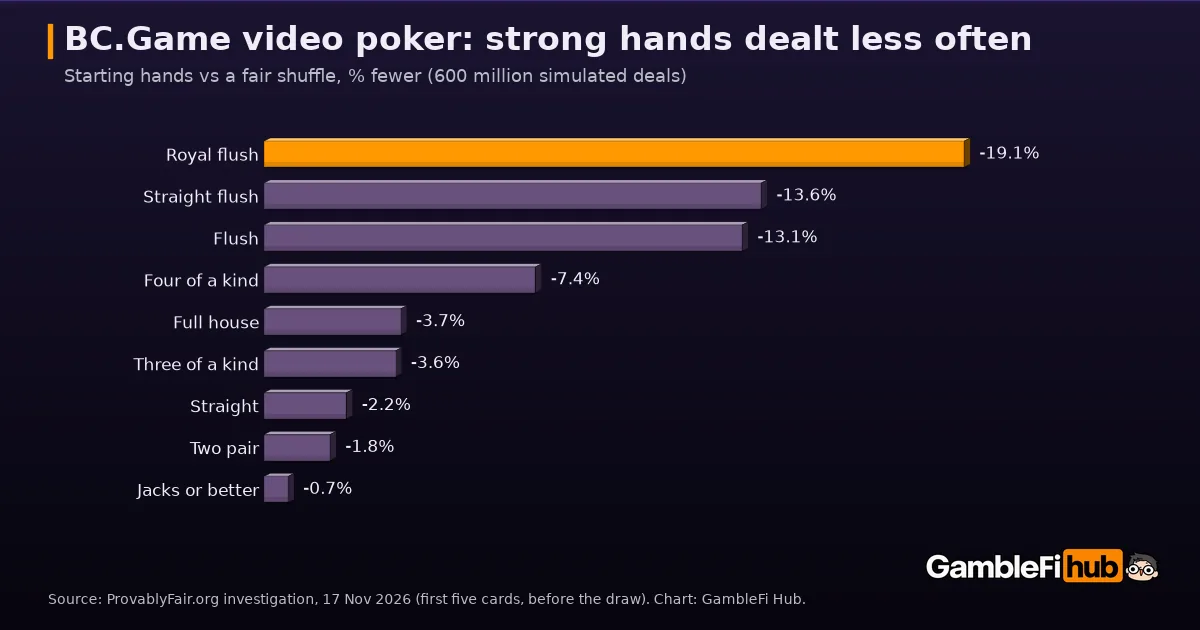
On the current 98% paytable, Video Poker returned about 96.4% under optimal play, according to both ProvablyFair.org and BC.Game. That means a house edge of about 3.6% instead of the advertised 2%, or roughly $36 instead of $20 of expected loss per $1,000 wagered. The report explains why. Instead of shuffling the deck properly, the game sorted cards using copies of one hash, so cards that sit next to each other in a fixed list tended to arrive together. Across 600 million simulated deals, strong starting hands came up less often than with a fair deck: royal flushes 19.1% less often, straight flushes 13.6% and flushes 13.1%.
In single-player Baccarat, the Player Pair side bet returned about 77.2% against 80.8% with a fair shuffle, BC.Game said. Other Baccarat bets moved less, some in the player’s favour. BC.Game says Keno, multiplayer Baccarat, Patti, Mines and StellarRush use a different shuffle and showed no material bias in its tests.
Why provably fair did not catch it
ProvablyFair.org played 62 real Video Poker hands, and every one matched BC.Game’s own verifier. That is the point of the case. A provably fair check proves that a round followed the seeds committed before the bet. It does not prove that the method turning those seeds into cards is fair. BC.Game’s statement makes the same distinction: the seed commitment and verification “remain intact”, but “the shuffle algorithm itself was flawed”. For players who rely on provably fair labels when choosing GambleFi platforms, a passing verification is a necessary check, not proof of the advertised return.
Key facts
Games affected: BC.Game Video Poker and single-player Baccarat (Player Pair bet most affected).
Video Poker return, 98% table: about 96.4% under optimal play.
Compensation: 1,779,578.29 USDT to 576,782 Video Poker accounts; 136,577.39 USDT to 142,267 Baccarat accounts.
Form: bonus with zero wagering requirements, withdrawable directly.
Fix: new shuffle modelled on BC.Game’s Bingo draw algorithm.
Sources: ProvablyFair.org investigation (17 November 2026); BC.Game CEO statements on X (19 November 2026).
Our numbers: about $3 per account
Video Poker takes 92.9% of the total payout. The average comes to about 3.09 USDT per eligible Video Poker account and 0.96 USDT per Baccarat account, although some accounts may appear in both groups. BC.Game says compensation is calculated from each player’s actual wagers to make up the return lost to the bias. ProvablyFair.org measured that gap at 1.5 to 1.7 percentage points across the 96%, 98% and 99% paytables. If the payout tops up roughly that share of each dollar wagered, the Video Poker figure implies about $104m to $116m of eligible wagers. That is our estimate, not a BC.Game figure.
The 2020 change and open questions
According to BC.Game, the shuffle was built in-house in 2018 and at first favoured players. In 2020 the team changed the deck’s starting order after spotting irregularities, and that change turned the bias against players without anyone noticing. ProvablyFair.org dates the new card list in the published verifier to 8 April 2020. On the paytable then in use, the old list returned about 102.6% and the new one about 97.3%. The report makes no finding about intent and does not establish total player losses. BC.Game did not say which period its compensation covers. A few hours later the CEO said all affected players had been notified and credited.
Why it matters for GambleFi
BC.Game is one of the 17 iGaming token platforms we follow, with its own project page for the BC token. The shuffle case follows the end of its Leicester City shirt deal and the launch of CrashX this month. In our licence check of 17 iGaming token platforms, ten had a current entry in the Curaçao, Anjouan or Tobique registers. A register entry shows that a licence exists; it does not show whether a game’s math matches its advertised return. Here an outside group found the flaw, not a regulator.
For background on how these platforms work, see the GambleFi FAQ. This is news and data, not investment advice and not a recommendation to use any platform. If gambling is causing you harm, contact a local support service.