
Gibraltar’s Gambling Division has put a full rewrite of its Remote Technical and Operating Standards (RTOS) out for consultation. The RTOS is the code that tells the territory’s online gambling licensees how to run accounts, games, payments and security. The consultation draft is version 2.0, dated 19 November 2026 and issued under section 13 of the Gambling Act 2025. It would replace the 2012 code, which is still in force. The consultation page asks for responses by 19 January 2027, and the draft has no legal effect until a final version is issued.
Our numbers: from advice to rules
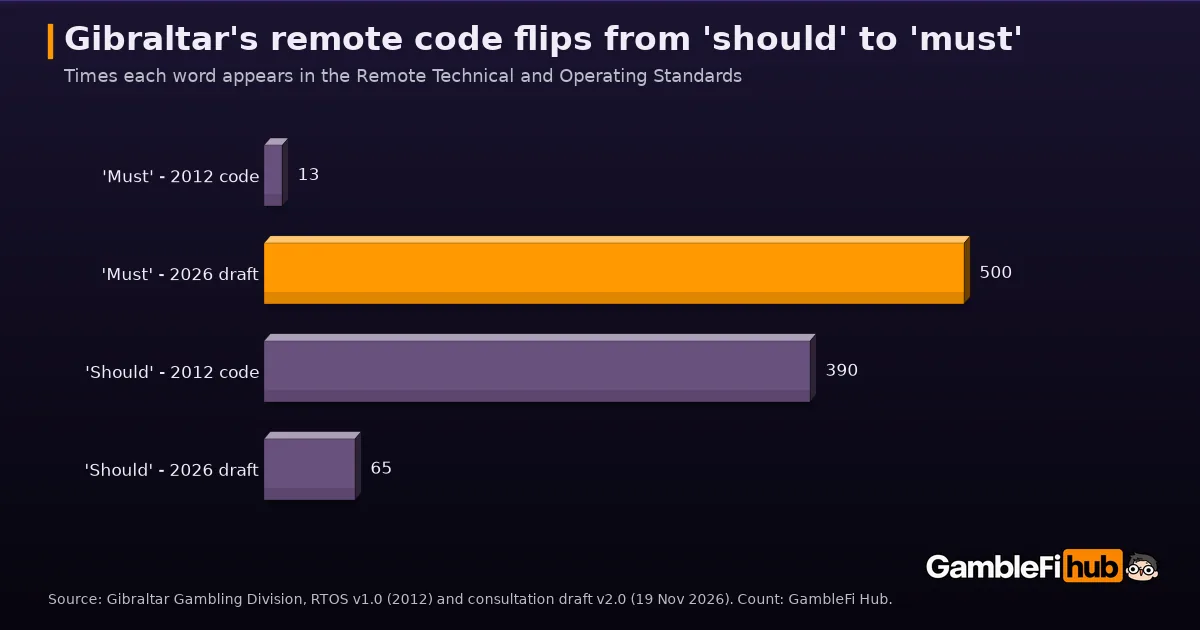
The draft defines its own wording. “Must” marks a prescribed requirement, while “should” marks the approach the Commissioner would normally expect, with room for alternatives that reach the same goal. So we counted both words in the two documents. The 2012 code uses “must” 13 times and “should” 390 times. The 2026 draft turns that around: “must” appears 500 times and “should” only 65 times. The documents are about the same size, 54 pages in 2012 and 51 pages now, so the shift is not about length. In plain terms, a code that was mostly guidance becomes mostly hard requirements. A word count does not measure how strict each rule is, but it shows how much of the text an operator can no longer treat as optional.
What changes for players
Several new requirements are aimed at the customer account. Licensees must offer deposit limits at registration or by the first deposit at the latest, and a “no limit” choice should not be the default. Raising or removing a limit cannot take effect for at least 24 hours. Self-exclusion must cover every brand and label the licence holder controls, not just the site where the player asked for it. Time-outs should run from 24 hours to six weeks, and self-exclusion periods should be six months or longer. Withdrawals are not allowed until age and identity checks are complete, and after that they should normally be paid within five working days. On games, a losing result must not be swapped to show a false near miss, and a new random number generator needs a certificate from an approved testing facility before it goes live.
Key facts
Document: Remote Technical and Operating Standards, consultation draft v2.0 (2026).
Issued by: Gibraltar Gambling Commissioner, under section 13 of the Gambling Act 2025.
Draft date: 19 November 2026; responses due 19 January 2027.
Replaces: RTOS version 1.0 (2012), in force until a final code is issued.
Structure: 15 standards, including new chapters on esports, live-dealer studios, white labels and AI.
Sources: Gibraltar Gambling Division draft, 2012 code and consultation page.
Hacks, fairness claims and AI
Standard 7 requires licensees to report any material security incident to the Commissioner. The draft says an incident should normally count as material if it puts customer data, customer funds, fair outcomes or critical systems at risk, or if it keeps customers out of key services for more than 12 hours. Reporting must not wait until all the facts are known. A drained hot wallet, like the Gamdom and Duelbits cases or the Anjouan casino drain we covered, would clearly fall into the funds category. Standard 5 adds that any claim that a game is fair, random, certified or independently tested must be accurate, current and capable of being proven. Standard 15 is new: material AI systems need records and a named owner, a human must be able to override decisions that seriously affect a customer, and AI-made content must be disclosed where leaving it out would mislead.
Why it matters for GambleFi
The draft does not mention cryptocurrency, blockchain or provably fair systems. Its relevance for iGaming token platforms, also called GambleFi projects, is the benchmark it sets. In our licence check of 17 iGaming token platforms, ten had a current entry in the Curaçao, Anjouan or Tobique registers, and seven of those ten were licensed in Anjouan. Those regimes are tightening on their own timetable, as with Curaçao’s crypto rules, while smaller jurisdictions compete in new areas such as prediction market licences in Nevis. Gibraltar’s draft shows where a tier-one regulator draws the line on withdrawals, self-exclusion and incident reporting, and gives players a concrete list to compare against. For background, see the GambleFi FAQ. This is news and data, not investment advice and not a recommendation to use any platform. If gambling is causing you harm, contact a local support service.