
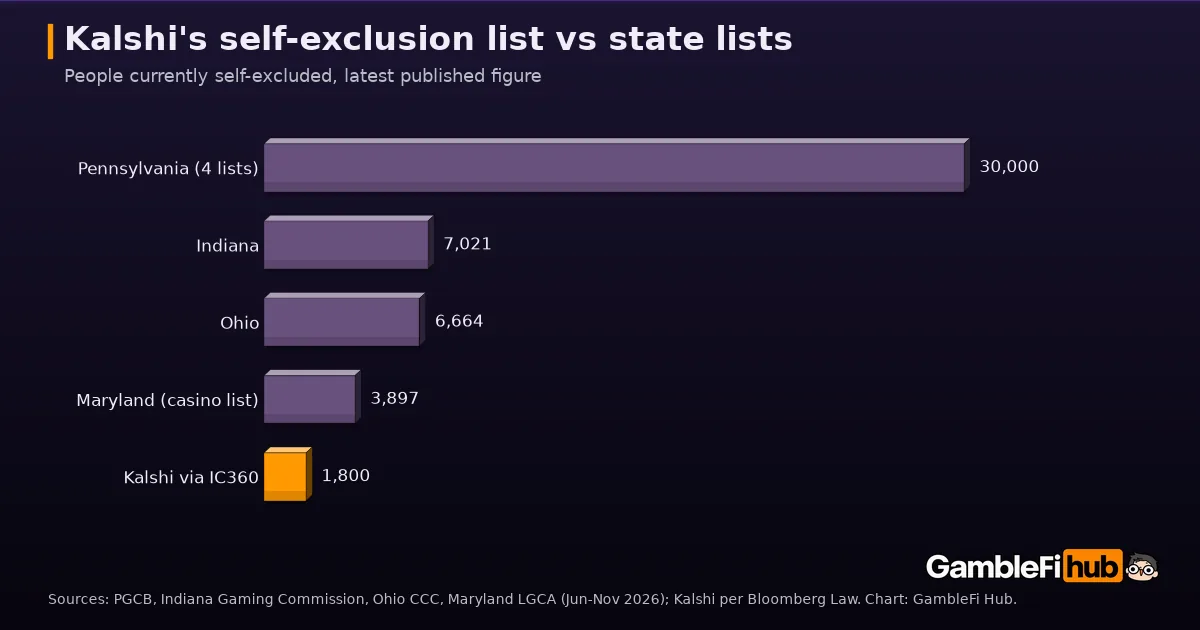
Kalshi and its smaller rival Novig have asked 35 US states to share their gambling self-exclusion lists, the registers of people who have asked to be barred from betting. Bloomberg Law, which reviewed the joint letter, reported that it went out on 19 November 2026 and asks states to reply by 15 December. The letter has not been published; the Washington Examiner also obtained a copy. The request comes from two companies that are in court with several of the same states over whether their sports contracts are gambling at all. We looked at the program the letter promotes and compared Kalshi’s list with the counts that state regulators publish.
What the letter asks for
The argument is a gap in coverage. A state self-exclusion list binds only the operators that state licenses, so a person who has barred themselves from local sportsbooks can still open an account on a CFTC-regulated exchange. According to Bloomberg Law, the companies wrote that “a person’s choice to self-exclude should not depend on where they live or which regulator oversees a platform”, and that “a single federal self-exclusion program can protect every person who asks for it, on every platform, in every state”. In return for the state lists, Kalshi offers the roughly 1,800 people on its own register, which is held by the compliance firm IC360. Polymarket is named as an IC360 partner but did not sign the letter, Bloomberg Law reported.
How SelfExclude.io works
The letter points states to SelfExclude.io, a voluntary program run by IC360. Users verify their identity with a government ID through Veriff and pick a fixed term of 1 month, 3 months, 6 months or 1 year. Their data is double-hashed, and partner platforms only receive a match or no-match answer, not a name or address. The site lists Kalshi and Novig as fully integrated; Polymarket, Robinhood, ProphetX, Matchbook and Juice Exchange are “in-progress”. Every exclusion ends automatically when the term runs out, and the program is open only to people in the United States.
Key facts
Senders: Kalshi and Novig, both CFTC-regulated prediction market exchanges.
Recipients: 35 states; letter dated 19 November 2026, reply requested by 15 December.
Offer: Kalshi’s list of about 1,800 people, held by IC360.
Program: SelfExclude.io; terms 1 month to 1 year, auto-expiring; US only.
Not signed by: Polymarket, Robinhood and other in-progress partners.
Sources: Bloomberg Law, Washington Examiner, SelfExclude.io, state regulator reports.
Our numbers
State lists are far larger than Kalshi’s. The Pennsylvania Gaming Control Board says in its 2025-26 annual report that about 30,000 people remain actively enrolled across its four self-exclusion programs, which makes Kalshi’s list about 6% of Pennsylvania’s alone. Indiana’s Gaming Commission reports 7,021 enrolled participants in a report printed on 2 November 2026. Ohio’s Casino Control Commission counted 6,664 active participants on 9 October 2026, and Maryland’s casino list had 3,897 people on 30 September 2026, not counting its separate sports list. The longer terms matter too: in Ohio, 3,478 of the 6,664 active participants, or 52%, have stayed enrolled past their expiration date. Under SelfExclude.io, by contrast, no exclusion can run longer than a year without the user signing up again. These counts are not fully like-for-like, since states define their lists differently.
Why it matters for GambleFi
Self-exclusion has become part of the wider fight over who regulates prediction markets. If states share their lists, they help a product they are trying to ban; if they refuse, the exchanges can point to the refusal when they argue for federal rules. State privacy rules may also stand in the way: Pennsylvania’s gaming board, under 58 Pa. Code § 503a.7, “will not disclose identifying information” about who is on its casino list. The move follows other player-protection steps under state pressure, such as Kalshi’s $2,500 deposit limit for 18 to 20-year-olds, while lawsuits like Arkansas’s deceptive trade practices case and the CFTC’s suit against Louisiana continue. Novig is also under CFTC scrutiny over its micro and scorigami contracts. Onchain venues such as SX Bet are not part of any of these lists. For background, see the GambleFi FAQ. This is news and data, not investment advice and not a recommendation to use any platform. If gambling is causing you harm, contact a local support service.