
Arkansas has become the latest state to take Kalshi to court. Attorney General Tim Griffin filed a civil lawsuit against KalshiEX LLC and Kalshi Inc. on 4 November 2026, accusing the prediction market of running unlicensed gambling in the state. The AG’s release frames it bluntly: betting on whether the Razorbacks win “is gambling”, and Arkansas law “is concerned with substance, not semantics”.
A consumer-protection case, not a gambling prosecution
Unlike Utah, which filed criminal charges against Kalshi and its founders in October, Arkansas is suing under the Arkansas Deceptive Trade Practices Act. Griffin says Kalshi skipped the licences, oversight, restrictions and taxes that apply to lawful gambling operators, then opened its platform to Arkansans and profited from their wagers. The relief he names is restitution, penalties, taxes and an injunction.
According to AskSpinner, which reviewed the filing, the case is State of Arkansas v. KalshiEX LLC and Kalshi Inc., No. 32CV-26-717 in the Independence County Circuit Court. It describes a 57-page complaint with three deceptive-practices counts plus unjust enrichment, a jury demand, and outside counsel from the firm DiCello Levitt. The act allows civil penalties of up to $10,000 per violation. The complaint calls Kalshi, for most of its offerings, “a pocket-sized bookie” rather than a risk-management tool.
The age gap
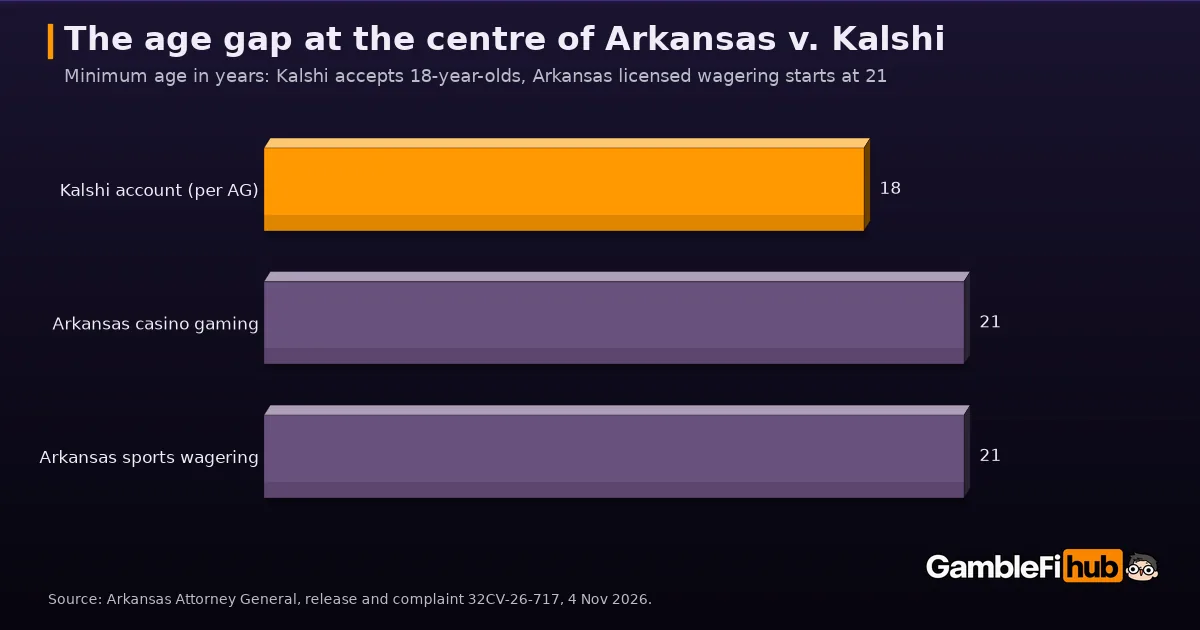
The sharpest point is age. The AG says Kalshi accepts users “as young as 18”, while regulated casino gaming and sports wagering in Arkansas start at 21 (see chart). Kalshi had already moved on this front: it introduced a $2,500 deposit limit for 18- to 20-year-olds in October. Arkansas also alleges, on information and belief, that thousands of residents hold Kalshi accounts and that the company never paid sales or use taxes there.
Griffin turns Kalshi’s own safety features against it. Self-exclusion, deposit limits, trading breaks and a partnership with the National Council on Problem Gambling are, in his words, tools “commonly associated with gambling operators”, which shows Kalshi knows its product carries gambling risks.
One of many fronts
Kalshi is registered with the CFTC as a designated contract market and argues that federal law pre-empts state gambling rules. It is already fighting Utah, Missouri and New York, among others. The same day, Griffin filed a separate suit in White County against VGW, the company behind the sweepstakes casino Chumba Casino, the Arkansas Advocate reported. Kalshi had not commented publicly when the suits were reported. The claims are allegations and have not been tested in court.
Key facts
Case: State of Arkansas v. KalshiEX LLC and Kalshi Inc., No. 32CV-26-717, Independence County Circuit Court, filed 4 November 2026.
Legal basis: Arkansas Deceptive Trade Practices Act (three counts) plus unjust enrichment.
Relief sought: restitution, civil penalties (up to $10,000 per violation), unpaid taxes, damages, injunction; jury trial demanded.
Age point: Kalshi open from 18; Arkansas regulated wagering from 21.
Same-day suit: VGW (Chumba Casino, LuckyLand, Global Poker), White County.
Sources: Arkansas Attorney General release (4 November 2026); AskSpinner and Arkansas Advocate for complaint details.
Why it matters for GambleFi
States are not waiting for courts to settle the pre-emption fight. Consumer-protection law gives an attorney general a path that skips the question of whether an event contract is a swap, which matters for every onchain betting venue and iGaming token (GambleFi token) project that serves US users from offshore. For background on how prediction markets and crypto casinos differ, see the GambleFi FAQ or our SX Bet project page. This is a report on a lawsuit, not legal or gambling advice.