
The US Senate has passed S. 4035, the DEATH BETS Act, a bill that would stop CFTC-registered exchanges from listing contracts on terrorism, assassination, war, US military operations or a person’s death. According to the Senate floor log, Senator Adam Schiff won passage by voice vote on the evening of 19 November 2026, together with an amendment he wrote with Senator John Curtis. The bill is not law yet: Congress.gov shows it was received in the House on 20 November and is being held at the desk. We read both versions of the text and counted how much money already sits in war-themed markets on Polymarket’s international onchain venue.
What the Senate text bans
The version passed by the Senate adds a new subsection to Section 5c of the Commodity Exchange Act. A registered entity, meaning a CFTC-designated exchange or clearing house, “shall not list for trading or accept for clearing” two kinds of event contract. The first is any contract that “expressly references” terrorism, assassination, war, US Armed Forces military operations, or a similar activity that the CFTC defines by rule. The second is any contract that, when it is listed, “is reasonably expected to resolve principally based on a death of an individual”. A rule of construction says the bill does not change how the other activities named in the existing law are treated, gaming among them. In practice this turns a power the CFTC already has, and uses at its discretion, into a fixed ban written into the statute.
Narrower than the March draft
The amendment made the bill tighter in scope. The text introduced on 10 March 2026 covered any contract that “involves, relates to, or references” terrorism, assassination or war, and any contract that “could otherwise be construed as correlating closely” to a person’s death. The passed text only catches contracts that expressly reference those topics, and death contracts only if the death is expected to drive the result at the time of listing. In exchange it adds US military operations as a named category. Markets that merely move with a conflict, such as oil prices or a leader leaving office, are much harder to reach under the new wording.
Key facts
Bill: S. 4035, Discouraging Exploitative Assassination, Tragedy, and Harm Betting in Event Trading Systems (DEATH BETS) Act.
Sponsors: Sen. Adam Schiff (D-CA); cosponsor Sen. John Curtis (R-UT).
Timeline: introduced 10 March 2026; Senate Agriculture Committee discharged and bill passed by voice vote 19 November; received in the House 20 November.
Applies to: CFTC registered entities (exchanges and clearing houses).
Next steps: House vote, then the President’s signature.
Sources: Congress.gov, Senate Daily Press, bill texts as introduced and as passed, Polymarket Gamma API.
Our numbers
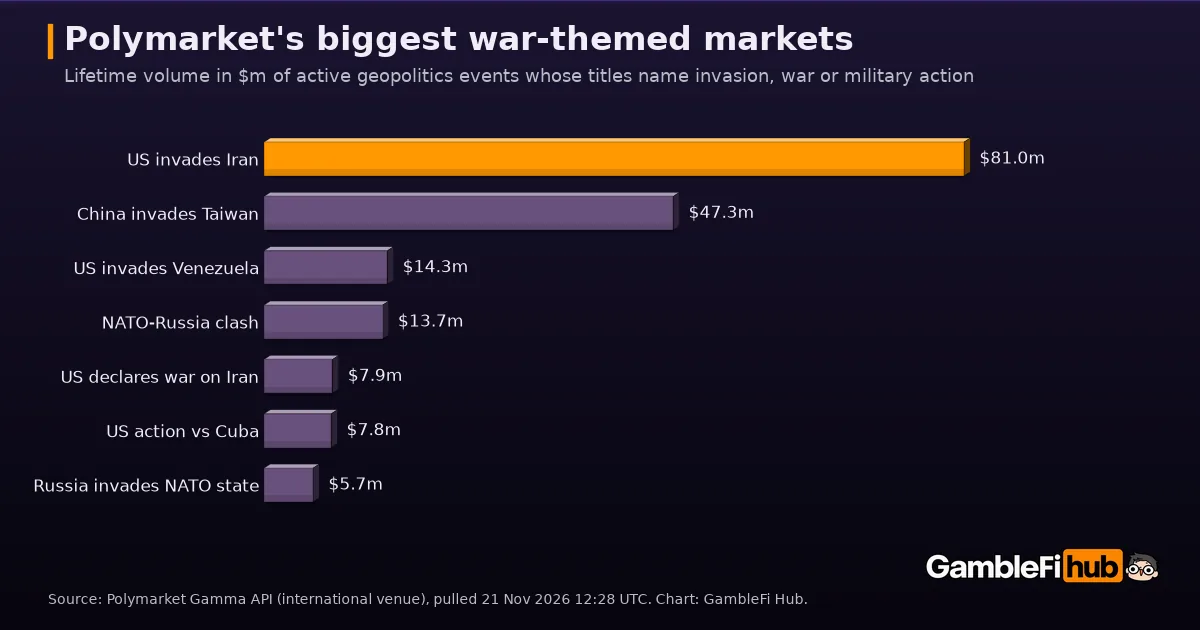
The ban only binds CFTC-registered entities. Polymarket’s international onchain venue is not one; its separate US exchange is. To see what sits outside the bill’s direct reach, we pulled every active event tagged geopolitics from Polymarket’s public Gamma API on 21 November at 12:28 UTC. There were 493 such events with $1.31 billion in lifetime volume. Of these, 46 events have a title that names an invasion, a war or military action; together they have traded $206.1 million, or 15.7% of the category. Two markets carry most of it: “Will the U.S. invade Iran before 2027?” at $81.0 million and “Will China invade Taiwan by end of 2026?” at $47.3 million, 62% of the 46-event total between them. In the last 24 hours the 46 events drew about $0.80 million in new volume. Our title filter is a simple word match, not a legal test of what counts as “expressly” referencing war, and lifetime volume includes trading in sub-markets that have already resolved. As noted in our fee analysis, Polymarket charges no taker fee in the geopolitics category at all, before and after its 20 November fee change.
Why it matters for GambleFi
For prediction markets and the wider GambleFi space, the bill draws a line by venue, not by contract. If the House passes it, US-regulated exchanges would lose these markets by law, while onchain venues outside CFTC registration would not be covered by the ban directly. That widens the gap between the two halves of the market that we tracked in our comparison of Polymarket US and its international venue. It also lands in the middle of the wider fight over who regulates event contracts, from the 43 states asking the CFTC to drop its sports swap rule to the senators’ letter on geoblocking. For background on how these markets and onchain betting venues such as SX Bet work, see the GambleFi FAQ. This is news and data, not investment advice and not a recommendation to use any platform.