
A bipartisan coalition of 43 state attorneys general and the District of Columbia has asked the US Commodity Futures Trading Commission to withdraw its proposal to define event contracts as swaps. The formal comment, filed on 18 November 2026, the last day of the comment period, is co-led by Ohio Attorney General Andy Wilson with Kentucky, Maryland, Nevada, New Jersey, New York, Tennessee and Utah. “A sports bet isn’t a derivative just because the CFTC says so,” Wilson said.
What the states argue
The October proposal would expressly add event contracts on sports, politics, culture and weather to the CFTC’s definition of a swap, which would put them more firmly under federal derivatives law. The attorneys general say Congress never gave the agency power over sports gambling and point to federal appeals courts that have ruled against prediction-market operators, most recently the Fourth Circuit in Maryland. They also argue the Commission cannot adopt the rule with only one commissioner serving, and warn that licensed sportsbooks could reorganise as prediction markets to escape state licensing, age limits and problem-gambling rules. They ask the CFTC to state that sports-betting contracts are not swaps at all.
Key facts
Proposal: “Further Definition of ‘Swap’ – Inclusions”, RIN 3038-AF82, 91 FR 66022, published 19 October 2026.
Comment period: 19 October to 18 November 2026 (30 days).
Vote: Chairman Michael Selig voted in favour; no commissioner voted against.
Coalition: 43 states and DC; 8 co-leads, 35 further states plus DC.
Earlier letter: 44 attorneys general, July 2026, on the CFTC’s first prediction-market proposal.
Sources: Ohio Attorney General release, Federal Register, Regulations.gov docket CFTC-2026-2213.
Our numbers
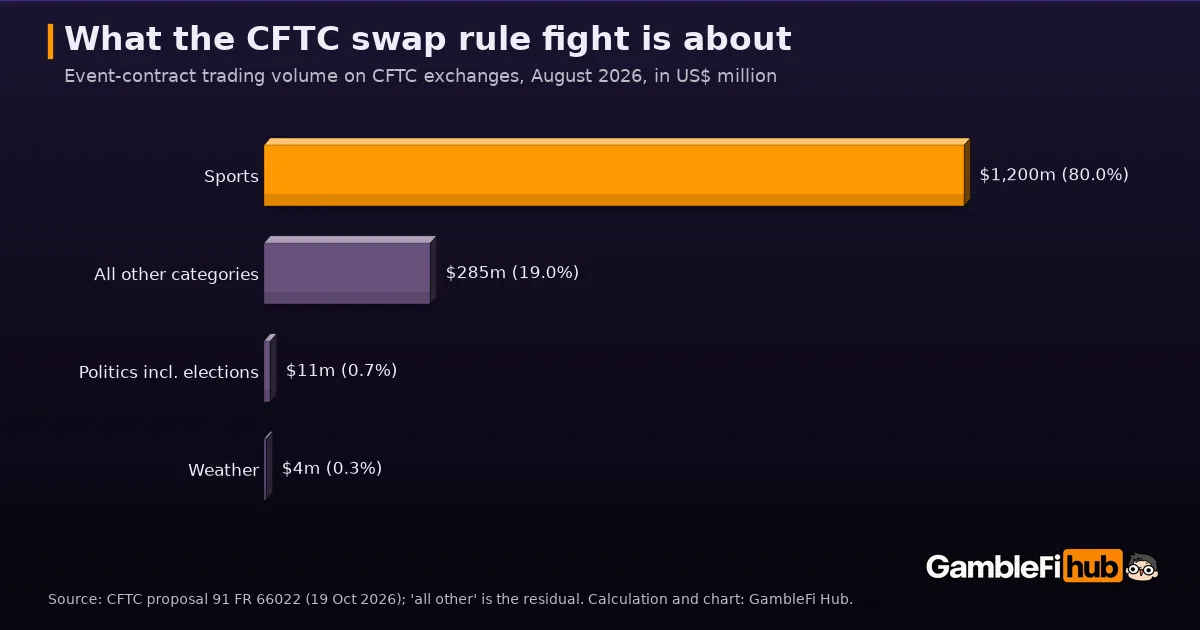
The CFTC’s own proposal shows what is at stake. In August 2026 event contracts on CFTC-registered exchanges traded about $1.5 billion; about $1.2 billion of that was sports, $11 million politics and elections, and $4 million weather. That makes sports 80% of the volume, politics 0.7% and weather 0.3%; the remaining $285 million (19%) sat in all other categories (see chart). The states are contesting the category that carries four of every five dollars.
The coalition covers 44 of 51 attorney-general offices (50 states plus DC), or 86%, leaving 7 states off the comment. The full signature list was not yet public when we checked: on 19 November around 13:30 CET the public docket showed 56 comments on the proposal and 45 on the separate casino carve-out rule, and the attorneys general’ filing was not among them. Of the 56, 37 had been posted in the previous three days, and 10 came from tribal nations or tribal gaming associations. Industry filers include Underdog, Gemini, the Hyperliquid Policy Center and Brazil’s exchange B3. The quorum point rests on simple arithmetic: the Commission has five seats and one is filled, which is why the nominee hearing matters for the rule’s fate.
Why it matters for GambleFi
The swap definition is the legal footing CFTC-registered exchanges use against state gambling law, and the coalition’s co-lead Ohio is the state Novig sued on 16 November. The same federal-state clash sits behind the senators’ geofencing letter. Even if finalised, the rule would cover exchanges registered with the CFTC; it would not make unregistered onchain prediction markets, Hyperliquid’s outcome markets or betting exchanges such as SX Bet lawful for US users, and iGaming token (GambleFi) projects offering sports books stay under state law either way. The CFTC must now review the comments and decide whether to finalise, revise or drop the proposal. Our GambleFi FAQ explains how prediction markets differ from casino betting. This is a brief on a public rulemaking, not legal advice.