
Three US states have now written taxes on prediction markets into law, and each one taxes something different. That is the finding of a Pew Charitable Trusts analysis published on 19 November 2026, which counts at least 15 states that considered prediction-market legislation this year and three, North Carolina, Kentucky and Illinois, that enacted a tax. Pew warns that states have little data to forecast the revenue and should not build ongoing spending on it.
Three laws, three tax bases
North Carolina’s tax, in the state budget Senate Bill 257, takes 6% of an operator’s net trading fee revenue from sports event contracts traded by residents present in the state; market-maker payments, promotions, clearing and withdrawal fees are deducted first. Kentucky’s House Bill 757, passed over the governor’s veto in April, sets 14.25% of “transaction fees”, which the Kentucky Department of Revenue defines to include the amount a consumer pays to buy the contract. Illinois, in Public Act 104-0468, put sports exchange wagers under its Sports Wagering Act with a tax of 1.75% of each wager for an operator’s first 5 million wagers in a fiscal year and 3.5% after that.
Key facts
North Carolina: 6% of net trading fee revenue; from 1 January 2027; annual return.
Kentucky: 14.25% of fees plus purchase amounts; from 1 January 2027; first monthly return due 22 February 2027.
Illinois: 1.75% per sports exchange wager, 3.5% above 5 million wagers a fiscal year; in force since mid-2026 (signed 16 June).
Litigation: the CFTC sued Kentucky (E.D. Ky. 3:26-cv-00049), calling the levy a fee meant to push exchanges out; Kalshi has sued Illinois.
Sources: Pew, NC SB 257 § 44.9, KY Department of Revenue, Illinois General Assembly, CFTC.
Our numbers
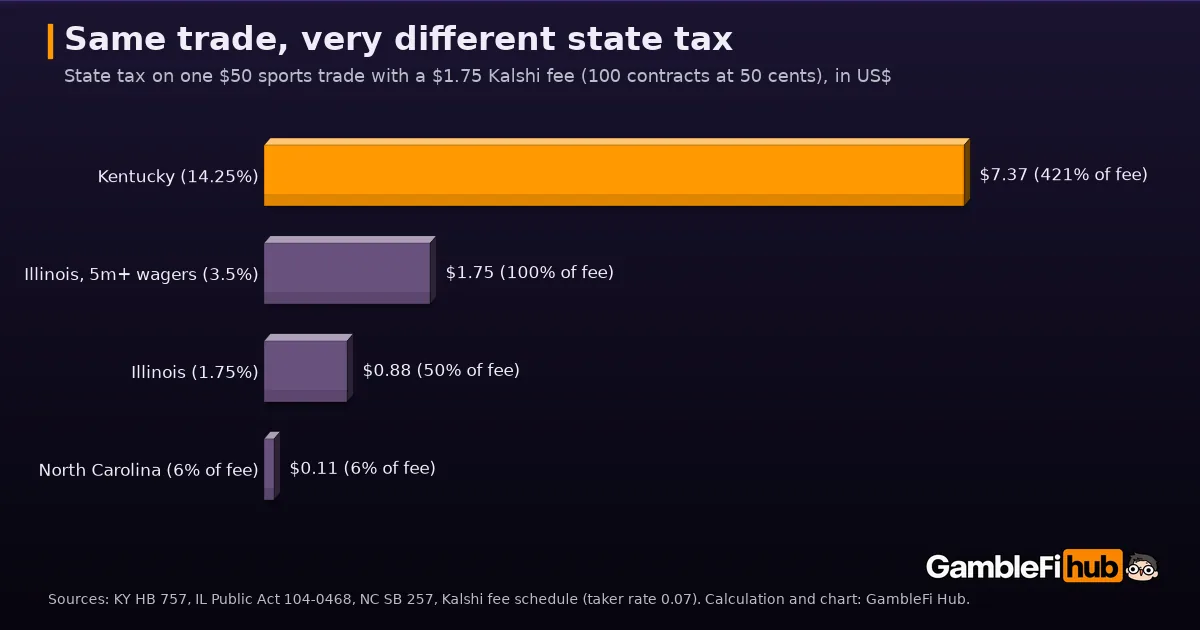
The difference in base matters more than the headline rate. Take one sports trade: 100 contracts bought at 50 cents, so $50 paid. At Kalshi’s general taker rate of 0.07 (see our fee comparison) the fee is 0.07 × 100 × 0.50 × 0.50 = $1.75. North Carolina’s 6% of that fee is about 11 cents. Illinois takes 1.75% of the $50, or 88 cents, half the fee, and at 3.5% it takes $1.75, the whole fee. Kentucky takes 14.25% of $51.75, or $7.37: 421% of the fee and about 70 times North Carolina’s tax on the same trade (see chart).
That is not a quirk of the example. Under Kalshi’s formula the fee is 0.07 × (1 − price) of the amount paid, so it never exceeds 7% of the stake, while Kentucky’s tax is at least 14.25% of it. Kentucky’s levy therefore exceeds the exchange’s fee on every taker trade at that rate, which is the core of the CFTC’s argument. North Carolina’s own estimate is modest: about $1 million in 2026-27, according to the Carolina Journal. Both new regimes start in 43 days, on 1 January 2027.
Why it matters for GambleFi
Sports are the bulk of event-contract trading (see our volume by category), so taxes aimed at sports contracts hit the core of the business. They also sit inside the wider state-federal fight: the same week 43 states and DC asked the CFTC to drop its swap rule, while the CFTC presses exchanges to drop state geoblocks and has sued states such as Arkansas. The laws target registered operators; offshore onchain markets, iGaming token (GambleFi) platforms and exchanges such as SX Bet do not become licensed or legal for US users through them. Our GambleFi FAQ explains how prediction markets differ from casino betting. This is a brief on public law and filings, not tax or legal advice.