
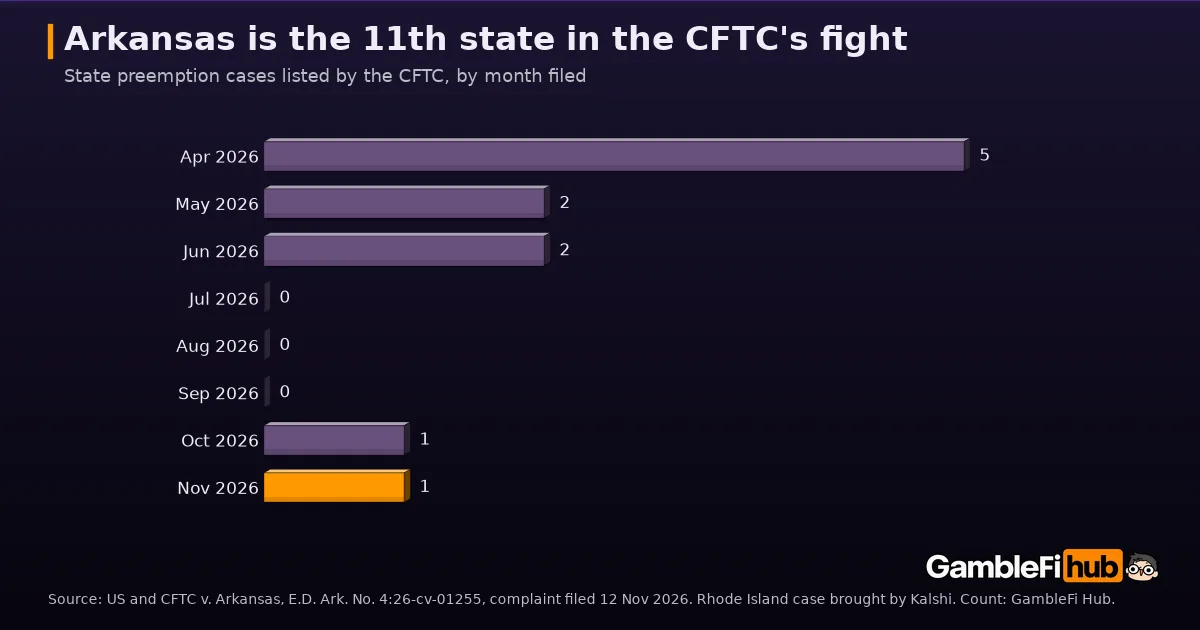
The federal government has stepped into Arkansas’s fight with Kalshi. On 12 November, the United States and the Commodity Futures Trading Commission filed a 34-page complaint against the State of Arkansas and Attorney General Tim Griffin in the US District Court for the Eastern District of Arkansas in Little Rock (case 4:26-cv-01255, docket). It asks the court to stop the state’s gambling case against Kalshi and any future Arkansas action against CFTC-regulated exchanges. Kalshi itself is not a party.
The target is the suit Griffin filed on 4 November in Independence County Circuit Court, which calls Kalshi “a straightforward gambling platform” and brings claims under the Arkansas Deceptive Trade Practices Act plus unjust enrichment. The federal complaint is dated 10 November, six days after the state filed, and reached the docket two days later.
What Washington is asking for
The complaint has a single count under the Supremacy Clause. It argues that Kalshi’s event contracts are swaps under the Commodity Exchange Act, that Kalshi is a CFTC-designated contract market, and that the agency’s “exclusive jurisdiction” over swaps on such markets pushes state law aside. It claims express, field and conflict preemption. The laws it names are the deceptive trade practices act, the state’s gambling chapter (Ark. Code Ann. §§ 5-66-101 to -120), § 7-1-103, the state rules at 23 CAR §§ 358-2001 to -2031, and common law.
It asks for a declaration that these laws are invalid as applied to trades on CFTC-regulated exchanges, and for a preliminary and permanent injunction that would bar Arkansas from investigating those exchanges “and their affiliates and partners” or enforcing state law against them. That is the same wording the CFTC used against Utah in October. The docket shows no separate motion for a preliminary injunction yet.
The complaint also points to the CFTC’s 5 November impartial access interpretation, which tells exchanges to drop US state geoblocks within 30 days. If Arkansas wins, it says, exchanges would have to shut out Arkansas residents and break that rule, and they would face “the prospect of 50 regulators”.
The penalty math
Arkansas wants civil penalties of up to $10,000 per violation. The complaint says Kalshi earns between $0.07 and $2.63 in fees per 100 contracts on most markets, and warns that per-violation penalties could reach hundreds of millions of dollars. By our calculation, a single maximum penalty equals Kalshi’s fees on about 380,000 contracts at the top fee rate, or about 14.3 million contracts at the lowest.
Key facts
Case: United States and CFTC v. State of Arkansas and Tim Griffin, E.D. Ark. No. 4:26-cv-01255; filed 12 November 2026, complaint dated 10 November.
State case targeted: Arkansas v. KalshiEX LLC et al., No. 32CV-26-717, Independence County Circuit Court, filed 4 November 2026.
Claim: one count, Supremacy Clause preemption under the Commodity Exchange Act.
Relief sought: declaration; preliminary and permanent injunction; costs.
CFTC state cases: 11 states including Arkansas; preliminary injunctions so far in Arizona, Illinois and Minnesota, per the complaint.
Signed for: CFTC General Counsel Tyler S. Badgley’s office and the Justice Department.
Eleven states and counting
The complaint lists ten earlier state cases: Arizona, Connecticut and Illinois on 2 April, New York on 24 April, Wisconsin on 28 April, Minnesota on 19 May, Rhode Island on 21 May (a case Kalshi brought itself), New Mexico on 12 June, Kentucky on 23 June and Utah on 26 October. Arkansas makes eleven, and the second in under three weeks after a four-month gap. The Wisconsin case is on appeal at the Seventh Circuit.
Arkansas is also being sued by the platforms. Polymarket US and OG went to federal court against Griffin on 9 November. Louisiana, meanwhile, is not on the CFTC’s list yet, although a state judge there ordered Kalshi, Polymarket and 29 other entities to geofence the state on the same day this complaint was filed.
Why it matters for GambleFi
The federal government is now suing states almost as fast as states sue the platforms. Whether a CFTC licence shields an exchange from state gambling law will decide where US users can trade event contracts, including the crypto-settled ones. Offshore onchain casinos and iGaming tokens get no such cover, because they hold no CFTC registration at all. This is a news summary, not legal or investment advice. The GambleFi FAQ explains how prediction markets differ from crypto casinos.