
Maryland can keep enforcing its sports-wagering law against Kalshi. On 17 November 2026 the U.S. Court of Appeals for the Fourth Circuit affirmed the District of Maryland’s refusal to grant Kalshi a preliminary injunction, in a published one-line per curiam opinion in KalshiEX LLC v. Martin, No. 25-1892. The vote was 2–1, and the two judges in the majority reached the same result by different routes. With this ruling, three of the four federal appeals courts that have decided a Kalshi injunction appeal have sided with the states.
Two majority judges, two reasons
Judge Roger Gregory did not decide whether Kalshi’s sports event contracts are “swaps” under the Commodity Exchange Act, the category over which the CFTC has exclusive jurisdiction on registered exchanges. Even if they are, he wrote, neither the Act nor the CFTC’s rules clearly say that such contracts can trade free from state gaming laws, and gambling has long been a matter of state police power. “Until Congress and the CFTC are clear, I conclude that Maryland has concurrent authority under these facts.”
Judge Stephanie Thacker went further: in her view the sports contracts are not swaps at all, so they fall outside the CFTC’s exclusive authority and Maryland can co-regulate them. She leaned on the Ninth Circuit’s August ruling and was blunt about what the contracts are: “What is happening here is sports betting.” If the party that correctly predicts the outcome of a game gets paid, “That is gambling, plain and simple.” Kalshi’s reading, she added, “reaches an absurd result that would criminalize any sports bet placed in the United States”.
Judge DeAndrea Gist Benjamin dissented. She found the contracts are swaps under the Act and would have vacated the ruling and sent the case back. “Just because the CFTC hasn’t disapproved Kalshi’s sports-related contracts under its regulations, doesn’t mean Maryland can regulate Kalshi in its place.”
Key facts
Case: KalshiEX LLC v. John A. Martin et al., 4th Cir. No. 25-1892, published per curiam; appeal from D. Md. 1:25-cv-01283 (Judge Adam B. Abelson).
Panel: Gregory and Thacker (concurring separately), Benjamin (dissenting).
Dates: cease-and-desist 7 Apr 2025; suit 21 Apr 2025; injunction denied 1 Aug 2025; argued 7 May 2026; decided 17 Nov 2026.
Amici: Paradigm and Underdog for Kalshi; for Maryland, Nevada, Ohio, 36 other states and DC, the American Gaming Association, tribal gaming groups and 30 federally recognised tribes, among others.
Scope: a preliminary-injunction ruling, not a final judgment on the merits.
Our numbers
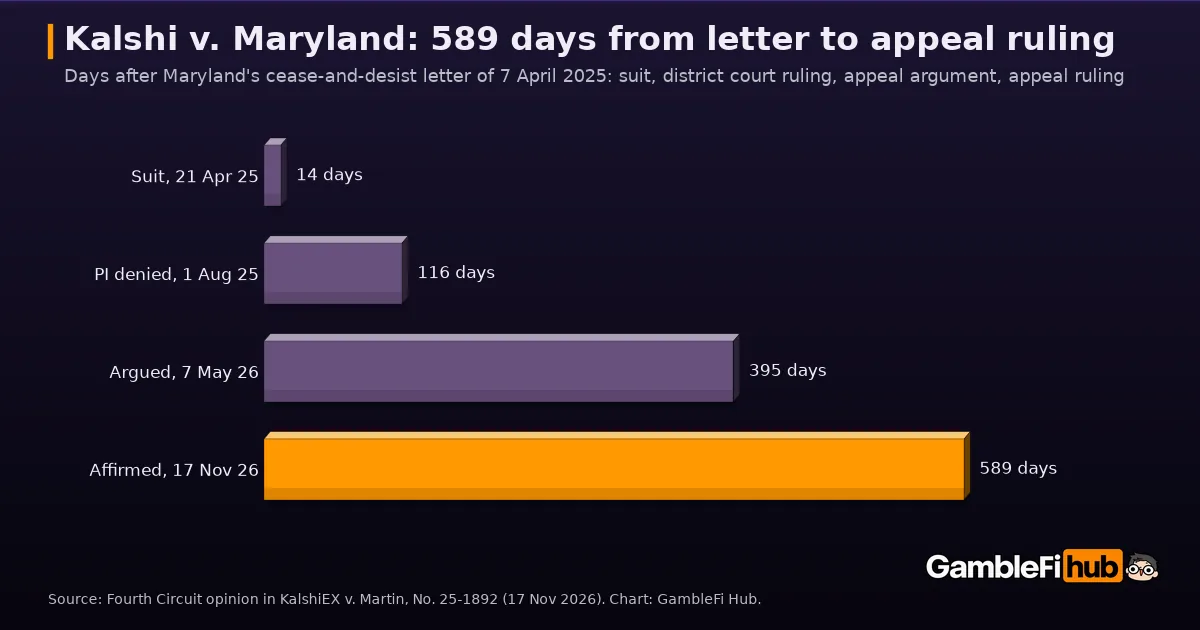
Maryland’s letter gave Kalshi 15 days to stop; Kalshi sued after 14. The district court ruled after 116 days, the appeal was argued after 395, and the decision came 589 days after the letter, or 194 days after argument (see chart). Counting the injunction appeals decided so far, the score is 3–1 for the states: the Third Circuit backed Kalshi against New Jersey on 6 April 2026 (172 F.4th 220), while the Sixth Circuit (Schuler, 24 April 2026), the Ninth Circuit (Assad, 28 August 2026) and now the Fourth Circuit went the other way. We leave out the Second Circuit’s 3 November order, which only refused an emergency injunction pending appeal. The split also runs inside the courts: both the Third Circuit and the Fourth Circuit decided 2–1, and in Maryland’s case the three judges gave three different answers to the swap question.
What comes next
The ruling lands while New Jersey’s petition in Flaherty v. KalshiEX waits at the Supreme Court. The docket shows Kalshi’s response is now due on 7 December 2026, 20 days from the Fourth Circuit decision, after a second extension. A fresh published opinion against Kalshi from another circuit adds to the split New Jersey says the Court must resolve. In parallel, the CFTC has taken the fight to the states itself, with suits against 12 states by mid-November, and state cases keep coming, from Louisiana to Ohio.
Why it matters for GambleFi
The Fourth Circuit covers Maryland, Virginia, West Virginia, North Carolina and South Carolina. Because the two majority judges disagreed on the reasoning, the one-line judgment sets no single rule on swaps, but the result stands: a CFTC registration alone did not shield Kalshi’s sports contracts from a state gaming law. That matters for every venue betting on federal cover, and even more for onchain sports exchanges such as SX Bet, which do not have that registration to begin with. Our GambleFi FAQ explains how prediction markets differ from sportsbooks. This is a report on a court ruling, not legal advice.