
A three-judge panel of the U.S. Court of Appeals for the Second Circuit denied motions by KalshiEX and Coinbase Financial Markets for an injunction pending appeal on 3 November 2026. The two-page order, entered as docket entry 74.1 in KalshiEX LLC v. Williams, No. 26-1835, covers three appeals the court is considering in tandem. It does not decide who wins those appeals.
What the panel did
Judges John M. Walker, Jr., Dennis Jacobs and Joseph F. Bianco wrote that the appellants “have failed to make the required showing that an injunction pending appeal is warranted,” citing Agudath Israel of America v. Cuomo, 983 F.3d 620, 631 (2d Cir. 2020). The caption lists KalshiEX v. Williams (26-1835), from the Southern District of New York; KalshiEX v. Cafferelli (26-2239); and Coinbase Financial Markets, Inc. v. Tong (26-2297). The Connecticut appeals come from District of Connecticut Nos. 25-cv-2016 and 25-cv-2121, both before Judge Vernon D. Oliver. Without that emergency stay, the Second Circuit has not blocked New York or Connecticut from enforcing their gambling laws while the appeals proceed.
How Kalshi reached the panel
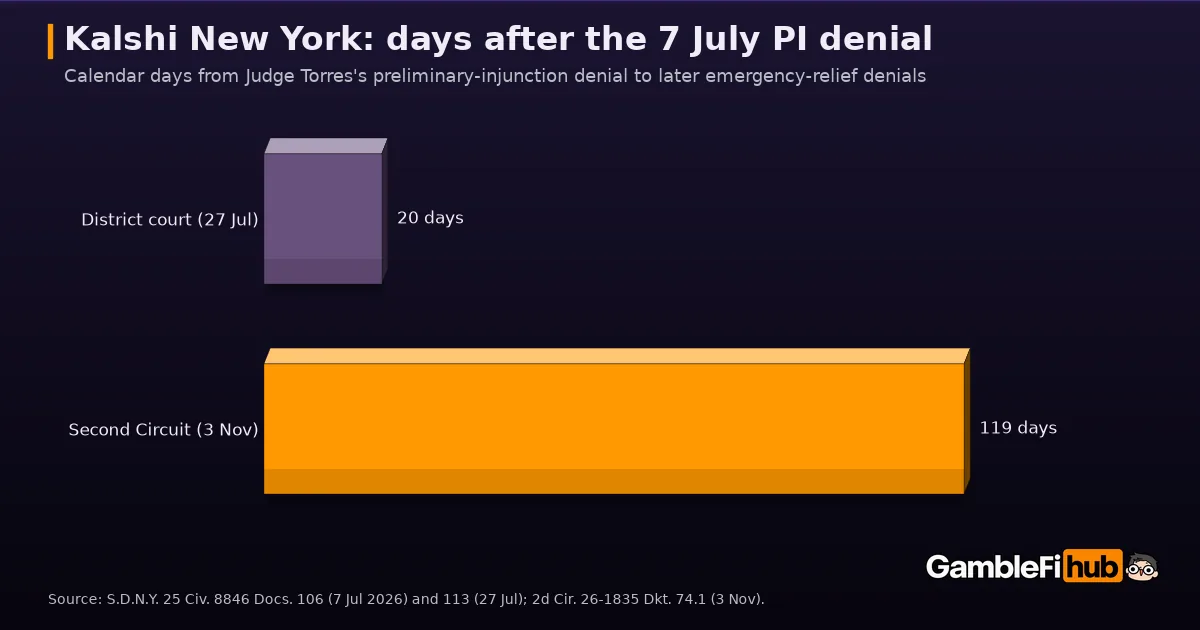
In New York, Kalshi sued Gaming Commission officials on 27 October 2025 after a 24 October cease-and-desist letter over sports-event contracts. Judge Analisa Torres denied a preliminary injunction on 7 July 2026 in 25 Civ. 8846, finding Kalshi had not shown that the Commodity Exchange Act clearly preempts New York’s sports-wagering rules. She denied an injunction pending appeal on 27 July. The chart above marks 20 days to that later district-court denial and 119 days to the Second Circuit order of 3 November.
In Connecticut, Judge Oliver denied Kalshi’s preliminary-injunction motion in a memorandum filed 10 August 2026 in 25-CV-2016 (signed 7 August). He concluded that Kalshi’s sports-event contracts are not “swaps” under the CEA and that, even if they were, Connecticut’s gaming laws would not be preempted. Coinbase’s parallel Connecticut case is 25-cv-2121; the Second Circuit order does not recap that district court’s reasoning.
Key facts
Court: Second Circuit (Walker, Jacobs, Bianco); order of 3 November 2026, No. 26-1835, Dkt. 74.1.
Appeals (tandem): KalshiEX v. Williams, 26-1835 (S.D.N.Y. 25-cv-8846, Torres, J.); KalshiEX v. Cafferelli, 26-2239 (D. Conn. 25-cv-2016, Oliver, J.); Coinbase Financial Markets v. Tong, 26-2297 (D. Conn. 25-cv-2121, Oliver, J.).
Relief denied: injunction pending appeal. The merits appeals remain pending.
Standard cited: Agudath Israel of Am. v. Cuomo, 983 F.3d 620, 631 (2d Cir. 2020).
Prior New York orders: preliminary injunction denied 7 July 2026 (Doc. 106); injunction pending appeal denied 27 July 2026 (Doc. 113).
Prior Connecticut Kalshi order: preliminary injunction denied, memorandum filed 10 August 2026 (Doc. 94, signed 7 August).
Sources: Second Circuit order; S.D.N.Y. Docs. 106 and 113; D. Conn. Doc. 94.
Why it matters for GambleFi
The order is about emergency relief, not a ruling on whether sports event contracts are federal swaps. That leaves New York and Connecticut free, for now, to treat those contracts as gambling during the appeals, alongside other limits we have covered: the tribal-lands sports injunction in California, New York’s separate effort to enforce Kalshi subpoenas, and Connecticut’s earlier sports-contract pullback by Webull.
It also sits next to the CFTC’s 30-day instruction that designated contract markets drop domestic geoblocks or explain why they cannot, and to the Supreme Court petition in the New Jersey case. For how onchain casinos and event-contract venues differ, see the GambleFi FAQ or our SX Bet and Shuffle project pages. This is a report on court orders, not legal or betting advice.