
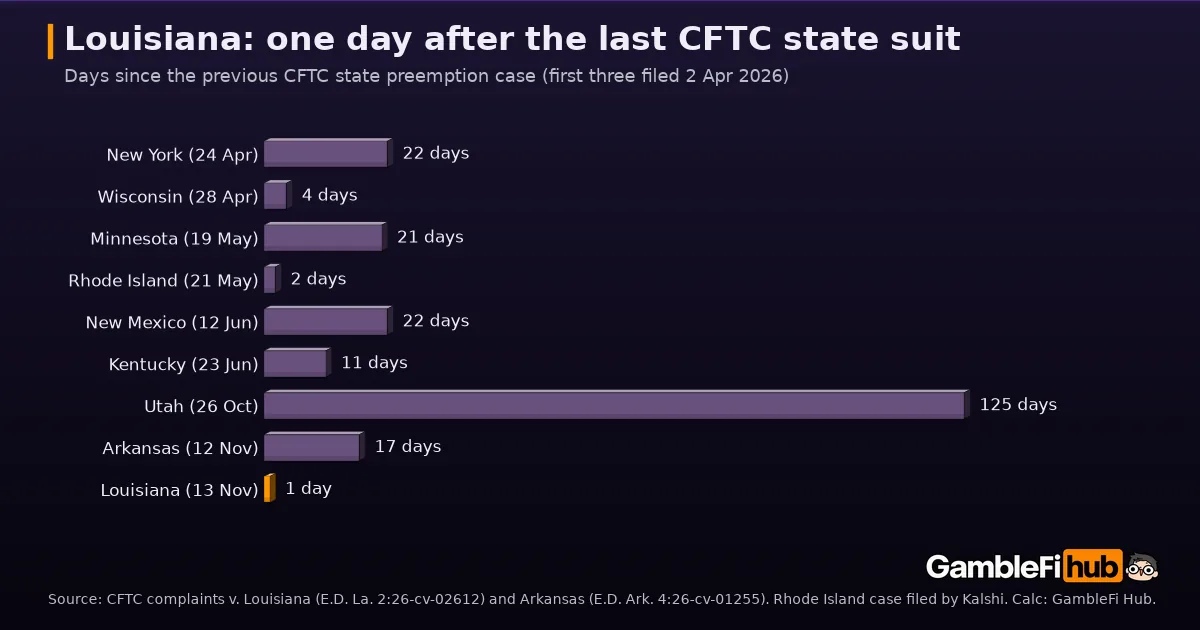
The federal government took one day to answer Louisiana. On 13 November, the United States and the Commodity Futures Trading Commission filed a 38-page complaint against the State of Louisiana in the US District Court for the Eastern District of Louisiana (case 2:26-cv-02612). It came the day after a state judge in Tangipahoa Parish ordered Kalshi, Polymarket and other prediction markets to geofence the state without hearing from them first.
In its press release, CFTC Chairman Michael Selig called the state’s “eleventh-hour ‘emergency’ lawsuit” “naked lawfare and a cynical political stunt”. He said the agency wants to keep the status quo while federal courts settle the question. The CFTC counts Louisiana as the 12th state it has sued, one day after Arkansas became the 11th.
Who is being sued
The defendants are the state, Attorney General Liz Murrill, the Louisiana Gaming Control Board and its chair Christopher Hebert, eight more board members, the State Police Gaming Enforcement Division, State Police Superintendent Frank Besson and Revenue Secretary Jarrod Coniglio. The complaint says Murrill’s 12 November petition targeted 32 entities, including exchanges, futures commission merchants and clearing houses. Our own count of the petition, in Friday’s post, was 31.
What Washington wants
The complaint has one count under the Supremacy Clause. It argues that event contracts are swaps under the Commodity Exchange Act, so the CFTC’s exclusive jurisdiction pushes aside the Louisiana Gaming Control Law and the criminal code section on “gambling by computer”. It claims express, field and conflict preemption.
It asks for a declaration that these laws are invalid as applied to trades on CFTC-regulated exchanges, and for a preliminary and permanent injunction. That injunction would bar the state from investigating those exchanges “and their affiliates and partners”, and from “enforcing or seeking to extend” the Tangipahoa order. The order runs for ten days unless extended, with a state hearing set for 30 November. The complaint again cites the CFTC’s impartial access rule: a geofence, it argues, would force exchanges to break federal rules.
Key facts
Case: United States and CFTC v. State of Louisiana et al., E.D. La. No. 2:26-cv-02612, filed 13 November 2026.
State case targeted: Louisiana v. Kalshi Inc. et al., No. 20060004268, 21st Judicial District Court, Tangipahoa Parish, filed and ex parte order granted 12 November 2026.
Claim: one count, Supremacy Clause preemption under the Commodity Exchange Act.
Relief sought: declaration; preliminary and permanent injunction; costs and fees.
Related federal cases: QCX LLC (Polymarket US) v. Murrill, E.D. La. No. 26-2482; KalshiEX LLC v. Murrill, W.D. La. No. 26-cv-4476.
Signed for: the Justice Department and CFTC General Counsel Tyler S. Badgley’s office.
The other Louisiana cases
The platforms got to federal court first. Polymarket US operator QCX sued Murrill in the Eastern District, and Kalshi sued in the Western District, where it asked for a temporary restraining order on 12 November. RG reports that Kalshi withdrew that request at a status conference on Friday and that a hearing on its preliminary injunction is set for 23 November, according to the docket. RG also reports a second filing in the new federal case about a restraining order and preliminary injunction. Its text was not public as of Saturday morning.
The quickest response yet
The complaint lists ten earlier state cases, from Arizona, Connecticut and Illinois on 2 April to Utah on 26 October. It does not mention Arkansas, which the CFTC sued a day earlier. By our count of the filing dates, the gap between cases has shrunk from 125 days before Utah to 17 days before Arkansas and one day before Louisiana. In Arkansas, the federal suit came eight days after the state sued Kalshi. In Louisiana, it came one day after the state order.
Why it matters for GambleFi
The fight is about whether a CFTC licence beats state gambling law. Offshore crypto casinos and iGaming tokens have no such licence to point to. The complaint also flags a law that reaches them directly: Act 182, enacted on 1 August 2026, widened Louisiana’s “gambling by computer” offence to games that use “a dual-currency system” that can be swapped for prizes or cash, the model used by sweepstakes casinos like those Arkansas is pursuing. Fines go up to $100,000 and prison terms up to five years. This is a news summary, not legal or investment advice. The GambleFi FAQ explains how prediction markets differ from crypto casinos.