
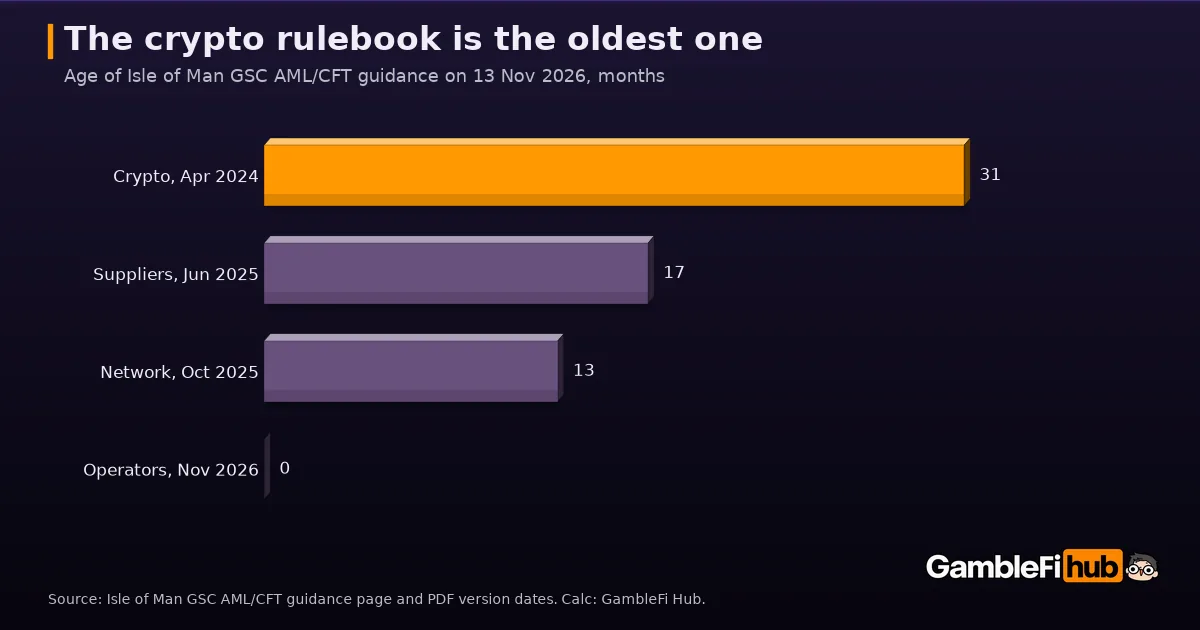
The Isle of Man Gambling Supervision Commission (GSC) published version 1.4 of its AML/CFT guidance for gambling operators on 10 November. In its notice to licensees, it also named the documents it is revising next: guidance for software suppliers, guidance for licence holders with network services permissions, and the guidance on virtual assets and virtual goods. That last one is the rulebook for any Isle of Man licensee that takes crypto deposits or skins.
The GSC stressed that the underlying Gambling (Anti-Money Laundering and Countering the Financing of Terrorism) Code 2019 has not changed. The new guidance explains how operators are expected to meet it.
What changed for operators
The 149-page document now reflects the island’s 2025/2026 national risk assessments. The main addition is a wider view of risk: operators are told to look past their direct customers to B2B partners, group structures and beneficial owners. Sections on risk assessments, identity checks, due diligence, payments, sanctions, reporting and training were also refreshed. The GSC asked licensees to review it ahead of its other recent publications and to update their frameworks “as soon as practicable”. It set no fixed deadline.
Crypto appears in the new text mostly as a risk flag. Virtual assets are listed among emerging threats, next to AI and deepfakes, as tools to hide identities and move money across borders. The guidance says crypto should be monitored “as if it were money”, that each crypto channel belongs in the operator’s technology risk assessment, and that the IOMFSA, not the GSC, supervises the island’s virtual asset service providers.
The crypto rulebook in force today
The detail sits in the separate virtual assets and goods guidance, version 1.3 from April 2024. By our count it is now 31 months old, the oldest of the four AML guidance documents on the GSC’s guidance page. It allows five deposit models. Two route crypto through an exchange before play, which must sit under an FATF-compliant reporting regime. Two let crypto in and the same crypto out, against other players or against the house. The fifth lets the operator convert deposits into an in-house unit for play, as long as winnings go back out in the asset the player deposited.
One model is banned: taking one currency in and paying another out, crypto to fiat, fiat to crypto or one coin to another. The GSC says this would make the operator “an unregulated exchange”. Skin buy-back features are looked at case by case.
Key facts
Regulator: Isle of Man Gambling Supervision Commission (GSC).
New document: AML/CFT Guidance for Gambling Operators V1.4, published 10 November 2026; replaces V1.3 of June 2025.
Legal basis: Gambling (AML/CFT) Code 2019, unchanged.
Next in line: software suppliers (V1.4, June 2025), network services (V1, October 2025), virtual assets and goods (V1.3, April 2024).
Crypto models: five permitted, one banned (operator acting as an exchange).
Online licensees: 49 on the GSC register (last updated 29 October), 48 active and one suspended since 2 October.
Why it matters for GambleFi
The Isle of Man is one of the few licensing regimes that spells out how a gambling operator may handle crypto. Any change to the five-model list would reach the island’s licensees directly and give other regulators a template. Curaçao is moving the same way with its crypto rules for B2C licensees. None of the operator companies we could name in our licence check of 17 iGaming token platforms appears among the 49 Isle of Man licensees; those platforms point to Curaçao, Anjouan or Tobique, and Comoros has called Anjouan licences illegal. The GSC has asked operators to send suggestions for the new crypto guidance, and has not given a date for it. This is a news summary, not legal advice. The GambleFi FAQ explains how GambleFi platforms are licensed.