
Polymarket US has ended its flat taker fee, and the exchange has published two different versions of what replaced it. In a weekly notification to the CFTC dated 10 November (PMX-2026-63), QCX LLC, which trades as Polymarket US, said it swapped its single coefficient of 0.0695 for eight volume tiers on 6 November. Its public fee schedule, when we read it on 13 November, lists four tiers with different rates and gives a different start date: 1:00 PM ET on 11 November.
The filing says the change “is reflected in the public Fee Schedule”. Neither document explains the gap, so it is unclear which rates traders are actually paying.
Two schedules side by side
Both versions keep the same formula, fee = rate × contracts × price × (1 − price), and set the tier daily from a trader’s taker volume over the past 30 days. Here they part ways. The CFTC filing runs from 0.1170 below $10,000, through 0.1100, 0.1000, 0.0700, 0.0695, 0.0690 and 0.0675, down to 0.0650 at $50 million and above. The website stops at four tiers: 0.095 below $10,000, 0.085 up to $50,000, 0.075 up to $250,000 and 0.0695 from $250,000.
Both give new accounts 0.0695 for their first seven days. The website adds that during November, existing accounts get the better of their 30-day tier or a tier based on their October volume, which softens the switch for this month. The filing does not mention that.
What a small trader pays
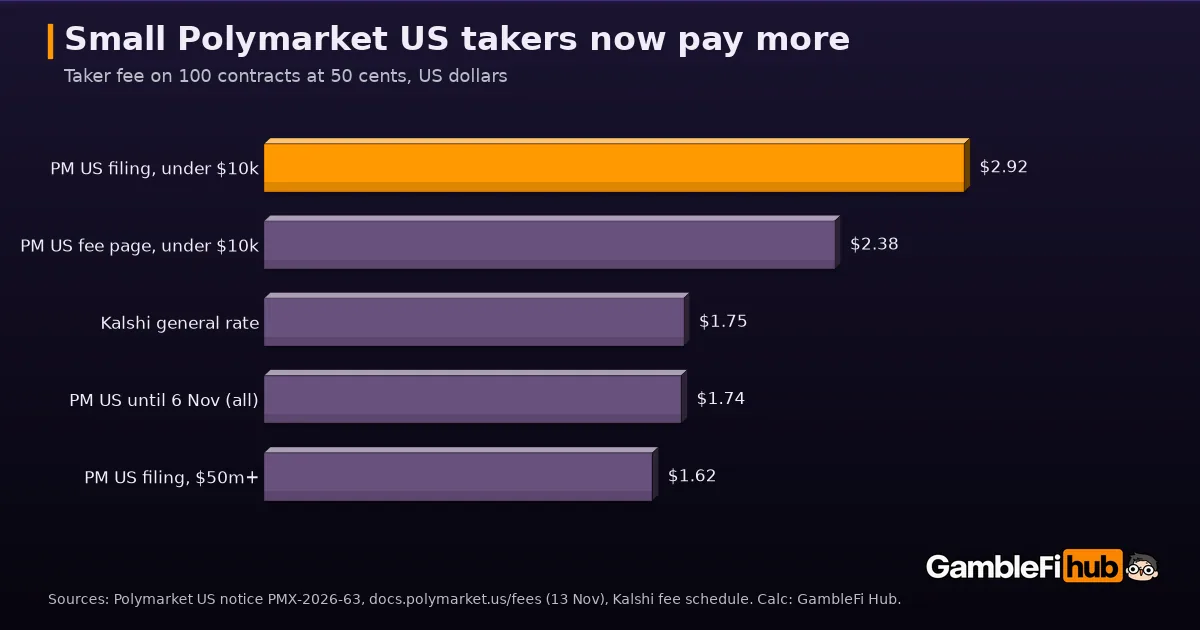
By our calculation, a taker buying 100 contracts at 50 cents with under $10,000 in monthly volume pays $2.92 under the filed schedule and $2.38 under the website schedule, after the exchange’s banker’s rounding. Before the change, everyone paid $1.74. That is a rise of 68% on the filing’s numbers and 37% on the website’s. Kalshi’s general rate of 0.07 works out to $1.75 on the same trade, as we found when we compared the two fee schedules in October. Only the biggest Polymarket US traders now pay less than before: $1.62 at the filing’s top tier.
Key facts
Exchange: QCX LLC d/b/a Polymarket US, a CFTC-designated contract market.
Filing: weekly notification PMX-2026-63 under CFTC Regulation 40.6(d), dated 10 November 2026; change effective 6 November.
Filed taker tiers: eight, from 0.1170 (under $10,000) to 0.0650 ($50 million and up).
Website taker tiers: four, from 0.095 (under $10,000) to 0.0695 ($250,000 and up); effective 11 November, per the page.
New accounts: 0.0695 for the first seven days in both versions.
Combo maker fee: 0.03 × contracts × price × (1 − price) from 12:00 AM ET on 14 November 2026, up from zero.
Combo makers start paying on Saturday
A separate notice dated 11 November (PMXN-2026-2) ends free quoting on combos, the parlay-style contracts built from two or more sports legs. From 12:00 AM ET on 14 November, makers on combo athletic event contracts pay a fee with a 0.03 coefficient, which comes to 75 cents on 100 contracts at 50 cents. Combo fills also carry no maker rebate. Combo takers already pay a steeper curve, and the tier rate now feeds into that formula too. On our numbers, a 100-contract combo at 50 cents costs a tier-four taker $1.92 and a website tier-one taker $2.56.
Combos matter to Polymarket’s numbers. The company said they made up more than 70% of volume on Sunday 8 November when it told CNBC its revenue run rate topped $1.8 billion.
Why it matters for GambleFi
Polymarket US is raising prices for casual traders while it cuts staff and loses volume share to Kalshi, and while federal and state authorities fight over who regulates event contracts. Fees are the main cost of a prediction-market trade, and a public schedule that differs from the filed one makes them hard to check. Onchain casinos and iGaming tokens publish no CFTC filings at all, so a trader there has even less to compare. This is a news summary, not financial advice. The GambleFi FAQ explains how prediction markets differ from crypto casinos.