
Polymarket wants to swap out the engine at the centre of its onchain exchange next month. On 13 November, Josh Stevens, the company’s vice president of engineering for its DeFi exchange, announced Nex, a new exchange written from scratch in the Rust programming language. The same day, Polymarket opened a Nex sandbox in its developer documentation, where trading firms and app builders can test their bots against the new system.
Nex is not live yet. Stevens wrote that it has run for a week in “shadow mode”, copying every order the current exchange receives so the team can compare speed, stability and matching results. The plan is four more weeks of that. “If everything is good, we will go live mid-December,” he wrote. The documentation is more cautious: Polymarket is “aiming to release NEX before the end of 2026”.
What Polymarket is replacing
The current engine is a central limit order book, or CLOB, which matches buy and sell orders for every market on Polymarket’s international, crypto-based venue. That is the venue now moving new markets to Protocol V2 contracts, and it is separate from the CFTC-regulated Polymarket US exchange. On 31 August, Stevens had written that this order book “grew fast, got hacked together” and “can’t be saved long-term”. The new docs put it more politely: the old system “accumulated a lot of technical debt”, and fixing one part “can still cause problems elsewhere”.
The numbers, and what they are not
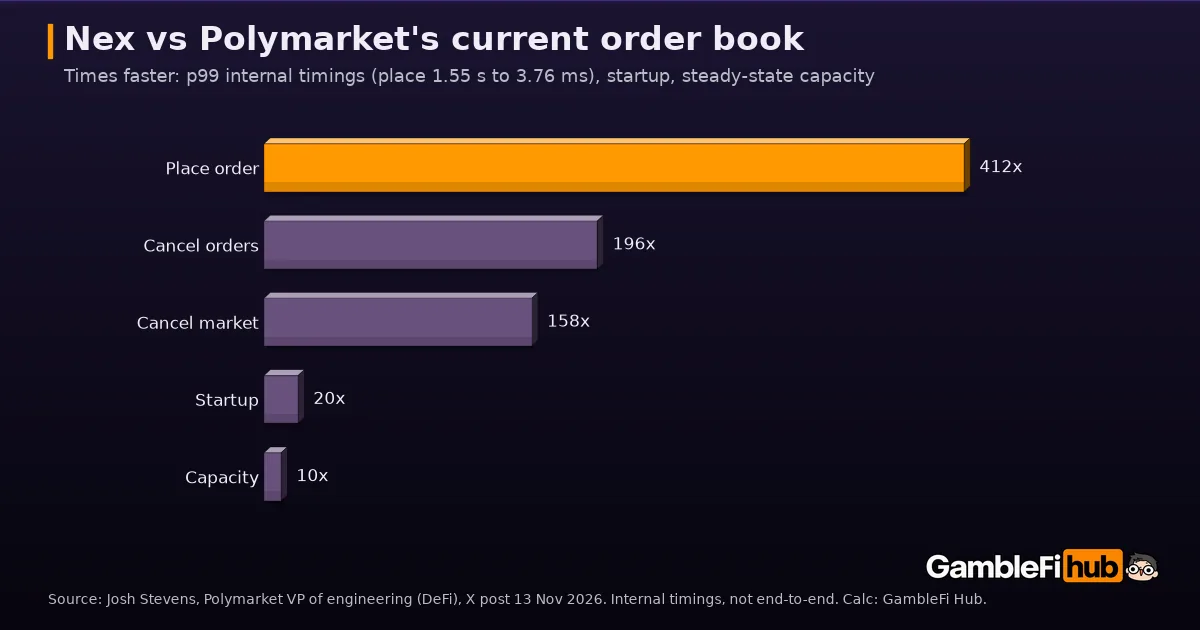
Stevens published p99 timings, the slowest 1% of requests, measured inside the exchange. Placing an order took 1.55 seconds on the old engine and 3.76 milliseconds on Nex. Cancelling orders fell from 627.92 to 3.20 milliseconds, and cancelling a whole market’s orders from 810.16 to 5.14 milliseconds. Startup time dropped from five minutes to 15 seconds. Capacity goes from 10,000 commands per second, with bursts of 15,000, to 100,000 with bursts of 150,000. Commands include placing and cancelling orders, so this is not a count of trades.
He was clear that these are “internal exchange timings, not e2e”. A trader’s full round trip, from clicking to seeing a fill, will be slower, and Polymarket says it will publish those figures later. He also flagged a quirk of the old system: its “cancel all” button replies at once but cancels in the background, which can take another 0.6 to 2 seconds. During that gap, quotes a market maker meant to pull can still be traded against. Nex answers only once the orders are gone.
Key facts
Announced: 13 November 2026, by Josh Stevens on X; sandbox documented on docs.polymarket.com.
Built in: Rust; new matching engine and WebSocket price feeds.
Sandbox: Polygon Amoy test network (chain 80002), test pUSD, bot liquidity, order books separate from production.
Access: form, then allowlisted IP addresses or AWS PrivateLink in London (eu-west-2).
Compatibility: no breaking changes to the existing CLOB API, according to Polymarket.
Target: mid-December after four weeks of shadow testing; docs say before the end of 2026.
Our numbers: promise vs delivery
Dividing the published timings, we get 412 times faster order placement, 196 times faster cancels and 158 times faster market cancels at p99. At p95, order placement is 215 times faster (341.84 to 1.59 milliseconds). In August, Stevens promised “200,000 orders per second”, which he called 15 times the old engine. That implies the old engine handled about 13,300. The November post puts it at 10,000 and Nex at 100,000, half the August figure. Stevens says 200,000 is reachable “with a few optimisations”. From the August post to the sandbox took 74 days. A mid-December launch would land inside the “Q4 (mid to end)” window he gave then.
Why it matters for GambleFi
Speed decides who wins on an order book. When prices update slowly, the market makers who quote both sides get “picked off”, as Stevens put it, by faster traders, and they protect themselves by quoting wider spreads. A faster engine should mean tighter prices for ordinary users, but only if the end-to-end numbers hold up under live load. It also matters for business reasons: Polymarket is losing volume share to Kalshi and its US arm has been changing its fees. Onchain betting exchanges such as SX Bet face the same trade-off between onchain settlement and speed. These figures come from Polymarket itself and have not been independently tested. This is a news summary, not investment advice. The GambleFi FAQ explains how prediction markets differ from crypto casinos.