
Australia is moving its fight against offshore gambling from domains to deposits. On 17 November 2026 the Australian Communications and Media Authority published initial guidance on a new duty that starts on 1 January 2027: banks and other payment system participants must prevent, so far as reasonably practicable, transfers from Australian accounts to illegal online gambling services. The guidance spells out that “funds” includes digital currency and that cryptocurrency service providers can be among the firms caught, depending on their role.
What the law requires
The duty is section 15J of the Interactive Gambling Act 2001, inserted by the Interactive Gambling Amendment (Gambling Reform) Act 2026, which Parliament passed on 26 August. It applies to authorised deposit-taking institutions and to participants in a payment system. They must stop payments made in connection with a “designated interactive gambling service” when the money goes from an account held in Australia to the provider, an associate, a related company or anyone acting for it. A designated service is either prohibited outright, such as an online casino or slot site, or a wagering or lottery service offered to Australians without a state or territory licence. The guidance adds that a site can be lawful where it is licensed and still be designated in Australia. Winnings paid out to Australian customers are not the target.
Key facts
Law: Interactive Gambling Act 2001, Part 2C, section 15J (in force 1 Jan 2027).
Who: banks and other ADIs, payment system participants; per ACMA possibly wallets, card schemes, gateways, acquirers, processors and crypto service providers.
What counts as funds: money and digital units of value, including digital currency.
Penalty: civil penalty of 1,000 penalty units per contravention.
Safe harbour: no civil liability for a good-faith, proportionate block taken promptly, for at most 28 days per suspected payment.
Next step: formal guidance under section 15K possible later; the Minister can exempt classes of firms.
What ACMA expects
The regulator is clear that its own blocklist is not a compliance programme: “reliance on ACMA information alone is unlikely to be sufficient”. Each firm is expected to start with a documented risk assessment, then build controls that fit its place in the payment chain. Suggested tools include merchant category codes, payment identifiers, blacklists of illegal operators, whitelists of licensed ones, rules-based monitoring and information sharing. Because illegal operators change merchant identifiers and account details to avoid detection, controls have to be tested and updated. A firm also cannot point at another participant with a better view of the transaction; each is expected to use the steps open to it.
Our numbers
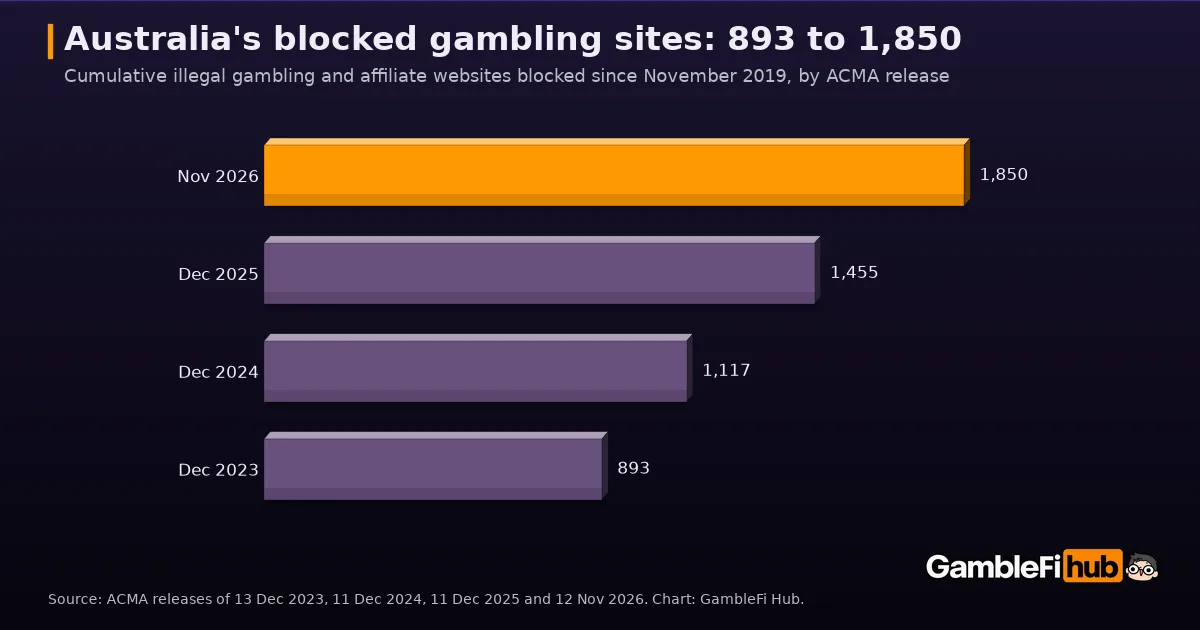
The statutory maximum is 1,000 penalty units, and a Commonwealth penalty unit is A$364 for breaches on or after 1 July 2026, so a single contravention can cost up to A$364,000. The duty starts 45 days after the guidance and 128 days after the Act passed. The reason for the new route is visible in ACMA’s own figures. Its blocked-site count rose from 893 in December 2023 to 1,117 a year later, 1,455 in December 2025 and 1,850 on 12 November 2026 (see chart). That is 395 sites in 336 days this year, about 1.2 a day against 0.9 a day in 2025, and more than double the 2023 total. Over the same period the number of illegal services ACMA says have left the Australian market went from 220 to “over 230”. Blocks more than doubled; exits barely moved.
Why it matters for GambleFi
Many crypto casinos and iGaming token (GambleFi) platforms hold licences from places such as Curaçao or Anjouan, which do not make online casino games legal for Australians; our licence check of 17 registers shows how thin that cover can be. From January, an Australian exchange, wallet provider or card issuer that sends customer funds to such a site can face the A$364,000 question. The text bites on intermediaries and on transfers from accounts held in Australia; it does not put a duty on someone moving coins from a self-custody wallet, so on-ramps are where the pressure lands. Other regulators are testing their own levers, from Sweden’s order against Duel to Telegram betting raids in Turkey. The GambleFi FAQ covers how onchain casinos handle deposits. This is a report on a regulatory change, not legal advice.