
Utah has taken its gambling fight from prediction markets to a sweepstakes casino. On 17 November 2026 Attorney General Derek Brown and the Division of Consumer Protection sued the companies behind Stake.us, Sweepsteaks Limited of Cyprus and Easygo Group Holdings of Australia, in the Third Judicial District Court in Salt Lake County. The complaint alleges that Stake.us has run what amounts to a 24-hour online casino for Utah residents since 2022, in a state whose constitution bars the legislature from authorising any gambling. The timing has a twist: Stake’s own terms and conditions added Utah to the list of excluded states four days earlier.
What Utah alleges
Stake.us presents itself as a sweepstakes or social casino. Users buy Gold Coins and receive a second currency, Stake Cash, which the complaint says works like a casino chip because it can be redeemed one to one for money. Stake’s terms confirm the rate: Stake Cash is redeemable at “1 Stake Cash per 1 USD”, paid out in fiat or in cryptocurrency. Utah’s view, in the attorney general’s words: “You don’t get to legalize gambling in Utah simply by using clever marketing tricks.”
The complaint also targets how the product is marketed: VIP tiers, rakeback and promotions that grow with wagering, influencer and celebrity campaigns, and slots themed around cartoon monkeys, candy and gummy bears. It cites at least 127 million site visits a month, without saying how many come from Utah. The claims run under the Utah Consumer Sales Practices Act, plus unjust enrichment, public nuisance and a request to declare Stake.us illegal gambling. These are allegations; Stake had not commented when the suit was announced.
Key facts
Plaintiffs: Utah Attorney General and the Utah Division of Consumer Protection.
Defendants: Sweepsteaks Limited (Cyprus) and Easygo Group Holdings Pty Ltd (Australia).
Court: Third Judicial District Court, Salt Lake County; filed 17 Nov 2026.
Relief sought: stop Stake.us in Utah, return Utah residents’ money, civil penalties, public-nuisance remedies; per the Deseret News, restitution and penalties “well in excess” of $300,000 each.
Stake.us terms: version 21.0 of 13 Nov 2026 names 27 excluded states, Utah and Arkansas last.
Our numbers
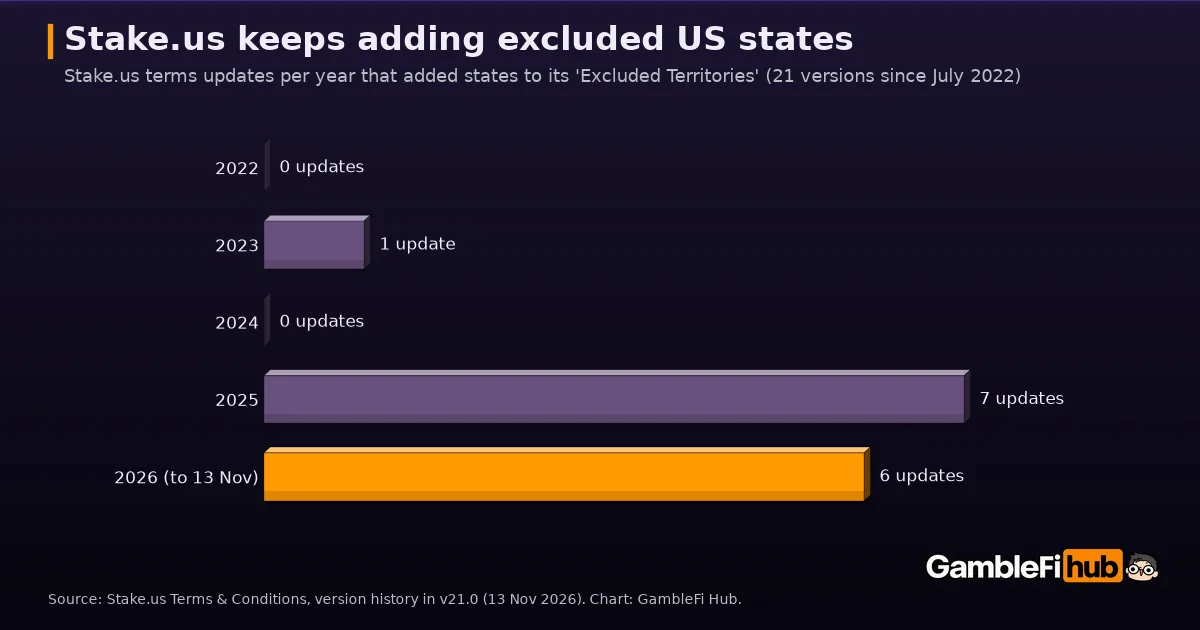
The complaint, as reported by the Deseret News, says Stake publishes a list of 25 states it refuses to serve and that Utah is not on it. That matched Stake’s terms until version 20.0 of 5 November. Version 21.0, dated 13 November, added Arkansas and Utah, so Utah became the 27th named state four days before the filing. Stake’s public pages do not say what happens to existing Utah accounts or Stake Cash balances. The pace has changed too: 14 of the 21 terms versions since July 2022 added excluded territories, seven in 2025 and six in 2026, three of those in the 14 days from 30 October to 13 November (see chart). The lawsuit itself lands 1,576 days after the first Stake.us terms of 25 July 2022, and 28 days after Utah sued Kalshi on 20 October. In between came the criminal charges against Kalshi’s founders and a CFTC suit against Utah.
What comes next
Stake now has to answer in state court. Adding Utah to the terms may help it argue the conduct has stopped, but it does not touch the claim for money already taken from Utah residents, which may be the larger part of the case. Utah is not alone: Arkansas went after a sweepstakes operator with a deceptive-practices suit against VGW on 4 November, and Stake.us added Arkansas in the same 13 November update. Each new state on the list shrinks the US market that dual-currency sweepstakes casinos can serve.
Why it matters for GambleFi
Stake is the best-known crypto casino brand, and Stake.us pays out Stake Cash in crypto as well as dollars. Utah’s case tests the idea that a label, sweepstakes in this case, can carry a crypto casino product into a state that bans gambling, the same question Stake’s Brazil licence fight asked in a regulated market. For iGaming token (GambleFi) platforms the lesson is that a published exclusion list is evidence a state can use: if it exists and a state is missing, that gap ends up in a complaint. Our GambleFi FAQ covers how crypto casinos and iGaming tokens fit together. This is a report on a lawsuit, not legal advice.